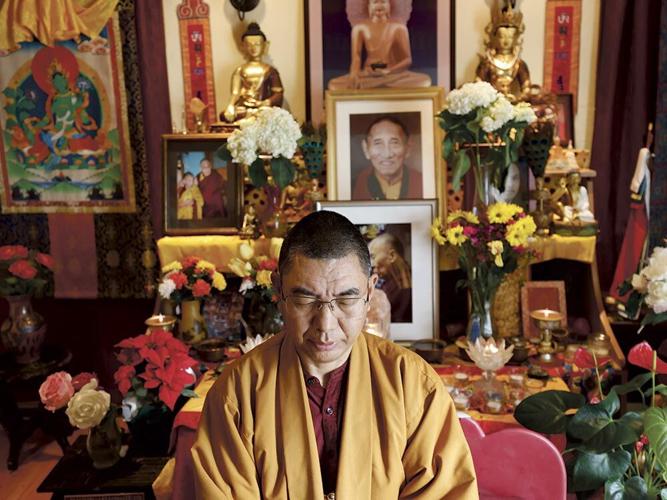


Khenpo Karten, a Tibetan monk who leads the Manjushri Dharma Center in Pacific Grove, recommends beginners start with silent, five-minute meditations three times a day.
Khenpo Karten, cross-legged on the floor of the Manjushri Dharma Center in Pacific Grove, removes his surgical mask to stick out his tongue.
“The tongue lightly touches the palate, the eyes are set down the length of the nose,” Kharten says as he folds his hands on his lap, palms up, thumb tips touching. Kharten, a Tibetan monk, explains that people new to the Buddhist form of meditation must first learn how to sit. Hips slightly elevated above the knees, shoulders strong but not tense, spine straight. “You need to slow down the body, speech and mind. This body, everyday, is working; this mind, always thinking; this mouth, always talking. We lose connection with our mind and forget how to take care of it.”
The Dharma Center is covered wall-to-wall in a colorful bouquet of Buddhist symbols, portraits and books, scored by Tibetan hymns; however, Kharten, who alternates between joyful laughter and grave seriousness while discussing meditation, explains the practice is for everyone, not just those in burgundy robes.
“People should meditate because we all have a monkey mind. Sometimes the mind is very difficult. Meditation is medicine for the mind,” Kharten says.
The term “monkey mind” is common lingo in meditation circles, referring to the noisy, restless, thinking mind; the one that clouds us with narratives about ourselves and the world around us. The one that, for many, has probably been on hyperdrive over the last two years, and much longer. Meditation, in its many forms of practice in Monterey County, offers a vehicle toward inner silence and connection, some more expedient and expensive than others.
During an hour-long introduction to Transcendental Meditation, Lindsay Dyson, director of the Carmel TM center, uses the analogy of riding a boat in the middle of the ocean when, suddenly, massive swells approach and strong winds overwhelm. Stuck on the surface, the entire ocean appears turbulent (our monkey mind), but zooming out, you see the ocean is a mile deep, and silent and still at its depth.
Developed by Maharishi Mahesh Yogi – the man the Beatles visited in India in the 1960s – TM uses a silent mantra to help reach the mind’s silent depths, and is recommended in 20-minute sessions twice a day. The technique prides itself for its ease and its distinction from any philosophy or spiritual dogma; however, TM needs to be taught by a trained practitioner. Although centers across the world began offering income-based rates in recent years, they aren’t cheap, ranging from a course fee of $420 to nearly $1,000. Dyson says the Carmel TM center offers some scholarships.
Scientific literature on the impact of meditation is surprisingly thin, as many studies have tested small sample sizes or lacked control groups. However, the existing research has tied meditation to various signs of improved health, regardless of whether the meditation is motivated by religion or discovering an inner awareness.
The American Heart Association promotes meditation as a way to lower blood pressure. Studies have linked the practice to treating irritable bowel syndrome, anxiety and depression. A 2018 Harvard study indicated that meditation alters the expression of 172 genes that regulate inflammation, circadian rhythms and glucose metabolism.

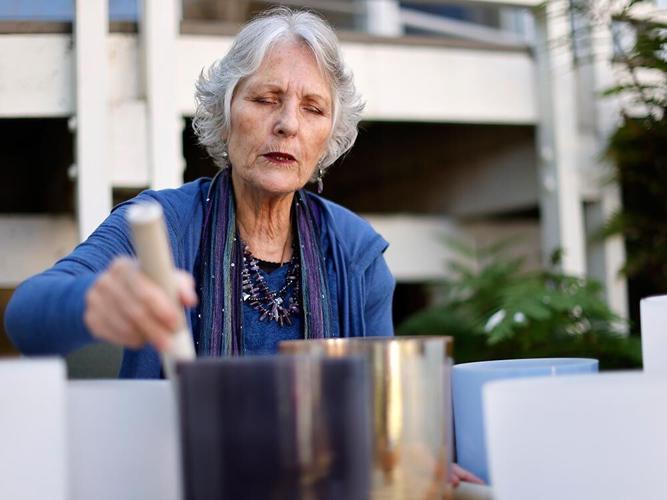
ValiAnna Francis rings a glass bowl has she leads a peace meditation session at The Center for Spiritual Awakening. ValiAnna has been practicing sound meditation for 13 years.
BEHIND THE CENTER FOR SPIRITUAL AWAKENING IN PACIFIC GROVE, a woman named ValiAnna, a master sound practitioner and shaman activist according to her business card, enters the courtyard tapping a hollow, rust-hued cylinder like a gong. She is decked out in amethyst crystals. The bowl, she explains, is made of quartz, ruby, white diamond, yellow gold and iron; it is singing an F tone, which she says connects to the heart chakra. Six other bowls of varying sizes – one for each of the other chakras, or energy centers in the body – sit on a table under the courtyard’s magnolia tree. Around 11:45am, people, mostly older, mostly women, begin trickling in, filling up roughly 20 chairs for the weekly Wednesday “vibrational detox.”
Over the course of the next hour, the group, eyes closed, meditates while ValiAnna plays the bowls, chiming in now and then with vocal intonations. Toward the end, she approaches each participant individually with a humming bowl to “bless their biofields.” The effect is overwhelming for some who wipe away tears as the session ends. What began as a silent courtyard now sings with chirping squirrels and various types of bird calls.
“The crystal bowls, I think, deepen the experience, but some people prefer no noise,” says Coleen Gsell, executive director at the center.
The Center for Spiritual Awakening, which offers a full menu of meditation techniques, is a nondenominational spiritual center that Gsell says focuses on “inner wisdom.” The center, located in a former Christian Science facility, doesn’t require membership and is open to the public.
Bill Little, spiritual director at the center, has maintained a strict meditation practice for 60 years, which began with TM. He recommends starting with what’s known as the “Hamsa” breath mantra. Sit comfortably in a seat, close your eyes, and breathe. On the inhale, silently say the first half, pronounced “hahm.” On the exhale, the second half, pronounced, “sah.”
“Just keep patient, eventually the mind will slow down,” Little says. “The crucial thing is that the breath stops for a split second between [the inhale and exhale]. In that split second, not only is the breath not moving, the mind is not moving either.”


(0) comments
Welcome to the discussion.
Log In
Keep it Clean. Please avoid obscene, vulgar, lewd, racist or sexually-oriented language.
PLEASE TURN OFF YOUR CAPS LOCK.
Don't Threaten. Threats of harming another person will not be tolerated.
Be Truthful. Don't knowingly lie about anyone or anything.
Be Nice. No racism, sexism or any sort of -ism that is degrading to another person.
Be Proactive. Use the 'Report' link on each comment to let us know of abusive posts.
Share with Us. We'd love to hear eyewitness accounts, the history behind an article.