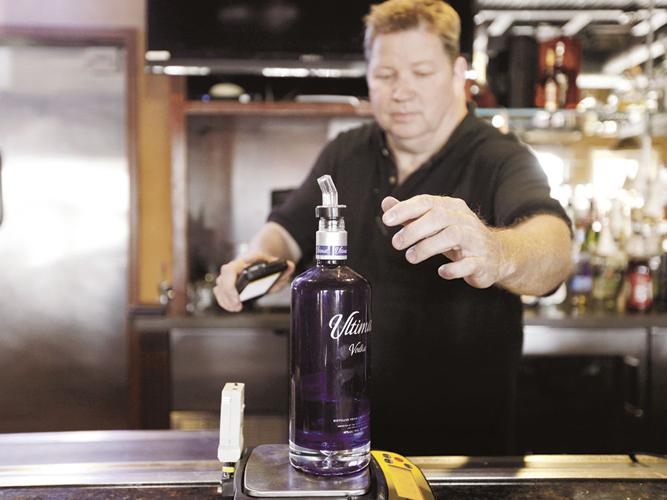
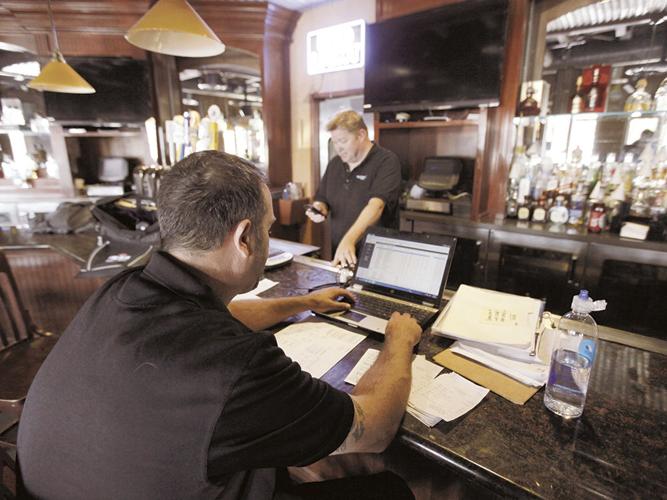

It’s lunchtime on a Monday, and light streams in through the windows onto the bar at Hacienda Mexican Grill in Westridge Shopping Center in Salinas, illuminating bottles of water and a bag of Cheez-Its next to a laptop, a small digital scale and a stack of receipts.
No cocktails. But a lot of booze is about to start moving around.
A team of two auditors has arrived for its weekly visit. Dan Olson stands behind the bar, and places every bottle of open, partially empty liquor – dozens all told – on the precision scale, a $500 machine that takes readings to the tenth of a gram; the same scale is used by some pot dispensaries. Olson uses his iPhone to scan the UPC code on the bottle, then puts it back on the shelf. A bluetooth device on the scale sends the weight to Olson’s colleague Matthew Derbyshire, who’s at the laptop trying to match the numbers with the stack of the week’s receipts.
It’s a tedious process that lasts about three hours, but the software does a lot of the work: It factors in the density of each liquor and the weight of the bottle, and converts the weight in grams from the scale to ounces of liquor in an instant. And it’s got all of the recipes, so it tabulates how many ounces belong in a cocktail – in Hacienda’s cadillac margarita, for example, there should be 1.5 ounces of Patron Silver tequila for every half-ounce of triple sec and quarter-ounce of grand marnier as a float – and how many should remain in a bottle.
A series of those calculations reveal Hacienda sold 157 shots of Patron Silver last week, or 236.17 ounces – more than nine bottles’ worth. Counting the fraction of the bottle that’s open, they’re short by 6.34 ounces, or 2.7 percent – not bad. When this weekly audit process first began at Hacienda Grill, they were regularly missing about 25 percent of their Patron Silver.
It’s a mathematical, highly accurate descendent of an old-school bar inventory technique called “tenthing”: looking at a bottle and estimating how many tenths of liquor are left in it.
"There’s overpouring, mis-ringing, spills not recorded, trucks that forget to drop off a case,” Derbyshire says. “I’ve been in the bar business a long time, and there’s nothing like [this technology]. It’s bringing accountability. We’re not looking to put people in trouble.”
Derbyshire and Olson are the audit team for 17 clients of the Monterey Bay franchise of Bevinco, an international restaurant inventory company that’s now under the corporate umbrella Sculpture Hospitality. (The client list confidential – some clients don’t want their employees, or their customers, to know about the audits. A few agreed to interviews for this story.) The due generally does three audits a day, each lasting two to three hours, from Carmel to Watsonville.
Olson recalls one client who was a case – six bottles – of Grey Goose short two weeks in a row. They set up a camera and caught a busboy stashing it in the air vent. More common are innocent mistakes, or the practices bartenders employ that help boost tips: comping a drink for loyal customers (and not noting it), refilling a spilled beer at no charge, or pouring an extra-stiff drink. At Hacienda, those are the types of things bartenders are suppose to record in a composition book next to the register, so Derbyshire and Olson can adjust their numbers to match.
As the audits prove successful, they point to an industry truth many sitting down to a $100 tasting menu might not think about: The price tag on the food may be steep, but margins are often tiny.
Like their Bevinco boss Kevin Useldinger says, “The beverage side is where restaurants make most of their profits.” But because drinks happen more quickly and frequently (and with a lot less labor) than a dish of duck à l’orange – and often with more cash – there are lots of chances to cut into that profit.
Derbyshire knows his strengths. “I’m great with alcohol, and I’m great with math,” he says. He ran sporting goods stores for years before returning to bartending. He still tends bar a couple of nights a week at Famous Dave’s in Salinas, and started auditing about two years ago as a side gig. Now it’s his day job.
Olson used to manage nightclubs in a half-dozen different states. Useldinger has no bar experience. He spent years traveling the world as a motivational speaker promoting fitness, then got the idea to open a local franchise with his friend, who saw Bevinco mentioned on an episode of the TV show Bar Rescue.
His spiel about the virtues of alcohol audits resembles a pep talk: He’s got a three-ring binder with the number to prove Bevinco’s audits will help you find out where you’re losing booze, meaning potentially big cost savings.
In addition to Hacienda, Mike Hackett owns Casa Sorrento, and hired Useldinger and his team a little over a year ago. Before Olson and Derbyshire begin their weekly audits – which are public knowledge to bartenders and employees at those places – they make a few secret trips to get a baseline against which to measure their impact.
After a month of incognito audits, Hackett called a staff meeting at Casa Sorrento, and lined up bottles to create a visual for his staff on how much liquor was unaccounted for. There wasn’t enough space on the 30-foot bar to line them up side by side – some $4,500 worth of missing booze in just one month.
“Everybody was speechless,” Hackett says. “Nobody could understand how it could happen. Within one week, the loss was cut more than half.”
Within three weeks, 96 percent of all the booze sold was accounted for in inventory, thanks to better record-keeping of spills in that composition book, and measured pours using jiggers, instead of eyeballing.
Bevinco’s audit prices are based on the size of the restaurant and how complex the process is, but for Hackett, it’s well worth it: “To me, the service is free because he’s saving us so much money we would’ve been losing in the first place.”
One Bevinco client sells a 25-year Macallan Scotch for $150 a shot. But trying to eyeball a missing shot or three out of a bottle of Scotch is challenging.
“They would have never noticed the two to three shots missing per week,” Useldinger says. “The data is everything.”
John Eales, who owns London Bridge Pub at the foot of Wharf 2 and Coopers Pub on Cannery Row, tends to agree. For 10 years, he did booze audits a lot like this – but no bluetooth or even an Excel spreadsheet, just a pen and paper. At age 17, Eales got a job doing alcohol audits in his native U.K., traveling to pubs all over the country.
“That was before calculators,” Eales says. “There were no cell phones. I became very good at mental arithmetic.”
Based on British currency at the time – pounds, shillings and pence – Eales used to eyeball liquor to the 1/32nd of a bottle.
When he moved to Carmel 22 years ago and managed the now-defunct Red Lion Tavern, he was surprised there wasn’t a more sophisticated audit system already available – in the U.K., he says, precise measurements were part of bar culture. “I was totally surprised when I saw how loose and wild it was here,” he says. With a friend, he wrote basic software, but eventually upgraded to Bevinco’s more detailed audit program.
Another Bevinco client’s alcohol inventory was 35-percent lower than sales receipts showed it should’ve been when they first contracted with Bevinco. Now, they’re down to 2.1 percent. Last week, they poured 2,290.65 ounces according to Olson and Derbyshire’s scale, and the receipts show they sold 2,243.01 ounces. That’s a tight performance; they were missing just about the equivalent of four beers.
Kevin Phillips is managing partner of a major Monterey restaurant group that includes Abalonetti and The Beach House. He hired Bevinco to audit The Whaling Station over a year ago, and he says it’s worked out well.
“It pays for itself,” he says. “We’ve run the numbers on it.”
Phillips is optimistic about incorporating a new food-auditing program that Sculpture Hospitality is in the process rolling out.
In the restaurant business, Phillips says, keeping track of waste is essential: “A very important philosophy is: what you can measure you can manage.”





(0) comments
Welcome to the discussion.
Log In
Keep it Clean. Please avoid obscene, vulgar, lewd, racist or sexually-oriented language.
PLEASE TURN OFF YOUR CAPS LOCK.
Don't Threaten. Threats of harming another person will not be tolerated.
Be Truthful. Don't knowingly lie about anyone or anything.
Be Nice. No racism, sexism or any sort of -ism that is degrading to another person.
Be Proactive. Use the 'Report' link on each comment to let us know of abusive posts.
Share with Us. We'd love to hear eyewitness accounts, the history behind an article.