1
- Paul Fried
Jazz was America’s most popular music beginning in the Roaring ’20s, and like the universe itself, hasn’t stopped expanding. It is acoustic, electric, fusion, swing, big band, bebop, brass, bluesy, moody, often transcendent.
The storied Monterey Jazz Festival is a mecca for aspiring jazz musicians and seasoned masters alike, and the fairgrounds becomes a surprisingly divine space for one weekend a year. MJF’s 59th, presents Grammy winners to the best young players, delivered relentlessly on eight stages. This year, MJF features acclaimed guitarist Pat Metheny, 13-year old Bali phenom Joey Alexander, 83-year old legend Wayne Shorter (playing a piece commissioned by the festival), Joshua Redman, Quincy Jones, plus more than 500 other artists.
In the following pages, we bring you the stories of a few standout artists at various stages of their careers, a small jazz sampler. Monterey Jazz will surprise and delight.
– Bradley Zeve
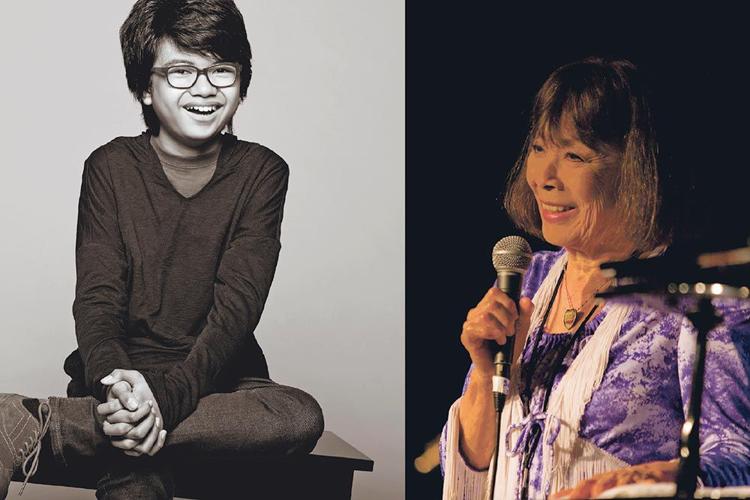
It was a quiet afternoon with family all around, at home in the living room playing games, eating, drinking tea, laughing. All of a sudden the youngest in the room climbs up onto the piano bench for the very first time, and out comes jazz music: real, live, full-blown piano jazz – from a 6-year-old. “Even when I was a baby I was listening to music all the time,” recounts Joey Alexander. “I just heard something in my head that day. My dad plays piano so I thought I would give it a try.”
He’d been playing on a few children’s keyboards since he was very young, but this was his first time on the bench, at a real grown-up piano. His surprised family members decided to encourage Alexander’s exceptional musical talent.
Now living in New York, Alexander, a Bali native, is being homeschooled by his dad and learning English as a second language. He also spends three to four hours per day practicing piano, and can already play famous tunes by the jazz masters as well as anyone, even though he stands barely as tall as the keyboards upon which he wails. Alexander turned 13 on June 25, and says he really likes hamburgers, movies and video games. But he sounds grown-up when he reflects on what he likes most about playing: “Being swept away to another place,” he says. “It’s just a part of the music.”
Just as classical has its masterpieces, jazz has its standards, and both fill similar functions within each genre. In jazz, they call them standards because encoded within the written music are specific instructions as to how the players create the sound we think of when we think of jazz; tunes so widely known they’re etched into the collective unconscious of listeners. Think “My Favorite Things” or “Georgia On My Mind.”
Even young Joey Alexander displays a reverence for these old-school greats, as evidenced in his latest disc Countdown, on which all but three of the cuts are jazz masters’ standards. It all reads like a fairy tale for him these days: He has already garnered two Grammy nominations, and became an overnight sensation after appearing at Wynton Marsalis’ Jazz at Lincoln Center Gala in 2014. He performed at both the Montreal and Newport jazz festivals last year for the first time, at age 12, and he makes his first Monterey Jazz Festival appearance this weekend at age 13.
His first album, My Favorite Things, was released in May 2015 when he was just 11, and he’ll celebrate the release of his second disc, Countdown, with a gig at the historic New York City jazz club Dizzy’s later this month. “I just want to play around the world, sharing my music with the world,” Alexander says.
“You can’t learn jazz from a book.”
And he’s still learning from the greats: “I’m still listening to all the great masters I always have: Monk, Coltrane, Miles, Wayne, Herbie. And now, I’m listening to gospel music,” he adds. “Oh yeah, gospel – I love it!”
Add to that list the celebrated jazz pianist Toshiko Akiyoshi, who is also appearing at the Monterey Jazz Fest this weekend. Alexander says he’s heard a lot about her in the New York City jazz circles they both frequent.
While both pianists started playing at nearly the same age in life – at 7 and 6 – Akiyoshi is now basking in the afterglow of an illustrious life-long career as a bandleader, composer and solo pianist which has spanned the past seven decades. Her family moved from her birthplace in Manchuria, in northeastern China, to Japan in 1946. It was the time of the Allied occupation, and there were separate dance halls for the American and Japanese troops. She was hired to play at the Japanese dance hall, where she met a jazz record collector who played Teddy Wilson’s classic “Sweet Lorraine” for her, and it changed her musical life.
“Suppose that he had played Thelonious Monk,” recalls Akiyoshi. “I don’t think I could’ve understood that because his music was too sophisticated for my ear, since I had never even heard jazz before.”
But tunes by Wilson, an older swing player, were different. “His music was clean, beautiful piano that really appealed to me because I was classically trained,” Akiyoshi says. “When I heard that, I thought, ‘I wanna play just like that.’ So that was my entry into the jazz world.”
Akiyoshi first came to the U.S. in 1956. At that time, all the jazz clubs were different. “Each group would stay for a week,” remembers Akiyoshi, “and they often would play five sets per night, unlike now when groups stay a night or maybe two, and play only two sets per night.”
This difference created myriad opportunities to sit in with the greats, and that is exactly what Akiyoshi did, rubbing elbows and jamming with the likes of Max Roach, Clifford Brown, Sonny Rollins and Miles Davis in Chicago, Boston and New York before permanently moving to New York in 1972. “This year is significant to me,” she says. “I came to the U.S. exactly 60 years ago, so I’m a little sentimental about that and I’m very happy and grateful that I was invited to play at the jazz festival this year.”
In some ways, she’s coming full circle from 1972, a year dominated by hardship. “I was in New York, and all I could think of was how I was going to get the next month’s rent. I was barely surviving, and struggling,” Akiyoshi says.
All that began to change for the better when another celebrated pianist, the great John Lewis of Modern Jazz Quartet fame, and then music director for the ’72 Monterey Jazz Festival, called and invited her out to perform with himself, Dr. Billy Taylor and Erskine Hawkins.
“It was quite an experience,” Akiyoshi says, “and after that the jobs slowly started to trickle in. Luckily I was able to make it.” She also founded the 16-person Toshiko Akiyoshi Jazz Orchestra ensemble in 1972, a project that spanned some 30 years.
“We have a saying,” Akiyoshi says, “‘You can’t learn to swim on a tatami (a Japanese floor mat).’ In other words, you can’t learn jazz from a book. You have to play with the players, and that’s how you learn. I was very fortunate to come at a time when that was easily possible. You can’t do that so easily today. It is just not the same. That experience is my asset.”
There will always be the succession of generations and often the music is its own reward. At this year’s Jazz Festival, the generations will be on full display.
In spite of their differences, Alexander and Akiyoshi share this: a simple desire to play jazz. Asked about her future plans, Akiyoshi says, “I don’t really have any goals or dreams. Remember, I had my own big band for over 30 years and it was a fully realized vehicle for my own personal expression. I just want to play now – solo, duo and I’m bringing a trio to Monterey. I have been very, very lucky,” offers Akiyoshi, “and I am very, very grateful.”
Asked about his future plans, Alexander echoes, “I’m just grateful for the now, and very thankful to God for my gifts.”
TOSHIKO AKIYOSHI TRIO performs at 8:30pm Friday, Sept. 16 on the Night Club Stage
JOEY ALEXANDER TRIO performs at 7pm Saturday, Sept. 17 on the Garden Stage.
59TH MONTEREY JAZZ FESTIVAL runs Fri-Sun Sept. 16-18, Monterey Fairgrounds and Event Center, 2004 Fairgrounds Road, Monterey. Gates open 6pm Fri, 11:30am Sat and Sun. $47-$360. (888) 248-6499, www.montereyjazzfestival.org.
2
In 1970, Nina Simone wrote a rallying cry of a song called “To Be Young, Gifted and Black,” an open letter of support to black kids who were otherwise being told that they were unwanted and disposable. It seems like Kamasi Washington grew up in the aura of Simone’s song.
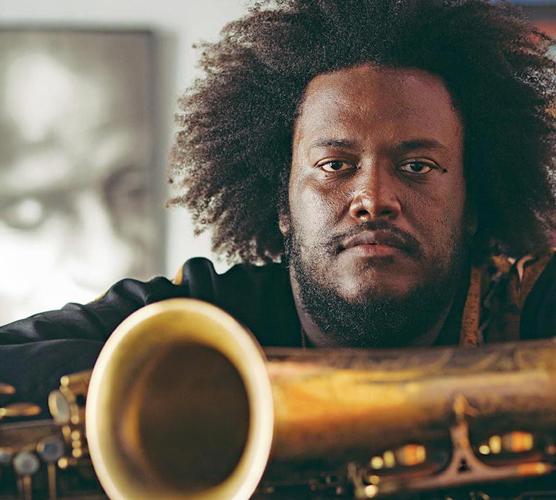
The 35-year-old tenor saxophonist is being hailed as a supremely gifted musician and bandleader, the latest heir of John Coltrane, with the spiritual vision of Pharaoh Sanders and the Afrofuturist aesthetic of Sun Ra. But he’s sure not a traditionalist just conjuring the past. He is of this moment. He’s helping create this moment.
Washington was born and raised in Los Angeles to parents steeped in music and education. His uncle Erwin co-founded the famous Lula Washington Dance Theatre. After studying at UCLA’s Department of Ethnomusicology, he began playing with heavyweights like Wayne Shorter, Herbie Hancock, Horace Tapscott and Stanley Clark. He joined the Gerald Wilson Orchestra in 2005 and played on the 2007 Monterey Moods album inspired by the Monterey Jazz Festival (Washington makes his festival debut this Sunday).
He also gets down with R&B legends like Raphael Saadiq and Chaka Khan, and hip-hop artists like Snoop Dogg, Mos Def and Lauryn Hill. He played and arranged strings on Kendrick Lamar’s landmark album To Pimp a Butterfly.
“Kamasi brought the jazz element to Kendrick’s music,” Erwin says of his nephew. “Kamasi’s connection to Kendrick has helped propel his own work to a wider worldwide audience.”
He’s not a traditionalist just conjuring the past. He is of this moment.
Washington is part of an L.A. musical collective – with bassist Miles Mosely (named after Miles Davis), keyboardist Brandon Coleman, drummer Ronald Bruner and bassist Stephen Bruner (the latter goes by Thundercat) – called the West Coast Get Down. His debut on the indie record label Brainfeeder is The Epic. He marshalled 10 musicians, a 32-piece orchestra and a 20-person choir to create an ambitious, three-disc, three-hour discourse on the artistic, intellectual and political world of black L.A. and black America.
The first song is “Change of the Guard,” a musical statement of purpose.
He allows some purposeful if meandering soloing and improvising here and there, but will suddenly bring in a cloudburst of choral singing or sweeping strings to send a song into flight. The first three tracks reach the 12-minute mark, filled with dynamics and changing colors – little epics unto themselves. There’s even a church organ cameo. “The Rhythm Changes” is the closest the entire suite of gorgeous songs comes to being a crossover single: seven and a half minutes, with a danceable groove and breezy singing by Patrice Quinn. It’s like a gateway song.
Washington’s claimed an important place in the world of music, but he is not pop-star famous; his music is too challenging, too jazz. But he’s played Coachella and Walt Disney Hall, andThe Epic debuted at number one on iTunes jazz charts in several countries. A profile in The New York Times last January extolled The Epic’s “soaring panorama of black American musical history, from gospel and blues to jazz, doo-wop and funk, offered as a celebration of black beauty in the face of adversity” and compared it to Ta-Nehisi Coates’ memoir Between the World and Me and Claudia Rankine’s prose-poem Citizen: An American Lyric.
“There’s a world waiting for you/ Yours is the quest that’s just begun,” Nina Simone sings in “To Be Young Gifted and Black.” She would nod with pride at Washington as he tours the world manifesting that message.
To go to the interview with Kamasi Washington, click here.
KAMASI WASHINGTON plays from his album The Epic at 2pm Sunday, Sept. 18 on the Jimmy Lyons Arena Stage.
3
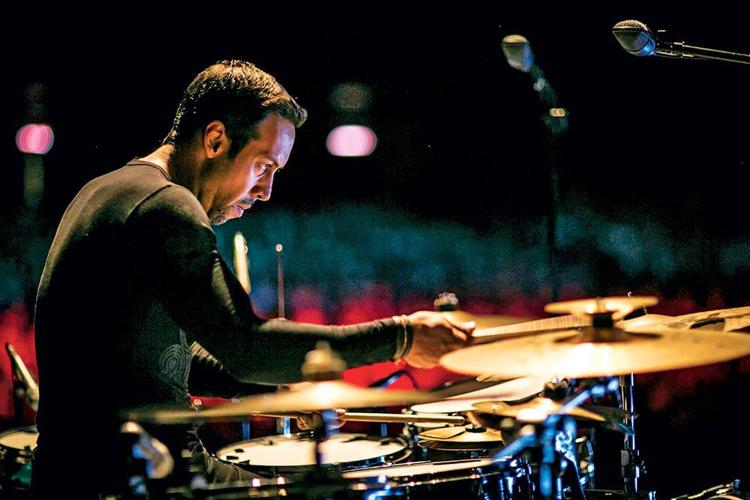
Antonio Sanchez uses his drumset as therapy – a place he feels the safest, because he is in command of his emotions.
“With drums, it does not spoon-feed to you what you’re supposed to be feeling,” he says. “Drums are a bit more ethereal in that way.”
Sanchez, 44, is keeping the beat for jazz guitarist virtuoso Pat Metheny at the Monterey Jazz Festival this Sunday. Sanchez was born in Mexico City. At age 5, he started playing drums and by his teen years, he was playing professionally. After studying jazz drumming at the Berklee College of Music, he worked his way up to play with Metheny’s trio in in the mid-2000s, and Sanchez played drums on their 2008 album Day Trip to critical acclaim. The year before, Sanchez recorded Migration, his first record as band leader.
Sanchez composed the drum-intensive score for the 2014 film Birdman, which won an Oscar for Best Picture. Director Alejandro Iñárritu, who was a Metheny fan, had seen Sanchez play a drum solo years earlier when he reached out regarding the soundtrack.
“He called me out of the blue. I was excited, elated and terrified,” Sanchez says. “I was just trying to do justice to the acting by using the music for dramatic effect. Drums are the perfect instrument for creating exciting stress.”
Birdman tells the story of actor Riggan Thomson (Michael Keaton) trying to gain relevance as he ages and the once-famous superhero character he played fades from popularity. Sanchez’s drumming follows Thomson’s ups and downs, and at points, as the story and characters nearly implode, so do the fast-paced drums with wild crashes and snare thumps.
Sanchez likes the creative control of recording his own records, which working with a movie director changes, but working with Iñárritu was different.
“With a movie, you have to be in touch with the director and music supervisor and aesthetically it may not be what you want,” Sanchez says. “Iñárritu wanted the drums to sound beat-up and old, as if they were stored in the bowels of the theater for a long time. I loved how the drums were mixed to sound big and natural.”
Birdman’s success helped boost Sanchez from a well-known jazz drummer into mainstream recognition. “It’s an interesting time for me, because I’m living in the afterglow of Birdman and doing my own band and other projects,” he says. “I’ve gotten to a place in jazz where I get to do only the stuff I want to do. I like having control and really want to do what I want to do.”
For Sanchez, playing with someone like Metheny – who has been in the jazz world for decades as a fusion guitarist recording dozens of records, both solo and with everyone from Joni Mitchell to Jack DeJohnette, and winning numerous Grammy awards – presents an exciting challenge.
“I want to sound current, but pay tribute to those who have come before me. I want to share things I have absorbed through the years,” Sanchez says. “It is something I have to keep in check – how much of the future and the past I want to bring to it.”
Despite the sometimes chaotic noise that comes across in his work, drumming is Sanchez’s meditation.
“It is one of the only times during the day I am completely immersed by myself. It takes everything to be in that moment and deliver,” he says. “It’s cleansing and exhausting and difficult, which all of those things makes is fascinating.”
ANTONIO SANCHEZ performs with the Pat Metheny Quartet at 8:30pm on Sunday, Sept. 18 on the Jimmy Lyons Stage.
4
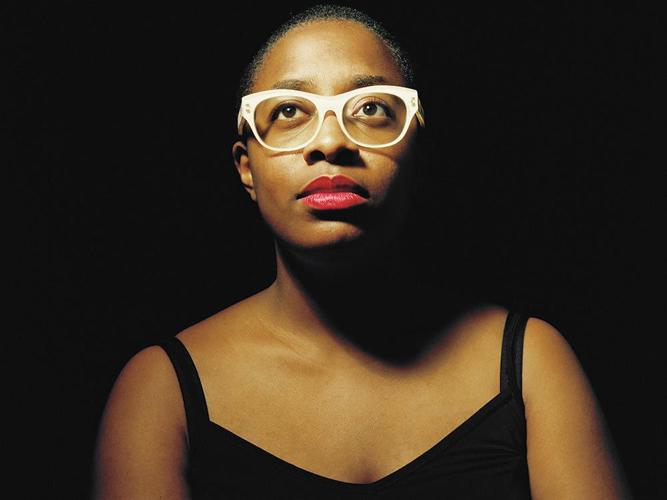
Cécile McLorin Salvant was riding the high of a first Grammy nomination (WomanChild in the Best Jazz Vocal Album category) when she made her Monterey Jazz Festival debut in 2014. The 27-year-old phenom returns to the Fairgrounds’ Main Stage Arena Friday soaring even higher: Not only did Salvant’s masterful follow-up to WomanChild, For One to Love, make her a Grammy Award winner again in 2016, it earned the Miami native a coveted Jazz Journalists Association Jazz Award for Female Singer of the Year.
“The goal is to always make music that’s sincere,” Salvant says. “When we get these awards, it’s a wonderful nod – for the Grammy, from a more mainstream group of people and from the Jazz Journalists Association, from people who are dealing with jazz all the time. It’s great to get both.”
Since erupting onto the jazz scene at 21, Salvant has been widely touted for her ability to blend her natural raw talent with an extensive education (formal and informal) that includes classical, baroque and jazz vocals. Ongoing learning is pivotal to the singer, especially when she’s making a new record. Salvant’s breathy soprano in the funky and playful “Growlin’ Dan” is pulp noir personified. The tune appears on For One to Love and was penned by Blanche Calloway, “another one of those great singers that nobody remembers,” Salvant says. Salvant had only recently been turned on to Calloway (jazz singer Cab Calloway’s older sister), but quickly devoured every recording she could find.
“It’s always been a passion of mine to discover forgotten artists."
“I thought it was insane that there was someone in [Cab’s] immediate family, with the same last name, making excellent music and we don’t know about her,” Salvant explains. “It’s always been a great passion of mine to discover these forgotten artists.”
Salvant’s passion for musical discovery is limitless. She says she’s always on the look-out for something new that touches her in any way. In 2014, she had immersed herself into ’90s grunge and punk and delved deep into bands like Bikini Kill.
“I have these little fixations,” Salvant says. “Now, it’s not so much even music. I’ve been obsessed with listening to interviews with certain comedians and actors. I want to get into their heads because they feel very fascinating to me.”
As Salvant continues to gain international fame, she’s only recently become comfortable with performing in front of large audiences.
“I’m able to look at people in the eye and focus on them,” she says. “I’d like to have a way of singing that’s a little more relaxed, so that’s what I’ve been working on.”
Salvant says she recently developed an unexplainable perpetual fear of forgetting song lyrics, but is hopeful that it will pass.
“Unfortunately, I now have to bring the lyrics out with me [on stage] even on the songs I know,” she admits. “It’s weird and neurotic – I’ve song these songs hundreds of times, so I know them, but there’s a little man in my head telling me I’m going to forget. Hopefully it passes. It’s more fun to be free.”
CÉCILE McLORIN SALVANT performs at 7:30pm Friday, Sept. 16 on the Jimmy Lyons Stage and at 9:30pm in Dizzy’s Den.
5
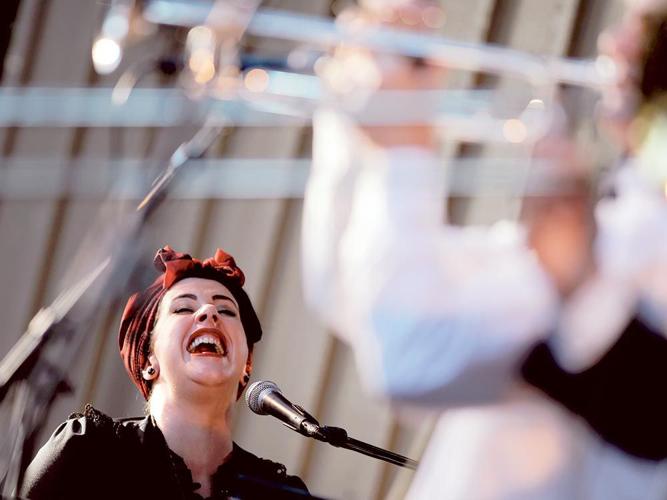
Playing music, Davina Sowers says, is a basic necessity. “It’s rudimentary,” she says. “I need an outlet. Singing has been the way to keep me balanced.”
That internal balance is reflected outwardly in the heavily emotional sound of The Vagabonds, a band 37-year-old Sowers formed in 2006. They play 1920s swing, gospel blues and New Orleans trombone-laden tracks, all brought together by Sowers’ vocals, which can go from a soft, gentle croon to a cannon boom.
Sowers got her early musical education from her dad, a music lover.
“I just listened to what I liked,” she says. “I liked the freedom of music.”
That freedom for Sowers originally took the shape of traveling around the country in her teen years, and is what inspired her band’s name.
As Davina and the Vagabonds, a five-piece band with Sowers on piano and vocals, tour the country, she is also riding the ups and downs of her music.
“Knowing that people are taking what we’re doing seriously makes me happy,” Sowers says. “I’m not an endorphin-running musician. It feels good to have people bounce that energy back to you.”
They play the Monterey Jazz Festival for the third time this Saturday, and make their second appearance on the main stage.
“Being part of that history was on the bucket list. I never thought I could call my mom and say I played Monterey Jazz,” Sowers says. “I was beautifully overwhelmed.”
Sowers says it’s that same sense of excitement drives her performances.
“It’s always a bit easier and looser the second time. It’s more road-tested,” she says. “I want new listeners to wiggle and be happy and excited.”
This year, they’ll play selections from their two studio records and recent live record, released in March 2016, which include many originals of swing-era dance tunes, like “Shake That Thing,” as well as Etta James’ emotionally moving ballad “I’d Rather Go Blind.”
While Sowers says she is still learning, she’s happy with the progression of The Vagabonds’ music – a comfortable place traveling through the world using instruments and voice.
“I just want to keep doing us.”
DAVINA AND THE VAGABONDS perform at 1pm Saturday, Sept. 17 on the Jimmy Lyons Stage and 3pm on the Garden Stage.
6
The festival packs in 659 artists on eight stages over three days. And if live music doesn’t move you, maybe films about jazz will. A few selected highlights are below; the complete schedule is available at www.montereyjazzfestival.org.
Friday, Sept. 16
7:30 and 9:30pm: Cécile McLorin Salvant
7:30pm: Joshua Redman, Ron Miles, Scott Colley and Brian Blade
8:30pm: Toshiko Akiyoshi Trio
10pm: Troker
Saturday, Sept. 17
1 and 3pm: Davina and the Vagabonds
3:40pm: Maceo Parker’s tribute to Ray Charles
4pm: Conversation with Toshiko Akiyoshi and Terri Lyne Carrington
5:30pm: Film: Brownie Speaks: The Life, Music & Legacy of Clifford Brown
7pm: Joey Alexander Trio
8:50pm: Terri Lyne Carrington’s Mosaic Project featuring Lizz Wright and Valerie Simpson
Sunday, Sept. 18
12:30pm: Next Generation Jazz Orchestra with Terri Lyne Carrington
2pm: Kamasi Washington
4:30pm: Film: Thomas Chapin, Night Bird Song: The Incandescent Life of a Jazz Great
7pm: Wayne Shorter Quartet
8:30pm: Pat Metheny with Antonio Sanchez, Linda Oh and Gwilym Simcock
9:15pm: Dr. Lonnie Smith
9:30pm: Joshua Redman Quartet
More like this...
- Paul Fried
Jazz was America’s most popular music beginning in the Roaring ’20s, and like the universe itself, hasn’t stopped expanding. It is acoustic, electric, fusion, swing, big band, bebop, brass, bluesy, moody, often transcendent.
The storied Monterey Jazz Festival is a mecca for aspiring jazz musicians and seasoned masters alike, and the fairgrounds becomes a surprisingly divine space for one weekend a year. MJF’s 59th, presents Grammy winners to the best young players, delivered relentlessly on eight stages. This year, MJF features acclaimed guitarist Pat Metheny, 13-year old Bali phenom Joey Alexander, 83-year old legend Wayne Shorter (playing a piece commissioned by the festival), Joshua Redman, Quincy Jones, plus more than 500 other artists.
In the following pages, we bring you the stories of a few standout artists at various stages of their careers, a small jazz sampler. Monterey Jazz will surprise and delight.
– Bradley Zeve
It was a quiet afternoon with family all around, at home in the living room playing games, eating, drinking tea, laughing. All of a sudden the youngest in the room climbs up onto the piano bench for the very first time, and out comes jazz music: real, live, full-blown piano jazz – from a 6-year-old. “Even when I was a baby I was listening to music all the time,” recounts Joey Alexander. “I just heard something in my head that day. My dad plays piano so I thought I would give it a try.”
He’d been playing on a few children’s keyboards since he was very young, but this was his first time on the bench, at a real grown-up piano. His surprised family members decided to encourage Alexander’s exceptional musical talent.
Now living in New York, Alexander, a Bali native, is being homeschooled by his dad and learning English as a second language. He also spends three to four hours per day practicing piano, and can already play famous tunes by the jazz masters as well as anyone, even though he stands barely as tall as the keyboards upon which he wails. Alexander turned 13 on June 25, and says he really likes hamburgers, movies and video games. But he sounds grown-up when he reflects on what he likes most about playing: “Being swept away to another place,” he says. “It’s just a part of the music.”
Just as classical has its masterpieces, jazz has its standards, and both fill similar functions within each genre. In jazz, they call them standards because encoded within the written music are specific instructions as to how the players create the sound we think of when we think of jazz; tunes so widely known they’re etched into the collective unconscious of listeners. Think “My Favorite Things” or “Georgia On My Mind.”
Even young Joey Alexander displays a reverence for these old-school greats, as evidenced in his latest disc Countdown, on which all but three of the cuts are jazz masters’ standards. It all reads like a fairy tale for him these days: He has already garnered two Grammy nominations, and became an overnight sensation after appearing at Wynton Marsalis’ Jazz at Lincoln Center Gala in 2014. He performed at both the Montreal and Newport jazz festivals last year for the first time, at age 12, and he makes his first Monterey Jazz Festival appearance this weekend at age 13.
His first album, My Favorite Things, was released in May 2015 when he was just 11, and he’ll celebrate the release of his second disc, Countdown, with a gig at the historic New York City jazz club Dizzy’s later this month. “I just want to play around the world, sharing my music with the world,” Alexander says.
“You can’t learn jazz from a book.”
And he’s still learning from the greats: “I’m still listening to all the great masters I always have: Monk, Coltrane, Miles, Wayne, Herbie. And now, I’m listening to gospel music,” he adds. “Oh yeah, gospel – I love it!”
Add to that list the celebrated jazz pianist Toshiko Akiyoshi, who is also appearing at the Monterey Jazz Fest this weekend. Alexander says he’s heard a lot about her in the New York City jazz circles they both frequent.
While both pianists started playing at nearly the same age in life – at 7 and 6 – Akiyoshi is now basking in the afterglow of an illustrious life-long career as a bandleader, composer and solo pianist which has spanned the past seven decades. Her family moved from her birthplace in Manchuria, in northeastern China, to Japan in 1946. It was the time of the Allied occupation, and there were separate dance halls for the American and Japanese troops. She was hired to play at the Japanese dance hall, where she met a jazz record collector who played Teddy Wilson’s classic “Sweet Lorraine” for her, and it changed her musical life.
“Suppose that he had played Thelonious Monk,” recalls Akiyoshi. “I don’t think I could’ve understood that because his music was too sophisticated for my ear, since I had never even heard jazz before.”
But tunes by Wilson, an older swing player, were different. “His music was clean, beautiful piano that really appealed to me because I was classically trained,” Akiyoshi says. “When I heard that, I thought, ‘I wanna play just like that.’ So that was my entry into the jazz world.”
Akiyoshi first came to the U.S. in 1956. At that time, all the jazz clubs were different. “Each group would stay for a week,” remembers Akiyoshi, “and they often would play five sets per night, unlike now when groups stay a night or maybe two, and play only two sets per night.”
This difference created myriad opportunities to sit in with the greats, and that is exactly what Akiyoshi did, rubbing elbows and jamming with the likes of Max Roach, Clifford Brown, Sonny Rollins and Miles Davis in Chicago, Boston and New York before permanently moving to New York in 1972. “This year is significant to me,” she says. “I came to the U.S. exactly 60 years ago, so I’m a little sentimental about that and I’m very happy and grateful that I was invited to play at the jazz festival this year.”
In some ways, she’s coming full circle from 1972, a year dominated by hardship. “I was in New York, and all I could think of was how I was going to get the next month’s rent. I was barely surviving, and struggling,” Akiyoshi says.
All that began to change for the better when another celebrated pianist, the great John Lewis of Modern Jazz Quartet fame, and then music director for the ’72 Monterey Jazz Festival, called and invited her out to perform with himself, Dr. Billy Taylor and Erskine Hawkins.
“It was quite an experience,” Akiyoshi says, “and after that the jobs slowly started to trickle in. Luckily I was able to make it.” She also founded the 16-person Toshiko Akiyoshi Jazz Orchestra ensemble in 1972, a project that spanned some 30 years.
“We have a saying,” Akiyoshi says, “‘You can’t learn to swim on a tatami (a Japanese floor mat).’ In other words, you can’t learn jazz from a book. You have to play with the players, and that’s how you learn. I was very fortunate to come at a time when that was easily possible. You can’t do that so easily today. It is just not the same. That experience is my asset.”
There will always be the succession of generations and often the music is its own reward. At this year’s Jazz Festival, the generations will be on full display.
In spite of their differences, Alexander and Akiyoshi share this: a simple desire to play jazz. Asked about her future plans, Akiyoshi says, “I don’t really have any goals or dreams. Remember, I had my own big band for over 30 years and it was a fully realized vehicle for my own personal expression. I just want to play now – solo, duo and I’m bringing a trio to Monterey. I have been very, very lucky,” offers Akiyoshi, “and I am very, very grateful.”
Asked about his future plans, Alexander echoes, “I’m just grateful for the now, and very thankful to God for my gifts.”
TOSHIKO AKIYOSHI TRIO performs at 8:30pm Friday, Sept. 16 on the Night Club Stage
JOEY ALEXANDER TRIO performs at 7pm Saturday, Sept. 17 on the Garden Stage.
59TH MONTEREY JAZZ FESTIVAL runs Fri-Sun Sept. 16-18, Monterey Fairgrounds and Event Center, 2004 Fairgrounds Road, Monterey. Gates open 6pm Fri, 11:30am Sat and Sun. $47-$360. (888) 248-6499, www.montereyjazzfestival.org.
In 1970, Nina Simone wrote a rallying cry of a song called “To Be Young, Gifted and Black,” an open letter of support to black kids who were otherwise being told that they were unwanted and disposable. It seems like Kamasi Washington grew up in the aura of Simone’s song.
The 35-year-old tenor saxophonist is being hailed as a supremely gifted musician and bandleader, the latest heir of John Coltrane, with the spiritual vision of Pharaoh Sanders and the Afrofuturist aesthetic of Sun Ra. But he’s sure not a traditionalist just conjuring the past. He is of this moment. He’s helping create this moment.
Washington was born and raised in Los Angeles to parents steeped in music and education. His uncle Erwin co-founded the famous Lula Washington Dance Theatre. After studying at UCLA’s Department of Ethnomusicology, he began playing with heavyweights like Wayne Shorter, Herbie Hancock, Horace Tapscott and Stanley Clark. He joined the Gerald Wilson Orchestra in 2005 and played on the 2007 Monterey Moods album inspired by the Monterey Jazz Festival (Washington makes his festival debut this Sunday).
He also gets down with R&B legends like Raphael Saadiq and Chaka Khan, and hip-hop artists like Snoop Dogg, Mos Def and Lauryn Hill. He played and arranged strings on Kendrick Lamar’s landmark album To Pimp a Butterfly.
“Kamasi brought the jazz element to Kendrick’s music,” Erwin says of his nephew. “Kamasi’s connection to Kendrick has helped propel his own work to a wider worldwide audience.”
He’s not a traditionalist just conjuring the past. He is of this moment.
Washington is part of an L.A. musical collective – with bassist Miles Mosely (named after Miles Davis), keyboardist Brandon Coleman, drummer Ronald Bruner and bassist Stephen Bruner (the latter goes by Thundercat) – called the West Coast Get Down. His debut on the indie record label Brainfeeder is The Epic. He marshalled 10 musicians, a 32-piece orchestra and a 20-person choir to create an ambitious, three-disc, three-hour discourse on the artistic, intellectual and political world of black L.A. and black America.
The first song is “Change of the Guard,” a musical statement of purpose.
He allows some purposeful if meandering soloing and improvising here and there, but will suddenly bring in a cloudburst of choral singing or sweeping strings to send a song into flight. The first three tracks reach the 12-minute mark, filled with dynamics and changing colors – little epics unto themselves. There’s even a church organ cameo. “The Rhythm Changes” is the closest the entire suite of gorgeous songs comes to being a crossover single: seven and a half minutes, with a danceable groove and breezy singing by Patrice Quinn. It’s like a gateway song.
Washington’s claimed an important place in the world of music, but he is not pop-star famous; his music is too challenging, too jazz. But he’s played Coachella and Walt Disney Hall, andThe Epic debuted at number one on iTunes jazz charts in several countries. A profile in The New York Times last January extolled The Epic’s “soaring panorama of black American musical history, from gospel and blues to jazz, doo-wop and funk, offered as a celebration of black beauty in the face of adversity” and compared it to Ta-Nehisi Coates’ memoir Between the World and Me and Claudia Rankine’s prose-poem Citizen: An American Lyric.
“There’s a world waiting for you/ Yours is the quest that’s just begun,” Nina Simone sings in “To Be Young Gifted and Black.” She would nod with pride at Washington as he tours the world manifesting that message.
To go to the interview with Kamasi Washington, click here.
KAMASI WASHINGTON plays from his album The Epic at 2pm Sunday, Sept. 18 on the Jimmy Lyons Arena Stage.
Antonio Sanchez uses his drumset as therapy – a place he feels the safest, because he is in command of his emotions.
“With drums, it does not spoon-feed to you what you’re supposed to be feeling,” he says. “Drums are a bit more ethereal in that way.”
Sanchez, 44, is keeping the beat for jazz guitarist virtuoso Pat Metheny at the Monterey Jazz Festival this Sunday. Sanchez was born in Mexico City. At age 5, he started playing drums and by his teen years, he was playing professionally. After studying jazz drumming at the Berklee College of Music, he worked his way up to play with Metheny’s trio in in the mid-2000s, and Sanchez played drums on their 2008 album Day Trip to critical acclaim. The year before, Sanchez recorded Migration, his first record as band leader.
Sanchez composed the drum-intensive score for the 2014 film Birdman, which won an Oscar for Best Picture. Director Alejandro Iñárritu, who was a Metheny fan, had seen Sanchez play a drum solo years earlier when he reached out regarding the soundtrack.
“He called me out of the blue. I was excited, elated and terrified,” Sanchez says. “I was just trying to do justice to the acting by using the music for dramatic effect. Drums are the perfect instrument for creating exciting stress.”
Birdman tells the story of actor Riggan Thomson (Michael Keaton) trying to gain relevance as he ages and the once-famous superhero character he played fades from popularity. Sanchez’s drumming follows Thomson’s ups and downs, and at points, as the story and characters nearly implode, so do the fast-paced drums with wild crashes and snare thumps.
Sanchez likes the creative control of recording his own records, which working with a movie director changes, but working with Iñárritu was different.
“With a movie, you have to be in touch with the director and music supervisor and aesthetically it may not be what you want,” Sanchez says. “Iñárritu wanted the drums to sound beat-up and old, as if they were stored in the bowels of the theater for a long time. I loved how the drums were mixed to sound big and natural.”
Birdman’s success helped boost Sanchez from a well-known jazz drummer into mainstream recognition. “It’s an interesting time for me, because I’m living in the afterglow of Birdman and doing my own band and other projects,” he says. “I’ve gotten to a place in jazz where I get to do only the stuff I want to do. I like having control and really want to do what I want to do.”
For Sanchez, playing with someone like Metheny – who has been in the jazz world for decades as a fusion guitarist recording dozens of records, both solo and with everyone from Joni Mitchell to Jack DeJohnette, and winning numerous Grammy awards – presents an exciting challenge.
“I want to sound current, but pay tribute to those who have come before me. I want to share things I have absorbed through the years,” Sanchez says. “It is something I have to keep in check – how much of the future and the past I want to bring to it.”
Despite the sometimes chaotic noise that comes across in his work, drumming is Sanchez’s meditation.
“It is one of the only times during the day I am completely immersed by myself. It takes everything to be in that moment and deliver,” he says. “It’s cleansing and exhausting and difficult, which all of those things makes is fascinating.”
ANTONIO SANCHEZ performs with the Pat Metheny Quartet at 8:30pm on Sunday, Sept. 18 on the Jimmy Lyons Stage.
Cécile McLorin Salvant was riding the high of a first Grammy nomination (WomanChild in the Best Jazz Vocal Album category) when she made her Monterey Jazz Festival debut in 2014. The 27-year-old phenom returns to the Fairgrounds’ Main Stage Arena Friday soaring even higher: Not only did Salvant’s masterful follow-up to WomanChild, For One to Love, make her a Grammy Award winner again in 2016, it earned the Miami native a coveted Jazz Journalists Association Jazz Award for Female Singer of the Year.
“The goal is to always make music that’s sincere,” Salvant says. “When we get these awards, it’s a wonderful nod – for the Grammy, from a more mainstream group of people and from the Jazz Journalists Association, from people who are dealing with jazz all the time. It’s great to get both.”
Since erupting onto the jazz scene at 21, Salvant has been widely touted for her ability to blend her natural raw talent with an extensive education (formal and informal) that includes classical, baroque and jazz vocals. Ongoing learning is pivotal to the singer, especially when she’s making a new record. Salvant’s breathy soprano in the funky and playful “Growlin’ Dan” is pulp noir personified. The tune appears on For One to Love and was penned by Blanche Calloway, “another one of those great singers that nobody remembers,” Salvant says. Salvant had only recently been turned on to Calloway (jazz singer Cab Calloway’s older sister), but quickly devoured every recording she could find.
“It’s always been a passion of mine to discover forgotten artists."
“I thought it was insane that there was someone in [Cab’s] immediate family, with the same last name, making excellent music and we don’t know about her,” Salvant explains. “It’s always been a great passion of mine to discover these forgotten artists.”
Salvant’s passion for musical discovery is limitless. She says she’s always on the look-out for something new that touches her in any way. In 2014, she had immersed herself into ’90s grunge and punk and delved deep into bands like Bikini Kill.
“I have these little fixations,” Salvant says. “Now, it’s not so much even music. I’ve been obsessed with listening to interviews with certain comedians and actors. I want to get into their heads because they feel very fascinating to me.”
As Salvant continues to gain international fame, she’s only recently become comfortable with performing in front of large audiences.
“I’m able to look at people in the eye and focus on them,” she says. “I’d like to have a way of singing that’s a little more relaxed, so that’s what I’ve been working on.”
Salvant says she recently developed an unexplainable perpetual fear of forgetting song lyrics, but is hopeful that it will pass.
“Unfortunately, I now have to bring the lyrics out with me [on stage] even on the songs I know,” she admits. “It’s weird and neurotic – I’ve song these songs hundreds of times, so I know them, but there’s a little man in my head telling me I’m going to forget. Hopefully it passes. It’s more fun to be free.”
CÉCILE McLORIN SALVANT performs at 7:30pm Friday, Sept. 16 on the Jimmy Lyons Stage and at 9:30pm in Dizzy’s Den.
Playing music, Davina Sowers says, is a basic necessity. “It’s rudimentary,” she says. “I need an outlet. Singing has been the way to keep me balanced.”
That internal balance is reflected outwardly in the heavily emotional sound of The Vagabonds, a band 37-year-old Sowers formed in 2006. They play 1920s swing, gospel blues and New Orleans trombone-laden tracks, all brought together by Sowers’ vocals, which can go from a soft, gentle croon to a cannon boom.
Sowers got her early musical education from her dad, a music lover.
“I just listened to what I liked,” she says. “I liked the freedom of music.”
That freedom for Sowers originally took the shape of traveling around the country in her teen years, and is what inspired her band’s name.
As Davina and the Vagabonds, a five-piece band with Sowers on piano and vocals, tour the country, she is also riding the ups and downs of her music.
“Knowing that people are taking what we’re doing seriously makes me happy,” Sowers says. “I’m not an endorphin-running musician. It feels good to have people bounce that energy back to you.”
They play the Monterey Jazz Festival for the third time this Saturday, and make their second appearance on the main stage.
“Being part of that history was on the bucket list. I never thought I could call my mom and say I played Monterey Jazz,” Sowers says. “I was beautifully overwhelmed.”
Sowers says it’s that same sense of excitement drives her performances.
“It’s always a bit easier and looser the second time. It’s more road-tested,” she says. “I want new listeners to wiggle and be happy and excited.”
This year, they’ll play selections from their two studio records and recent live record, released in March 2016, which include many originals of swing-era dance tunes, like “Shake That Thing,” as well as Etta James’ emotionally moving ballad “I’d Rather Go Blind.”
While Sowers says she is still learning, she’s happy with the progression of The Vagabonds’ music – a comfortable place traveling through the world using instruments and voice.
“I just want to keep doing us.”
DAVINA AND THE VAGABONDS perform at 1pm Saturday, Sept. 17 on the Jimmy Lyons Stage and 3pm on the Garden Stage.
The festival packs in 659 artists on eight stages over three days. And if live music doesn’t move you, maybe films about jazz will. A few selected highlights are below; the complete schedule is available at www.montereyjazzfestival.org.
Friday, Sept. 16
7:30 and 9:30pm: Cécile McLorin Salvant
7:30pm: Joshua Redman, Ron Miles, Scott Colley and Brian Blade
8:30pm: Toshiko Akiyoshi Trio
10pm: Troker
Saturday, Sept. 17
1 and 3pm: Davina and the Vagabonds
3:40pm: Maceo Parker’s tribute to Ray Charles
4pm: Conversation with Toshiko Akiyoshi and Terri Lyne Carrington
5:30pm: Film: Brownie Speaks: The Life, Music & Legacy of Clifford Brown
7pm: Joey Alexander Trio
8:50pm: Terri Lyne Carrington’s Mosaic Project featuring Lizz Wright and Valerie Simpson
Sunday, Sept. 18
12:30pm: Next Generation Jazz Orchestra with Terri Lyne Carrington
2pm: Kamasi Washington
4:30pm: Film: Thomas Chapin, Night Bird Song: The Incandescent Life of a Jazz Great
7pm: Wayne Shorter Quartet
8:30pm: Pat Metheny with Antonio Sanchez, Linda Oh and Gwilym Simcock
9:15pm: Dr. Lonnie Smith
9:30pm: Joshua Redman Quartet
More like this...
advertisement
(0) comments
Welcome to the discussion.
Log In
Keep it Clean. Please avoid obscene, vulgar, lewd, racist or sexually-oriented language.
PLEASE TURN OFF YOUR CAPS LOCK.
Don't Threaten. Threats of harming another person will not be tolerated.
Be Truthful. Don't knowingly lie about anyone or anything.
Be Nice. No racism, sexism or any sort of -ism that is degrading to another person.
Be Proactive. Use the 'Report' link on each comment to let us know of abusive posts.
Share with Us. We'd love to hear eyewitness accounts, the history behind an article.