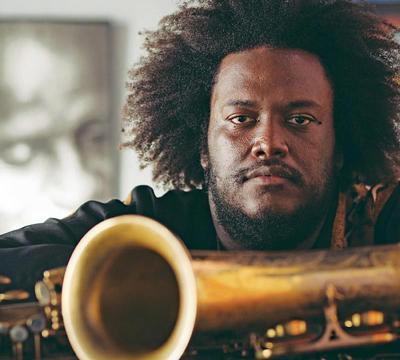

In 1970, Nina Simone wrote a rallying cry of a song called “To Be Young, Gifted and Black,” an open letter of support to black kids who were otherwise being told that they were unwanted and disposable. It seems like Kamasi Washington grew up in the aura of Simone’s song.
The 35-year-old tenor saxophonist is being hailed as a supremely gifted musician and bandleader, the latest heir of John Coltrane, with the spiritual vision of Pharaoh Sanders and the Afrofuturist aesthetic of Sun Ra. But he’s sure not a traditionalist just conjuring the past. He is of this moment. He’s helping create this moment.
Washington was born and raised in Los Angeles to parents steeped in music and education. His uncle Erwin co-founded the famous Lula Washington Dance Theatre. After studying at UCLA’s Department of Ethnomusicology, he began playing with heavyweights like Wayne Shorter, Herbie Hancock, Horace Tapscott and Stanley Clark. He joined the Gerald Wilson Orchestra in 2005 and played on the 2007 Monterey Moods album inspired by the Monterey Jazz Festival (Washington makes his festival debut this Sunday).
He also gets down with R&B legends like Raphael Saadiq and Chaka Khan, and hip-hop artists like Snoop Dogg, Mos Def and Lauryn Hill. He played and arranged strings on Kendrick Lamar’s landmark album To Pimp a Butterfly.
“Kamasi brought the jazz element to Kendrick’s music,” Erwin says of his nephew. “Kamasi’s connection to Kendrick has helped propel his own work to a wider worldwide audience.”
He’s not a traditionalist just conjuring the past. He is of this moment.
Washington is part of an L.A. musical collective – with bassist Miles Mosely (named after Miles Davis), keyboardist Brandon Coleman, drummer Ronald Bruner and bassist Stephen Bruner (the latter goes by Thundercat) – called the West Coast Get Down. His debut on the indie record label Brainfeeder is The Epic. He marshalled 10 musicians, a 32-piece orchestra and a 20-person choir to create an ambitious, three-disc, three-hour discourse on the artistic, intellectual and political world of black L.A. and black America.
The first song is “Change of the Guard,” a musical statement of purpose.
He allows some purposeful if meandering soloing and improvising here and there, but will suddenly bring in a cloudburst of choral singing or sweeping strings to send a song into flight. The first three tracks reach the 12-minute mark, filled with dynamics and changing colors – little epics unto themselves. There’s even a church organ cameo. “The Rhythm Changes” is the closest the entire suite of gorgeous songs comes to being a crossover single: seven and a half minutes, with a danceable groove and breezy singing by Patrice Quinn. It’s like a gateway song.
Washington’s claimed an important place in the world of music, but he is not pop-star famous; his music is too challenging, too jazz. But he’s played Coachella and Walt Disney Hall, andThe Epic debuted at number one on iTunes jazz charts in several countries. A profile in The New York Times last January extolled The Epic’s “soaring panorama of black American musical history, from gospel and blues to jazz, doo-wop and funk, offered as a celebration of black beauty in the face of adversity” and compared it to Ta-Nehisi Coates’ memoir Between the World and Me and Claudia Rankine’s prose-poem Citizen: An American Lyric.
“There’s a world waiting for you/ Yours is the quest that’s just begun,” Nina Simone sings in “To Be Young Gifted and Black.” She would nod with pride at Washington as he tours the world manifesting that message.
To go to the interview with Kamasi Washington, click here.





(0) comments
Welcome to the discussion.
Log In
Keep it Clean. Please avoid obscene, vulgar, lewd, racist or sexually-oriented language.
PLEASE TURN OFF YOUR CAPS LOCK.
Don't Threaten. Threats of harming another person will not be tolerated.
Be Truthful. Don't knowingly lie about anyone or anything.
Be Nice. No racism, sexism or any sort of -ism that is degrading to another person.
Be Proactive. Use the 'Report' link on each comment to let us know of abusive posts.
Share with Us. We'd love to hear eyewitness accounts, the history behind an article.