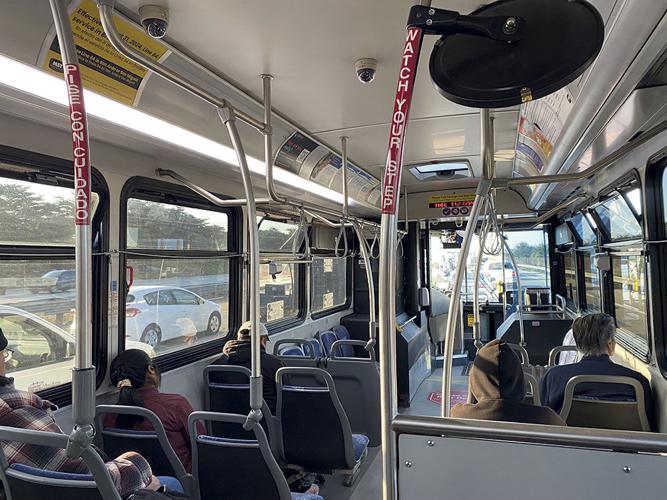

THE MORNING IS SUNNY AND CLEAR in Salinas on Nov. 7, and at 7:25am, Monterey-Salinas Transit’s Line 20 bus, which travels between Salinas and Monterey, departs from the Salinas Transit Center with nine passengers on board.
At 7:39am, as the bus approaches the Imjin Parkway intersection on Reservation Road, the queue of cars in line to turn left backs up around 200 yards as the bus carries on down Reservation.
After a few stops on the way, the bus pulls into the Marina Transit Center at 7:46am carrying 10 passengers. When the doors open, two more passengers board, and the bus remains idling for about five minutes before departing at 7:51am.

The view from inside MST’s Line 20 bus on Thursday, Nov. 7 as it heads south on Highway 1 in rush hour traffic.
At 7:54am, the bus makes a left turn on Del Monte Boulevard, and after a stop at Palm Avenue, merges onto the freeway at 7:57am with 13 passengers aboard the 40-seat coach.
Most passengers are keeping quietly to themselves, either closing their eyes or checking their phones, while two men sitting near each other in the front are having a conversation that is mostly drowned out by the white noise of the bus.
Traffic is slow on Highway 1 southbound, but still flowing, and then it becomes stop-and-go after reaching the Imjin Parkway overpass, as a line of cars wait to merge onto the freeway. For the next several minutes, traffic oscillates between stop-and-go and flowing slowly, and at 8:14am the bus gets off the freeway in Sand City at the Del Monte Boulevard exit.
Three passengers get off the bus in Seaside before it pulls into the Sand City Station at 8:19am, when there are a total of 10 passengers on board.
Only this one gets off.
Could the 54-minute trip have been made faster if there were a busway, running along the rail tracks west of Highway 1, that shaved off some time in traffic?
Maybe, but if the bus had to make another stop – in this case, by pulling off the busway to stop at a yet-to-be-built transit station at 5th Street in Marina in The Dunes development – maybe not.
Is it worth spending at least $90 million to save a few minutes for a few people every day, all while paving over a core section of the Monterey Branch rail line?
The California Coastal Commission and others in positions of influence have said yes. Why?
ACCORDING TO CARL SEDORYK, MST’s general manager, the first meeting about a potential bus rapid transit road along the Monterey Branch Line took place at Embassy Suites in Seaside in December 2003.
It was just three months after the Transportation Agency for Monterey County, on Sept. 12, 2003, acquired the Monterey Branch Line from Southern Pacific for $9.23 million using funds from Prop. 116, a 1990 state ballot measure that set aside nearly $2 billion for the purpose of establishing passenger and commuter rail systems in California.
But years went by, and according to Todd Muck, TAMC’s executive director, the funds were never there to reestablish rail service on the line, which he says experts determined would cost hundreds of millions of dollars.
So the tracks just sat there, not having been used since the former Fort Ord shut down in 1994, and Southern Pacific was able to pocket over $9 million of taxpayer money for what had become a stranded asset. Once TAMC acquired the line, it remained a stranded asset – it was just owned by the public.
As TAMC’s yearslong effort to establish some sort of rail service on the line foundered, the possibility of bus rapid transit gained momentum. In 2017 – after Monterey County voters in 2016 approved Measure X, a 0.375-percent transaction tax to fund local transportation projects – TAMC planned to spend $15 million on the development of the busway in its Measure X Strategic Plan. (Due to escalating costs, that number increased by $3.2 million, then in 2023, the TAMC board approved giving another $9.2 million to the project, bringing TAMC’s total contribution to $27.4 million.)
So MST got to work, and in 2019, its officials met with staff from the Coastal Commission to give an overview of the proposed busway. MST staff were told the project as proposed was not allowable under the Coastal Act, due to the impact on environmentally sensitive dune habitat. A Coastal Commission report outlining communications with MST staff about the project states, “MST still decided to continue to pursue the project notwithstanding the Commission staff advice to pursue alternatives instead.”
MST then reviewed a slew of alternatives for the project, including using local roads, and a busway within Caltrans’ right of way of Highway 1, but deemed them all infeasible for a variety of reasons.
For example, Sedoryk says a bus-on-shoulder busway would likewise impact dune habitat, as the dropoff on the shoulder is steep and would require tons of fill over dune habitat.
A busway down the median of the highway was likewise considered infeasible because it would require building infrastructure to get buses to and from the median, which Sedoryk says would also have environmental impacts, not to mention the cost.
In the years after 2019, MST lined up its funding sources for the project, which included up to $35.5 million of federal funds. Momentum for the busway called SURF! started to build.
In June 2021, MST approved SURF! with an environmental analysis called a mitigated negative declaration, meaning that MST didn’t plan to do a full environmental review under the California Environmental Quality Act.

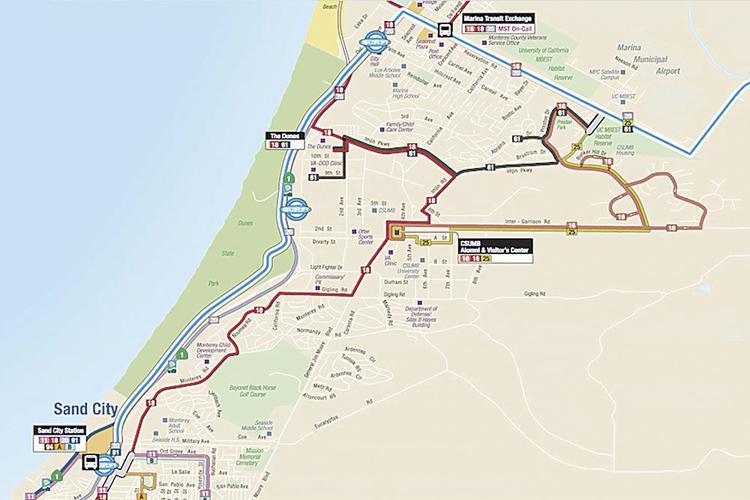
MST’s route network from Marina to Sand City; Line 20, which the SURF! project is designed to serve for a five-mile stretch, is shown in blue. It is one of five total bus rapid transit phases MST is pursuing; the first, the JAZZ line, started service in 2013.
The next month, Keep Fort Ord Wild and the Open Monterey Project filed a lawsuit against MST, arguing that the busway required a full environmental review.
The project stalled for a time, but in February 2022, State Sen. Scott Wiener, D-San Francisco, introduced SB 922, a bill that would exempt transportation projects from CEQA if they advanced the state’s climate, public safety and public health goals.
Gov. Gavin Newsom signed it into law in September 2022, and the lawsuit was dismissed in July 2023.
Meanwhile, MST officials were pushing the project forward, despite Coastal Commission staff continuing to reiterate that the project was “not approvable” under the Coastal Act because of its impact on dune habitat.
In April 2024, following Coastal Commission staff meetings with officials from California Public Utilities Commission’s railroad division and the California Transportation Commission, it appeared there were “fatal problems” associated with the project given that the proposed busway was incompatible with Prop. 116 funds, which TAMC used to purchase the Monterey Branch line – as stipulated by the CTC when it released the funds for the purchase, TAMC had a 10-year deadline to establish rail on the line, or the money was to be refunded to the state.
On June 5, 2024, the TAMC board approved entering into “curative” negotiation with the CTC to pay the agency back, which would also free up the rail easement to be used for a busway.
Just two days prior, on June 3, Coastal Commission staff met with MST staff, and according to a Coastal Commission report, “reiterated both strong support for the project objectives and strong admonition that it was difficult to see an approval path here,” adding: “MST’s evaluation of potential alternatives seemed to be flawed as they had funding only for their specifically proposed project, and not funding for any other project that might be able to meet project objectives.”
Yet as they had for the past five years, MST staff kept the project rolling, trying to get the Coastal Commission’s approval – and all the requisite permits – before a change in the White House come January 2025.
That meant bringing the matter before the California Coastal Commission.
ON FRIDAY, JULY 26, Coastal Commission staff published a blistering report regarding Monterey-Salinas Transit’s proposed SURF! busway from Marina to Sand City, saying the project was not approvable under the Coastal Act, due to environmental concerns.
“While staff believes that [MST] should have opted to not pursue this project as soon as they were informed by staff over five years ago that it was unapprovable, staff also notes that this is a classic symptom of the way transportation project funding in California often works, where funding tends to be allocated for projects well in advance of serious environmental analysis and entitlement processes,” the staff’s report to commissioners stated.
The report landed with impact, and the next morning, a Saturday, State Sen. John Laird, D-Santa Cruz, called Sedoryk to convene a meeting with Coastal Commission staff, along with TAMC, to try to hash out some sort of compromise.
A compromise was found: Instead of building the busway adjacent to the rail tracks – sometimes east, sometimes west – Sedoryk agreed to redesign the project on the fly by paving over the rail tracks, per the Coastal Commission’s request, to preserve more dune habitat. That change required approval from TAMC’s board, which unanimously approved it when promised SURF! wouldn’t preclude future rail projects on the easement.
With that major realignment in the works, Coastal Commission staff did a 180, or maybe more like a 120-degree turn, and came back with a new report in August that recommended the commissioners approve the project.
“This is at least partially because the applicant indicates they have obtained some $92 million in funding for this project,” the Aug. 30 report states, “where most, if not all, can only be used for this particular proposed project, and not for an alternative project.”
The momentum was real – like a wave, if you will – and on Sept. 12, when the Coastal Commission convened at the Portola Hotel in Monterey, it seemed going in like an approval was fait accompli.
Laird, among others, spoke in support of the project, and several SURF! supporters, some of whom are MST employees, sported white T-shirts MST staffers were giving out in the lobby that read, “I [heart] SURF!”
The Commission approved the project with a slew of conditions, with only one dissenting vote, from Dayna Bochco, who bristled at the price tag, among other things.
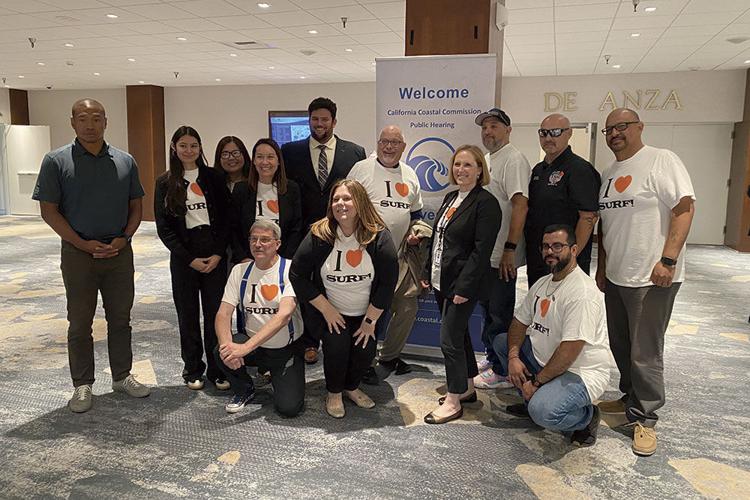
After the vote, MST staff huddled for a picture in the lobby with their T-shirts on, celebrating a hard-won achievement.
During a late afternoon break after the vote, several Coastal Commission staff members gathered on the patio at Peter B’s Brewpub, just outside of the meeting room.
They exuded a palpable relief for having put the project behind them.
Dan Carl, the commission’s director of the Central Coast District, said that while his agency might get sued over the approval, that was nothing new – the Coastal Commission gets sued all the time.
But he added that his staff repeatedly told MST they might get sued too.
That has not yet happened.
But it might.
ON A SUNNY SATURDAY AFTERNOON ON NOV. 2, riding a bike north from Sand City to Marina, there are just a handful of people – some walking, some riding – on the Rec Trail east of the railroad tracks.
But the Rec Trail is not the name the Coastal Commission has for it – it’s the California Coastal Trail – except that it’s east of the rail tracks, with a chainlink fence in between the two, and Highway 1 to the east.
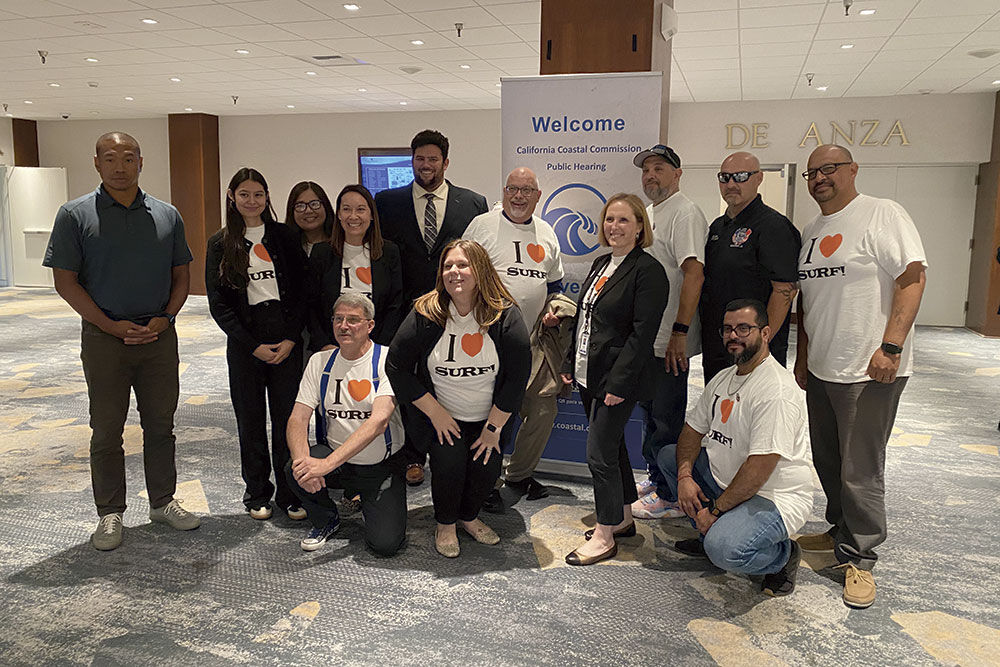
MST staff pose for a celebratory picture after the Coastal Commission approved the SURF! project at a meeting in Monterey on Sept. 12.
If one were to read a glossy brochure, perhaps advertising real estate, one might get the idea that the trail offers some sort of escape into nature. But that’s not the vibe – the highway is just yards away, and the din of traffic drowns out any birdsong, and dispels the notion of escape.
The dune habitat is largely iceplant, an invasive succulent from South Africa brought to California a century ago to help stabilize soil along railroad tracks.
In Marina, at the Handcar Tours headquarters west of Del Monte Boulevard and Palm Avenue on the railroad tracks, a dozen-plus people depart southbound on pedal-powered cars along the tracks.
Handcar Tours had a lease with TAMC to use the tracks until Oct. 31, but TAMC declined to renew it with the SURF! project on the horizon. But for now Todd Clark, the owner of the company, is still keeping business going as usual – there are certainly no trains on the tracks. As he drives a motorized car down the tracks to give a lay of the land (and the rail), Clark laments that the tracks are going to be paved over for a busway.
At various places, he points out the condition of the rail, noting that in one section – in Fort Ord Dunes State Park – the track was built in the 1960s but appears nearly as good as new, capable of carrying a train.
He also notes the undulation of the rail line as it carries south down the dunes – it was graded in 1874, and not intended to move trains at high speeds. “It’s like a rollercoaster,” he says.
That said, he still believes the line is a unique gem that should be not just preserved, but put to use. Perhaps before there’s enough demand for an inter-city train that could connect Sand City to Castroville, which would allow passengers to then travel to the Bay Area, Clark thinks there’s a market for a tourist train; maybe on weekends it could be used for actual travel.
But those are all just dreams. Clark is the one who called out TAMC for not fulfilling its Prop. 116 obligations to build rail within 10 years – the penalty calls for refunding the money – and as a result, TAMC is currently assessing the value of the rail line and is in active negotiations with the California Transportation Commission as to how to pay it back.
Muck, TAMC’s executive director, says the cost of other rail projects the agency is working on, like connecting passenger rail to Salinas, could potentially be credited to offset TAMC’s debt to the state.
If, say, TAMC were to do a project, also funded in part by the state, could the total cost of the project be applied to offset TAMC’s debt to the state? Muck says that’s still being negotiated.
He also adds that Clark’s belief the track can be restored for use of trains again without a huge investment is unfounded.
MST Deputy CEO Lisa Rheinheimer, who is the project manager for SURF!, concurs with Muck’s assessment. She says that restoring the railway would cost about $150 million per mile, as it essentially would need to be rebuilt.
But at this point, the question appears moot, because it’s been years since there’s been a concerted effort to bring rail back on the line, as the price tag never penciled out. And now that MST got its coveted permit from the Coastal Commission, it’s full steam ahead with a road.
To that end, MST has hustled to secure every other needed permit – permits of a more ministerial nature from Marina, Sand City and PG&E, etc. – before the change of the presidential administration, so as to not imperil the $35 million the FTA has promised to help build it.
That was true even before Election Day regardless of who won, Sedoryk says, but on Thursday, Nov. 7, he says MST’s FTA contacts reached out to say that MST had to get all their permits submitted by Friday, Nov. 15. That meant just five business days to tie up all the loose ends with permits.
So MST, with help from Sand City and Marina’s staff and contractors, got it done. Now all that is left for the agency is to submit the final design plans, as the project had to be redesigned on-the-fly per the Coastal Commission’s approval.
Sedoryk is confident those plans will be submitted within a week. After that, they’ll be subject to review from FTA and Coastal Commission officials, and Sedoryk adds that those agencies have been apprised of the high-priority nature of the project.
He’s “100-percent” confident they’ll be met with approval. “I’ve got to be,” Sedoryk says. “I’m not going to anticipate failure.”
Everything has to get inked by Jan. 14, he says, for the funds to get secured.
Whether litigation can potentially derail SURF! remains an open question, but Sedoryk says that a lawsuit wouldn’t impact funding already promised.
So the race – if one uses that term for something moving along for 20 years – is on to get the money locked in.
IF THE SURF! PROJECT IS EVER BUILT, it will take years to assess its impact.
There’s a need to move people efficiently to their jobs on the Monterey Peninsula, but the bus is just one line. If one works in Carmel or Pacific Grove but lives in Salinas, how many bus connections would you have to make to get to work? How much wait time?
And how much money is it worth to tackle that problem?
On the one hand, there is a public agency that’s secured more than $90 million to build it and has pushed it ahead at every turn to get it over the finish line. The bureaucratic momentum behind SURF! has been real, despite no hard data on how many people will ultimately use it – that’s not knowable.
And on the other hand, you have a local transportation network that’s not built to manage the traffic of the present, as thousands of cars commuting to the Monterey Peninsula every day clog up local roads. The hope SURF! offers is that it will be a pressure-release valve that will mitigate that congestion.
“We believe when people see the buses actually passing them when they’re on the highways heading south in the mornings and heading north in the afternoons, more people will try parking their cars and riding MST instead,” Sedoryk says.
MST’s data, from 2022, for riders on the section of Line 20 impacted by the project comes out to about 190,000 passenger trips.
Looking 20 years ahead, MST’s projections for ridership on the line – in the event SURF! is not built – are estimated to be 1.32 million trips in 2045. If the project does get built, that number jumps to 1.7 million annual trips.
The delta between those two projections is 380,000 annual trips, meaning that’s how many more drivers – divided by half, if you count the return trip – that MST expects SURF! to take off Highway 1 each year when 2045 rolls around. That’s about 500 cars per day.
But the rub is that most commuters who own cars and are confident they can find parking will likely continue driving if they feel it’s faster or more convenient.
So the true value of the project – if it ever gets built – won’t be known until traffic conditions worsen, as they are expected to in the coming decades. The project’s evangelists, who tout the greenhouse gas emission reductions it will facilitate, elide the fact that most people aren’t going to ride the bus unless they have to.
It’s not clear we can pave our way out of that conundrum. At the same time, even rail enthusiasts aren’t claiming trains would mitigate the commute traffic.
The Del Monte, the train that connected the Monterey Peninsula with San Francisco for nearly a century, had its last run April 30, 1971.
A Monterey Peninsula Herald story from that day begins, “In keeping with grand tradition, Southern Pacific’s Del Monte Limited arrived 30 minutes late today on what may have been the last northbound run from Monterey.”
For locals who dream of restoring rail on the Monterey Branch line, especially now that the plan is to pave over the tracks, the wait will be a lot longer than that.
(9) comments
And now Todd Clark of The Museum of Handcar Technology has filed a lawsuit against TAMC and the City of Marina. (https://tinyurl.com/mr3h53h8).
See also: https://handcar.com/retaliation/
Among other things, it seeks (a) a ruling that says it's against the rules for TAMC to use funds for SURF if it involves removing rail infrastructure, and (b) a ruling that says TAMC can't be involved in projects that don't improve rail infrastructure, based on a specific California law.
The lawsuit can be found here: https://tinyurl.com/3k2hd288
As of November 25th, the SURF project now costs $105,214,943. (https://tinyurl.com/48cb9nnp)
In that same document, it is clarified that the project is entitled only to $22,179,621 in Federal Transportation Authority Capital Investment Grant funding (if it gets approved). This is the original amount that MST had requested back in 2022.
That has now created a $22.5M funding shortfall for SURF given its new price tag of $105.2M. MST is thus now asking TAMC to bail out the project with money from SB125.
In other news, the California Transportation Commission has finally determined that TAMC owes the state $16,765,000 in Prop 116 credits for the Monterey Branch Line given that they want to use 6 miles of the 16-mile track for the SURF project. (https://tinyurl.com/3mx57auu)
That puts the total effective cost of the project to $121,979,943.
This article has been up only since November 21st and it already merits an update.
The most pressing issue and only immediate "justification" for Line 20 right now is that it is failing its on-time performance (OTP) by 6-10 minutes.
That could easily be solved by (a) adjusting the schedules to reflect the reality of current traffic and (b) possibly adding 1-2 buses during peak southbound weekday commute hours. MST apparently doesn’t want to do that.
As shown by your reporting, the ridership of Line 20 during those commute hours is low. Obviously, CURRENT ridership is a poor justification for SURF and adding 1-2 buses would only mean an even lower number of fares per bus despite improved OTP.
MST claims that FUTURE ridership will balloon and has used POST-PANDEMIC county-wide ridership growth trends in their “statistical packet” to imply that upward growth (Page 12 of https://tinyurl.com/2uyau39p). This was their own data that they had submitted to the American Public Transportation Association (APTA).
But PRE-PANDEMIC county-wide ridership data that MST also submitted to the APTA since the year 2000 up to 2019 clearly shows a DECLINE in ridership of 6.8% DESPITE a population growth of 6.4% for that same period. Charts and the data, with links to the quarterly APTA reports, can be found at this online spreadsheet (https://tinyurl.com/japu5jh5).
What's even worse is that POST-PANDEMIC ridership is still far below the last recorded levels of the PRE-PANDEMIC period. Ridership has NOT RECOVERED.
As you yourself reported, even MST CEO Carl doesn’t seem to have any hard data of how many people will actually ride SURF (https://tinyurl.com/2hxnxjxe). He only thinks, hopes, or prays that “If you build it, they will come.”
So for a project that MST claims will cost $93M, which obviously lacks hard data to justify its need, Sedoryk wants to pave and negatively impact 100 acres of environmentally-sensitive habitat in the dunes. Sadly, the Coastal Commission gave him a conditional green light to do that.
That $93M cost still ignores (at the very least) (a) the MINIMUM of $15M that the Transportation Authority of Monterey County (TAMC) will need to reimburse the state of California to pay back the current value of Prop 116 funds for the Monterey Branch Line and (b) the cost that TAMC will need to incur to rip-out the tracks for SURF to be built.
It’s an unjustified, speculative, and wasteful project.
MST and TAMC could probably serve commuters better if they redirected the funds for SURF towards adding a combined high-occupancy vehicle (HOV) lane and toll-lane to Hwy 1. During weekday peak commute hours, the HOV would be used by carpoolers and buses. At off-peak hours and on weekends, it would reduce the back-ups caused by tourists heading down to Monterey.
Good article summarizing the history of the SURF project, however a little fact checking would show that MST's Lisa Rheinheimer's self serving statement that rail restoration would be "..about $150 million per mile" is incorrect. TAMC's own very generous 2020 estimate was $10.6 million per mile for the 21 mile Monterey Branch Line and as Tina Walsh pointed out, this was budgeting for complete rail replacement. In fact the rails and track ballast are in excellent shape for the most part. TAMC has a detailed plan for improving Monterey county transportation using rail, the "Monterey Bay Area Rail Network Integration Study" and I do not see how paving over or removing the section of the Monterey Branch Line in any way furthers this plan. There are currently under construction and planned major increases in housing density in Marina and up the Salinas Valley, assuring that road congestion is only going to become much worse. The only transportation alternative to rail is to build more lanes on the existing roads. The planned destruction of the Monterey Branch Line rail by SURF is an accident of poor transportation implementation. There must be a better way to accommodate SURF.
There are two rec trails through the Fort Ord Dunes, the one referenced in the article as being lightly used is the one east of the train tracks separated from the highway by a chain link fence and was built by Caltrans when they reconfigured the highway in the 1970’s.
The other is the Beach Range Road Multi Use Trail which is part of the California Coastal Trail system and is listed as a recreational destination on TrailLink.com and elsewhere around the web. This trail more accurately fits what the Coastal Commission described as an escape into nature and is heavily used as such, at least it is on the Marina end.
In the article’s cover graphic how do bicyclists using the Beach Range Road trail exit to use the bike path going under the tunnel into the former Fort Ord/Marina? How does this bus road fit in with the coming State Parks recreational vehicle campground flow of traffic and the views from Highway One?
TRAC Train Riders Association of California, is an organization seeking to re-establish rail service on out-of-service tracks of our state. TRAC were sponsors of the original CA Prop 116 legislation; the source of funding used by TAMC to purchase the tracks now proposed to be a bus lane.
TRAC has advocated for improving passenger rail in California for four decades and is involved in several efforts around the state to restore rail lines to service including in Mendocino County and Santa Cruz (see https://calrailnews.org/trac-releases santa-cruz-rail-study/).
TRAC advocates restoring the line as railroads would do, to safe operation for the class of service needed, using the existing tracks, instead of basing restoration estimates on a standard public agency approach which is to rebuild the entire rail line. The standard approach, on which TAMC seems to rely, is so expensive that it makes the restoration of service appear infeasible.
Even though TRAC presented testimony to the Marina City Council in April 2024 and a Low-Cost Rail Option Consistent with Prop. 116 instead of Marina-Seaside/Sand City Busway was presented to the TAMC executive committee in June 2024, their message has not been made available to the interested public.
I found out by reading through public correspondence submitted to the Coastal Commission for their first hearing in Aug. 2024.
The Surf bus road project serves too little for too large a price and is not a good example of responsible government spending.
I appreciate the effort that went into article. Mr. Schmalz caught part of the picture by riding the bus. Why is this road being built through sensitive habitat when only 13 people are on the bus during rush hour and at best traffic delays the bus by 10 minutes? The real story here is real estate development. Within 1/2 mile of each of the three bus stops developers will enjoy unlimited housing density, parking requirements eliminated, and building height restrictions are extinguished. Local cities like Marina and Sand City will have no say over development.
Last week I received an email on November 15th from the Federal Transit Administration letting me know the project has not met the requirements for funding. The agency does not know if the project will be recommended for funding next year. The funding opportunity will lapse altogether on October 1, 2026. We also forwarded them information that the project is not yet compliant with Proposition 116, also known as the Clean Air and Transportation Act, something they did not seem to have been apprised of.
Our opposition at the Museum of Handcar Technology has led to the ouster of our handcar tour business in Marina. As we learned the political system of Monterey County is too powerful for a small family business such as ours to overcome. We’ll be packing up handcars over Thanksgiving weekend, but hopefully our efforts to thwart this terrible project will succeed so our sacrifice wasn’t for nothing.
Excellent article, David. Thank you.
I am sorry that this didn't get published before the election since I would have voted for Trump in that case. This is a typical example of agency incompetence running amok.
MST cannot provide useful service to the Peninsula since it designs its routes like a three-year-old drawing a map. Why would anyone take a bus when most buses run hourly?
The only useful bus service was when the Army paid MST to provide transportation to students and faculty to and from the Presidio. Those buses were always full, and traffic congestion was reduced. However, that service is no longer available.
Welcome to the discussion.
Log In
Keep it Clean. Please avoid obscene, vulgar, lewd, racist or sexually-oriented language.
PLEASE TURN OFF YOUR CAPS LOCK.
Don't Threaten. Threats of harming another person will not be tolerated.
Be Truthful. Don't knowingly lie about anyone or anything.
Be Nice. No racism, sexism or any sort of -ism that is degrading to another person.
Be Proactive. Use the 'Report' link on each comment to let us know of abusive posts.
Share with Us. We'd love to hear eyewitness accounts, the history behind an article.