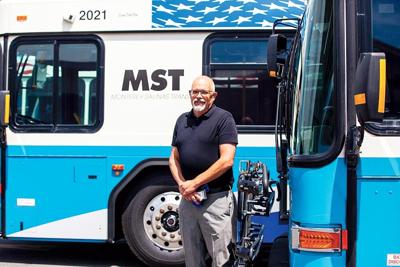

The late Frank Lichtanski was a true public transit devotee. For work, he ran Monterey-Salinas Transit. For leisure, he traveled to Curitiba, Brazil, and Bogotá, Colombia, because those cities were early adopters of a system known as bus rapid transit (BRT), in which buses have their own dedicated lanes, free of traffic, making buses more efficient than cars.
Before he died in 2005, Lichtanski brought the idea to MST. Now, two decades later, his successor, Carl Sedoryk, is getting ready to launch BRT. The transit agency has issued a notice of preparation for an environmental impact report, and at 5pm on Thursday, Aug. 27 will hold a public meeting via Zoom to kick off the process.
The BRT route, called the SURF! Busway, would go between Marina and Sand City. It would run along the old Del Monte line railroad tracks between the Rec Trail and Highway 1 – exactly where Litchtanski envisioned it would go. “He saw this empty, unused rail line as a perfect opportunity to build a lane that would take buses outside of Highway 1 traffic,” Sedoryk says. “We believe when people see the buses actually passing them when they’re on the highways heading south in the mornings and heading north in the afternoons, more people will try parking their cars and riding MST instead.”
The projected cost is roughly $50 million. So far, $15 million from Measure X funds are allocated; the agency would seek state and federal funding to pay for the rest. (MST applied to the State Transportation Agency but was denied, because they weren’t far enough along on planning.)
SURF! is one of five total BRT phases. The first, the JAZZ Line, runs from Sand City to the Monterey Bay Aquarium, and started in 2013. JAZZ was more basic than the proposed project; it included some bus-only signals and curbs that allow passengers to board without a bus driver pulling out of and back into traffic. It saves 15 minutes, and would connect to SURF! Future BRT segments going along Imjin Parkway to Marina and Davis Road to Salinas, across town to the Alisal, and maybe along the shoulder of Highway 101 for north/south travel.
It’s a concept that Mike DeLapa, executive director of LandWatch, supports: There’s the quality-of-life benefit of reduced traffic, and a benefit to the climate crisis. “Any time you can get people off the roads and into mass transit, it’s a good idea,” he says. “There should be one lens through which we look at everything: If it reduces greenhouse gases, it’s good.”
Editor's note: This story has been updated to reflect the following correction. Frank Lichtanski did not retire from his position at MST; he died unexpectedly.

(0) comments
Welcome to the discussion.
Log In
Keep it Clean. Please avoid obscene, vulgar, lewd, racist or sexually-oriented language.
PLEASE TURN OFF YOUR CAPS LOCK.
Don't Threaten. Threats of harming another person will not be tolerated.
Be Truthful. Don't knowingly lie about anyone or anything.
Be Nice. No racism, sexism or any sort of -ism that is degrading to another person.
Be Proactive. Use the 'Report' link on each comment to let us know of abusive posts.
Share with Us. We'd love to hear eyewitness accounts, the history behind an article.