When a green giant takes a big step, it usually makes a little noise. But as locally sown Earthbound Farm, the largest organic grower on the globe, stopped planting produce on its flagship 5-acre Carmel Valley fields, freed its popular farm manager Mark Marino to other pastures and added a powerful, specialized and sophisticated private equity firm as a “partner,” things happened kinda quietly.
First the partnership, which portends the most profound changes. In a succinct announcement on its website, Earthbound says, “we are excited to welcome a new partner, HM Capital Partners, to the journey we’ve been on for 25 years, to bring the benefits of organic food to as many people as possible.”
That was months ago. Either no one else was excited or they didn’t hear. The news appeared only on the principals’ websites and in the consumer pub The Packer. I found one blog that mentions it. No press release aimed at legion EBF consumers was generated.
On its site, HMCP describes itself as a Dallas-based private equity firm that primarily makes investments in the energy, food and media industries, using “a distinctive investment strategy that generates attractive returns.” (Quick private equity firm primer: They are most often brought on board to orchestrate a public stock offering, to allow owners to cash out, or to pursue strategic expansion. More on that in a minute.)
HMCP also prides itself as able to minimize leveraged risk – code for investments made on primarily borrowed money – “by acquiring controlling interests in companies in sectors where HM Capital has a high level of expertise and relationships.” Those companies include everything from wholesale insurance broker Swett & Crawford to natural gas production company BlackBrush Oil & Gas. The key word here, though, is controlling.
The obsessive organic community, including many who will gather at Asilomar Conference Grounds for next week’s landmark 30th Annual EcoFarm, probably won’t be too enthused at the news. Corporate Texas feels a ways from the 2.5-acre valley farm that gave EBF its fertile foothold in ’84.
Myra Goodman, who co-founded EBF with her husband Drew, cites fortuitous mergers with big Salinas farms Mission Ranches in 1995 (when parent company Natural Selection Foods was formed) and Tanimura & Antle in 1999 in explaining the deal, which she feels could ultimately lead to going public, though that’s not the goal. “It’s never something Drew and I have aimed for, but it’s not something we’ve ruled out either,” she says. “We’ve had a history of partnering for growth, to take advantage of opportunities in the marketplace.”
“GARDENING IS A GREAT METAPHOR FOR CONNECTING WITH THE EARTH AND YOUR SOUL.”
Still, those were local ag heavies. This is a different weight class. Goodman says the new direction is pointed toward products beyond fresh produce.
“Everything we sell is highly perishable. It’s a risky business to be in – maybe two days a year supply and demand meet perfectly,” she says. “Not that we won’t focus on produce, because HM believes in the brand, but we will be diversifying our product line.”
“We see tremendous opportunities,” says HM Capital partner Andrew Rosen, “to introduce additional organic products. Moreover, we will seek to acquire other organic food companies.”
Goodman – the woman behind the heirloom raspberry muffins that led to the organic greens that led to revolutionary bagged salads that led to the major partnerships that led to a 25,000-square-foot production facility in San Juan Bautista – also detects a misperception.
“I think people picture one huge monolith, mono-cropping 35,000 organic acres,” she says. “We work with 150 family farms with lots of different sizes.”
She says economies of scale are what make organic an affordable option – “It democratized organic,” she says – and allowed EBF to affect purchasing decisions like requiring the use of recyclable clamshell containers or pushing the bagged baby greens market EBF specializes in to nearly half organic (compared to 10 percent for all produce).
Goodman’s cagey when asked to comment on the size of HMCP’s stake and, since it’s a private deal, she doesn’t have to. (HMCP’s PR rep, Mark Semer of New York City’s Kekst and Company Incorporated, is also mum.) This represents a departure from past mergers, when EBF shared news that decision-making would be distributed evenly among its partners.
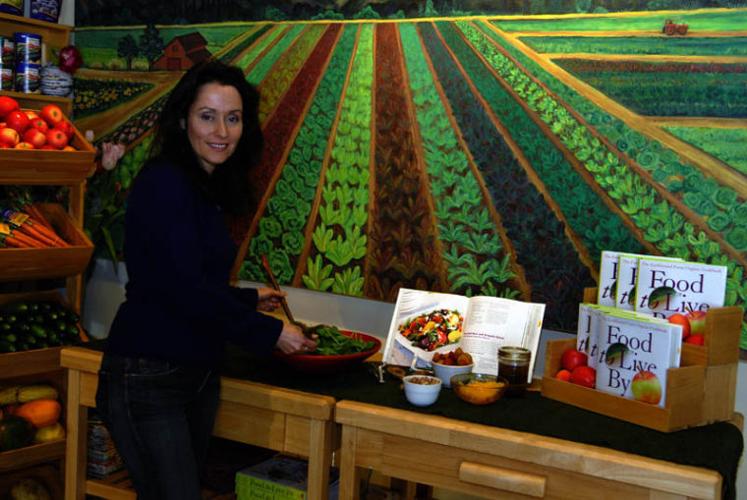
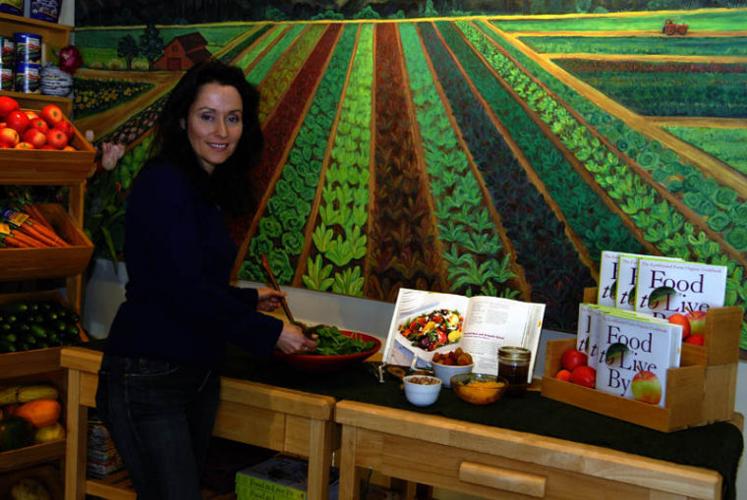
Ironically, a Farm Stand move is taking EBF back toward its infant incarnation at the same time these potentially big-money machinations are in motion. Running a production farm so far from its inland processing and transportation network was increasingly funky for efficiency and finances, so the EBF team is considering cover crops for the acres it leases along Carmel Valley Road – the ultimate use is still unknown, according to EBF spokesperson Samantha Cabaluna – as it focuses on how to re-create the original grounds on the property EBF owns, raspberries included. Picture an enhanced but down-home platform for organic practices in line with EBF’s increasing organic advocacy, which includes Myra’s upcoming über-eco cookbook (her second), a live showcase-museum of sorts on how things like artichokes and fennel grow, which will complement ongoing workshops, gatherings and cooking classes with Sarah LaCasse, who will tend a small kitchen garden for her own recipes. “The farming operation there was redundant,” Goodman says. “Now we can concentrate our educational resources on the property we actually own.”
The shift does mean that the longtime face of EBF, knowledgeable and charismatic Marino, who had cultivated godsent greens with his hands and many minds with his goofy-informative farm tours, is out of a gig. He says he’s filled with gratitude for his time at EBF and how the Goodmans treated “a hillbilly farmer from Missouri.” He’s also digging a chance to get back to the yoga he’s long taught and a county-wide mission consulting on community gardens through CSU Monterey Bay’s service learning program, including the Soledad Street plot that gears up the homeless to harvest job opportunities.
“Gardening is a great metaphor for connecting with the earth and your soul, to give them some kind of positive change,” Marino says. “I’ve got more than 30 years of organic farming experience and I want to share it. Because karma rules.”
The HMCP people might prefer a more profit-centered premise. But karma and soul ultimately grow a lot closer to the soil than the icy skyscraper on the equity group’s homepage.
~ ~ ~
Goodness cometh, including a raft of crab eats and a clambake Bing Crosby would’ve been proud of (www.golfandgrapes.org). More soon… Salinas’ Rotarians are rallying for their 12th Wine & Food Festival Jan. 23-30. Bring on the Boëté, Cambiata, Ludwig, Carmel Road, Manzoni, Miura, Pessagno and Wrath – plus the large and rare bottle auction – for the opening chairman’s invitational at Corral de Tierra Country Club, then the Paraiso wines and Todd Fisher feastables in the vineyard, followed by a winemaker’s dinner with Joyce at Grower’s Pub and a grand tasting at the National Steinbeck Center with 70 chefs, wineries and restaurants wrestling for palate affection. Tix start at $75; www.wineandfoodfestival.org or 775-4728 x220… Keep the rain coming.


(0) comments
Welcome to the discussion.
Log In
Keep it Clean. Please avoid obscene, vulgar, lewd, racist or sexually-oriented language.
PLEASE TURN OFF YOUR CAPS LOCK.
Don't Threaten. Threats of harming another person will not be tolerated.
Be Truthful. Don't knowingly lie about anyone or anything.
Be Nice. No racism, sexism or any sort of -ism that is degrading to another person.
Be Proactive. Use the 'Report' link on each comment to let us know of abusive posts.
Share with Us. We'd love to hear eyewitness accounts, the history behind an article.