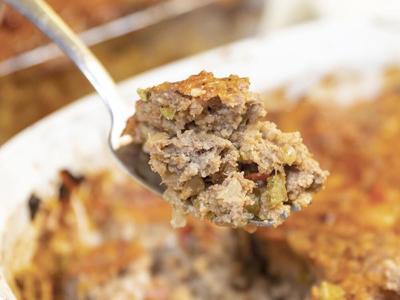

Is meatloaf a “summer” food? Maybe not – but maybe. Is it an anytime-of-the-year comfort food that can warm the soul in these trying times? Most definitely.
Yet unlike fried chicken – another comfort food that has become a sensation among American foodies over the past few years – meatloaf’s reputation has not ascended. Why?
Maybe the name is part of the problem – it’s not exactly enticing. But more likely it’s because meatloaf is a canvas of sorts, and the spectrum of possibilities of what it can become ranges from awful to heavenly, depending on the recipe and who’s painting the brushstrokes.
Frank Bruni and Jennifer Steinhauer, authors of the 2017 cookbook and essay collection A Meatloaf In Every Oven, have a deep understanding for how divine the dish can be, if made right. Its definitive provenance remains a mystery, but they offered up one theory that it emerged in the fifth century in medieval Europe, and evolved to become a dish comprising unused meat and vegetables that, in its finest iterations, “made music more uplifting than anyone could have anticipated.” I could not agree more.
That said, for much of my youth, I did not like meatloaf. That changed sometime in the late ’80s when my mom’s best friend, who had moved to L.A., sent her a newspaper clipping of a meatloaf recipe – via snail mail – from a trendy restaurant in Venice that has now long been shuttered.
It was meatloaf treated with the respect it deserves, and for me, it was love at first bite.
It wasn’t until the pandemic hit in 2020 – likely due to 12 years of vegetarianism – that I asked my mom about the meatloaf, and she directed me to a small wooden box filled with clippings of her favorite recipes. When I opened it, there it was, right in front: a found treasure with her own handwritten notes on it, tweaking it to her liking.
I made it several times in the months I lived with and cooked for my parents, and eventually experimented with plant-based ground beef substitutes – Beyond, Impossible – and was astonished to find that the flavor and texture remained nearly the same.
I made both versions for my colleagues at the Weekly recently, and while all could easily identify which dish contained actual beef – it was the first time I tried them side-by-side – there were mixed responses as to which they preferred.
I’m sharing this recipe because I think it’s extraordinary, and it’s personal to me: This is the dish I think about most when I think of my mom.
Pair it with creamy mashed potatoes and a crispy salad, and it’s a perfect meal. And feel free to experiment with the recipe – it also gets better with the more thought and care you put into it.
That, I think, in many ways gets to the heart of why it’s so good: There is no more important ingredient in food than love, and, I would argue, there is no better dish to deliver it.


(0) comments
Welcome to the discussion.
Log In
Keep it Clean. Please avoid obscene, vulgar, lewd, racist or sexually-oriented language.
PLEASE TURN OFF YOUR CAPS LOCK.
Don't Threaten. Threats of harming another person will not be tolerated.
Be Truthful. Don't knowingly lie about anyone or anything.
Be Nice. No racism, sexism or any sort of -ism that is degrading to another person.
Be Proactive. Use the 'Report' link on each comment to let us know of abusive posts.
Share with Us. We'd love to hear eyewitness accounts, the history behind an article.