
Why do you listen to music? Sara Rubin here, noting there are a lot of ways I can answer that question. There’s music we choose to energize a workout and maybe help us keep pace; there’s lulling music that can help us fall asleep; there’s spiritual music that may be something an entire congregation can sing together. Aesthetic beauty is just one reason among many, but of course listening to music just because we find it beautiful is an excellent reason.
But I’m also thinking about music that moves us in a different way. Through the first piece at a Carmel Bach Festival performance last Saturday, I felt unsettled more than anything. The music moved me, but not in a “this is beautiful” kind of way.
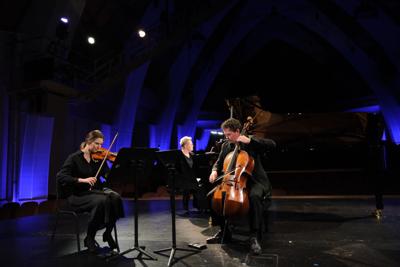
The song was the allegretto from Trio No. 2 in E minor, Op. 67, composed by Dmitri Shostakovich. “It was not written to be enjoyed or to feel good about,” according to cellist Keiran Campbell. The piece was deemed “too dark,” so it was not widely performed despite Shostakovich’s status as a leading Soviet composer. (Stalin exerted pressure that led the composer to change his style.)
It was probably Shostakovich’s musical depiction of horrors of the Holocaust, Campbell told the audience, drawing from Eastern European Jewish themes in a brusque, pizzacato-heavy buildup in intensity that finally ends with a whimper.
That music can do this—convey a feeling about something so dark that a listener generations later understands they should feel uncomfortable—is a remarkable feat of artistry. It’s also the kind of capability that has long brought music into the crosshairs of censors.
The Shostakovich piece was the darkest of a five-part program titled “Banned and Blacklisted,” curated by trumpeter Greg Smith. (There was no J.S. Bach performed in this program but there was Aaron Copland, an American caught up in McCarthyism, and there was Igor Stravinsky’s take on “The Star-Spangled Banner,” so hymnal in style that Stravinsky encountered the Boston police commissioner when arriving at the Boston Symphony for night two of its intended performance in 1944—police had already removed the sheet music from players’ stands.)
“Censorship in music isn’t new—it dates back at least to the Middle Ages—and it seems that every generation revisits the practice in its own way,” Smith wrote in the program notes.
This is part of what the Carmel Bach Festival does best—not just keep music alive but keeping stories and context about music alive, centuries after it was written. In contemporary hands, it takes on fresh meaning and it matters all over again.
The “Banned and Blacklisted” program was unfortunately performed just once, but as the two-week festival nears its end on July 25, there’s still a lot to hear. Of course that includes works by Bach, more by Copland, and contemporary composer Angélica Negrón, among others.
There’s also more straight-up learning available. Interested in what it takes to build a great concert hall? Attend a free lecture at 10am on Friday, July 24 at Sunset Center with acoustician Nicholas Edwards.
Everything from composition to playing instruments to concert hall design to government intervention shapes the way we hear music, whenever it was written.


(0) comments
Welcome to the discussion.
Log In
Keep it Clean. Please avoid obscene, vulgar, lewd, racist or sexually-oriented language.
PLEASE TURN OFF YOUR CAPS LOCK.
Don't Threaten. Threats of harming another person will not be tolerated.
Be Truthful. Don't knowingly lie about anyone or anything.
Be Nice. No racism, sexism or any sort of -ism that is degrading to another person.
Be Proactive. Use the 'Report' link on each comment to let us know of abusive posts.
Share with Us. We'd love to hear eyewitness accounts, the history behind an article.