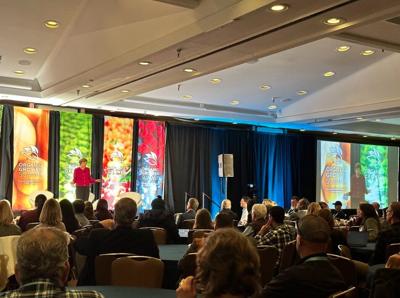

Katie Rodriguez here, thinking about a conversation I had with Kelly Damewood, CEO of the California Certified Organic Farmers (CCOF) at the end of the Organic Growers Summit last week at the Hyatt Regency hotel in Monterey.
We talked about big takeaways from the conference, with a standout being the immense pressure farmers—both conventional and organic, but especially organic—are facing. From persistent, stubborn pests and the volatility of climate change, to challenges in accessing markets amidst fierce global competition, these pressures are compounded by inflation and rising costs for labor and materials.
“Organic is very much now a global market. And so the competition is really heightened,” Damewood says. “I think all the market studies show it is anticipated to increase, but where it's getting sourced from has really changed.”
She adds that there’s also more consolidation, and therefore competition against operations at larger scales.
Yet, consumer demand shows a different story—one that not only supports the growth of organic farming, but also pushes for more. There was a panel titled “Can organics become a $144 billion market?” on the potential of this demand, envisioning a dramatic rise from the current $70 billion in U.S. sales. And consumers are also showing a burgeoning desire for a newer term on the table: regenerative agriculture.
“The growth of this space is insane,” said LaRhea Pepper during a panel, the Board Vice Chair at the Regenerative Organic Alliance, a nonprofit that oversees the “Regenerative Organic Certified” certification.
Regenerative agriculture is a style of farming you may have heard of before, or have noticed popping up at the grocery store. It’s a term that, while it has no widely accepted, formal definition, has already made significant inroads into the marketplace.
Regenerative agriculture refers to a farming approach rooted in indigenous practices that emphasize biodiversity and soil health. It typically includes methods like enhancing soil organic matter, implementing cover cropping, adopting no-till farming, and avoiding the use of synthetic pesticides and fertilizers.
During the conference, it was tough for me to reconcile how organic farmers still struggle to see meaningful profits from their efforts while consumers not only value the organic label, but are demanding even more with regenerative agriculture.
How can regenerative agriculture gain such momentum when organic farming itself still faces so many hurdles?
“A lot of it comes down to just economics and price point. It's time in the organic movement to get creative and think outside the box and start developing markets for organic,” Damewood says.
What the organic space can offer is a nationally recognized and enforceable standard that has been around for nearly 30 years. While farmers do face significant challenges, the industry continues to grow. With regenerative agriculture gaining attention, there may be lessons to draw from the organic movement and where we’re at today.
“[We’re] gonna have to grapple with the fact that people will greenwash and want to co-opt the term,” Damewood says. “But the focus on soil health, and talking about soil health, is incredible. And that did not happen 10 years ago.”
Our conversation, along with insights from some of the panels, provided valuable context as I wrapped up my cover story, “The State of Organics,” which will be available to read this Thursday.


(0) comments
Welcome to the discussion.
Log In
Keep it Clean. Please avoid obscene, vulgar, lewd, racist or sexually-oriented language.
PLEASE TURN OFF YOUR CAPS LOCK.
Don't Threaten. Threats of harming another person will not be tolerated.
Be Truthful. Don't knowingly lie about anyone or anything.
Be Nice. No racism, sexism or any sort of -ism that is degrading to another person.
Be Proactive. Use the 'Report' link on each comment to let us know of abusive posts.
Share with Us. We'd love to hear eyewitness accounts, the history behind an article.