
When was the last time you navigated somewhere without a map?
Sara Rubin here, reluctant to admit it’s been a while—and despite my fondness for old-fashioned things like paper maps and compasses, like so many modern humans, I am tethered to my phone, turning to the little blue dot when I am lost.
Our reliance on wayfinding tools makes the contrast of Polynesian outrigger canoe voyagers all the more extraordinary. Before there were tools like compasses to guide them, a community likely originating in Taiwan began to explore and settle on islands throughout the Pacific Ocean, traveling thousands of miles guided by the stars.
The use of outrigger canoes for travel continued for thousands of years, until colonization arrived in Polynesia. Outrigger canoeing—along with hula dance, native languages and so many other cultural traditions from across the planet, I know you’ve heard this story before—were suppressed or outright banned.
In reporting on local cultural groups honoring Hawaiian culture, I learned that the revival of these traditions is not only about building community, but it is an act of reclaiming what was taken, a continued act of resistance to colonialist efforts to eliminate a culture.
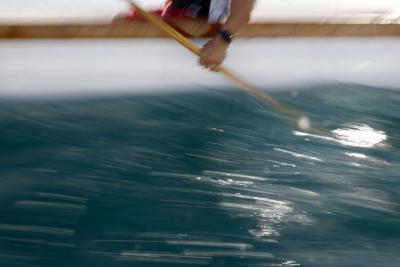
That is a serious and important element of this story, but I and Staff Photographer Daniel Dreifuss also had a lot of fun reporting and photographing this week’s cover story. We each attended a rec paddle, hosted by Hi’ilani ’O Ke Kai Outrigger Canoe Center the first and third Sundays of the month, at Del Monte Beach. (Don’t worry, nobody capsized and Daniel’s cameras survived.)
“It felt like we were out there for the perfect amount of time. It was fun,” he tells me. “It was a gorgeous day, calmish waters—in a way relaxing, in a sense. I felt a calmness.”
I find the water to be calming, yes, but I was also surprised by the athleticism of outrigger paddling—even though you are seated, you are seated high above the water and it’s really a full-body experience.
Beyond the physical dimension though, this tradition—like so many that I learned about through members of Hi’ilani ’O Ke Kai and Nā Haumāna, based in Marina—is about expanding the ohana, or family.
I learned that people of many cultural and ethnic backgrounds participate in both groups, learning and celebrating Pacific Islander traditions. “Our culture is open,” Marleen Bush, a founding member of Hi’ilani ’O Ke Kai, told me. “I was never taught not to share.”
Fortunately for all of us, there are lots of opportunities for sharing. Hi’ilani ’O Ke Kai’s big annual race happened yesterday, but there are continued opportunities to get involved and learn.


(0) comments
Welcome to the discussion.
Log In
Keep it Clean. Please avoid obscene, vulgar, lewd, racist or sexually-oriented language.
PLEASE TURN OFF YOUR CAPS LOCK.
Don't Threaten. Threats of harming another person will not be tolerated.
Be Truthful. Don't knowingly lie about anyone or anything.
Be Nice. No racism, sexism or any sort of -ism that is degrading to another person.
Be Proactive. Use the 'Report' link on each comment to let us know of abusive posts.
Share with Us. We'd love to hear eyewitness accounts, the history behind an article.