
Katie Rodriguez here, thinking about how difficult it can be to translate policy language into what it actually means in terms of community impact.
Take the Monterey County Environmental Justice Element (EJE) as an example. A draft of the plan is now available for public review through Monday, May 11. The EJE is a requirement mandated by California Senate Bill 1000, which went into effect in 2018, requiring county general plans to address degraded environmental conditions that may lead to inequitable outcomes.
What that means: The EJE requires local governments to map out which communities suffer from the highest levels of pollution with the least resources, using this information to adopt policies that reduce the disproportionate health risks, pollution exposure and land-use inequities. Studies have shown that residents in such areas, as a result, are more likely to suffer from a lower quality of life and worsened health outcomes compared to areas that are more affluent.
The challenge is getting input directly from these communities about what they are experiencing—something County officials are now trying to do to better understand the real health risks residents face across the region, especially in rural areas.
“Part of [our] outreach is really trying to distill down how this justice element—in the long term—can and will result in policy change that can and will affect people’s day-to-day lives,” Sarah Wikle, principal planner for the County, said at an informational meeting on Wednesday, April 1.
Once finalized, the element could shape land-use decisions, permitting and funding priorities.
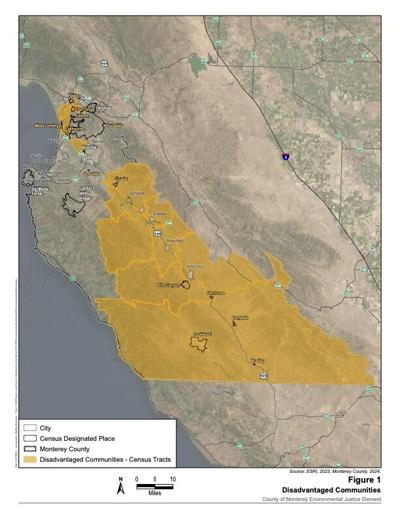
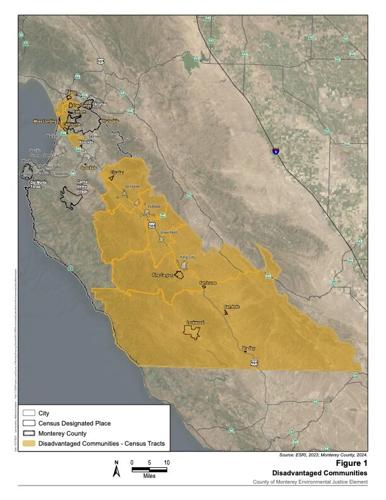
The County has already identified 11 disadvantaged communities, defined as unincorporated areas that are disproportionately burdened by environmental pollution and have characteristics that make these communities more vulnerable to the risks.
To identify these communities, the County evaluated indicators including income, exposure to things like traffic, toxic cleanup sites, in addition to statistics about asthma-related emergency department visits and low birth weight.
The disadvantaged communities include: Boronda, Bradley, Castroville, Chualar, Las Lomas, Lockwood, Moss Landing, Pajaro, Pine Canyon, San Ardo and San Lucas.
In recent years, the County has conducted community surveys and outreach to understand residents’ concerns and inform the current draft. Interestingly, preliminary findings show that 54 percent of respondents said they do not feel safe drinking their tap water. Among Spanish-speaking respondents, that number jumps to over 96 percent.
A central focus of the EJE is access—not only to public resources such as health care, physical activity and recreation, but also to information. One of the most significant barriers identified was difficulty participating in government processes due to language differences, limited internet access and work schedules.
“People who live in these communities are really the experts on their own communities and the challenges they face,” said Edgar Sanchez, county associate planner. “It’s really easy for county staff to look at the community and say these are the issues, but the comments that we hear daylight the ground truths.”
You can take a look at the draft EJE here, and mail in comments to the County directly at generalplanupdates@countyofmonterey.gov.


(0) comments
Welcome to the discussion.
Log In
Keep it Clean. Please avoid obscene, vulgar, lewd, racist or sexually-oriented language.
PLEASE TURN OFF YOUR CAPS LOCK.
Don't Threaten. Threats of harming another person will not be tolerated.
Be Truthful. Don't knowingly lie about anyone or anything.
Be Nice. No racism, sexism or any sort of -ism that is degrading to another person.
Be Proactive. Use the 'Report' link on each comment to let us know of abusive posts.
Share with Us. We'd love to hear eyewitness accounts, the history behind an article.