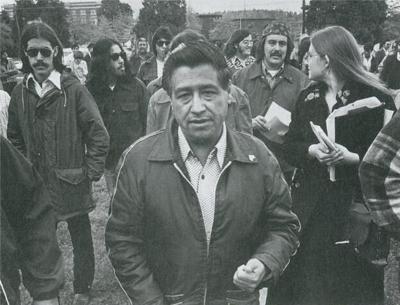

Celia Jiménez here, thinking about what I learned about the farmworker movement in a Chicano Studies class while trying to wrap my head around the sexual abuse allegations against Cesar Chavez, one of its leaders.
I learned about the allegations from a Facebook post by Dolores Huerta, and the first thought that crossed my mind was: Was her page hacked?
It wasn’t.
Huerta, a foundational leader of the farmworker movement who worked with Chavez and others to improve labor standards for farmworkers, bravely came forward and shared the abuse she and others reportedly endured from Chavez.
The news shocked many to the core, and Chavez’s legend fell like a house of cards.
“The farmworker movement was never about one man,” Assembly Speaker Robert Rivas said in remarks on Thursday to the State Assembly. “It was built by thousands—tens of thousands—of workers. People like my grandfather. People who labored in the fields. People who organized, who sacrificed, who stood up when it was hard.”
It generated a wave of statements in support of sexual assault survivors. Cities across the nation canceled celebrations, removed Chavez’s name and statues from schools, parks and streets. California intends to rename Cesar Chavez Day (March 31) to Farmworkers’ Day.
There are some places named after him in Salinas, Soledad and Greenfield, including parks, schools and a library.
Salinas could soon begin renaming the library and park named after Chavez.
Councilmember Andrew Sandoval, who represents District 5 in Salinas, said on March 18 he will request the city rename these facilities. “This decision must reflect our community's values,” Sandoval said.
In a statement the following day, Mayor Dennis Donohue said, “Any conversation around renaming our public spaces should involve the community.”
Another issue at the forefront is the mistreatment of sexual abuse survivors, especially women.
“It fills me with rage to know that even with all this attention on the issue, we still fail to talk about the myriad of systems of power that keep women silent,” County Supervisor Wendy Root Askew shared on social media. “Until we start talking about these realities faced by survivors, nothing will change. Our collective inability to challenge—to even see—the culture that feeds this violence is what will allow this story to be repeated over and over again.”
As a society, we must work together to create a safe space where survivors feel encouraged to report any type of sexual violence. In Monterey County, the rape crisis center helpline is available 24/7 by calling (831) 375-4357.


(0) comments
Welcome to the discussion.
Log In
Keep it Clean. Please avoid obscene, vulgar, lewd, racist or sexually-oriented language.
PLEASE TURN OFF YOUR CAPS LOCK.
Don't Threaten. Threats of harming another person will not be tolerated.
Be Truthful. Don't knowingly lie about anyone or anything.
Be Nice. No racism, sexism or any sort of -ism that is degrading to another person.
Be Proactive. Use the 'Report' link on each comment to let us know of abusive posts.
Share with Us. We'd love to hear eyewitness accounts, the history behind an article.