
Pam Marino here, reflecting on the fact that we—the collective Western culture “we”— don’t talk about dying enough. We may talk about death, but not necessarily about dying, the natural process of how we as mortals transition from this life to whatever may come next.
Last night, Tuesday, May 6, I attended an extraordinary event held at CSU Monterey Bay, a screening of The Last Ecstatic Days, a documentary about the last two weeks of one man’s life in hospice, surrounded by a loving community. It was presented in partnership between the Hospice Giving Foundation and the Shiley Haynes Institute for Palliative Care at CSUMB.
It was extraordinary for a few reasons. One, the film itself is extraordinary, an up-close look at not just Ethan Sisser’s process of dying, but how it was a natural extension of his life. It was Sisser’s wish to have his journey chronicled so that others could learn from it.
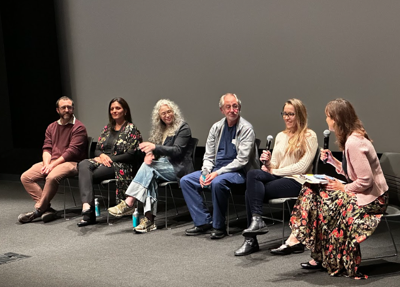
The event was also extraordinary for the thoughtful discussion that took place after the screening, a chance to talk about death and dying that we don’t often get to have in an open community setting.
A panel of experts, moderated by chair of the CSUMB Department of Nursing and faculty director CSU Shiley Haynes Institute for Palliative Care, Alyssa Erikson, were on hand, including the film’s director, Scott Kirschenbaum, and one of the main subjects, Sisser’s doctor and death doula, Dr. Aditi Sethi, who after the experience with Sisser founded the Center for Conscious Living and Dying.
Local experts on the panel included Dr. John Hausdorff, an oncologist, palliative care physician and director of Hospice of the Central Coast. He is also one of the founders of the nonprofit hospice Jerry’s Place in Seaside, where those who are dying with no home or adequate support can be cared for.
At one point Erickson asked Hausdorff the basic question of how do we normalize talking about end-of-life? He said the film was one way to help people understand, ease some of the stigma and get conversations going.
“We want to reach out to the community, we want to get beyond those of us who are already there,” Hausdorff said.
“It really is about normalizing something that is as normal as giving birth, yet bizarrely America, and really the West, has demonized, and it’s a terrible mistake,” Hausdorff said. “It’s our job to get this back into where it belongs, which is part of life.”
Panelists talked about the importance of having conversations with family about our own wishes of what we want our last days to look like and even write them down. Like Sisser, we need to not be filled with fear about contemplating our deaths but be intentional about what our final days could look like. It’s ultimately a gift not just for us, but for our family and friends who otherwise would be left in the dark about what decisions to make on our behalf.
If you want to see the film, you’re in luck: Kirschenbaum tells me that it will soon be on a few different platforms like Apple+, Amazon Prime and PBS. I highly recommend it. Maybe you could even invite loved ones to watch with you and get the conversation going.


(0) comments
Welcome to the discussion.
Log In
Keep it Clean. Please avoid obscene, vulgar, lewd, racist or sexually-oriented language.
PLEASE TURN OFF YOUR CAPS LOCK.
Don't Threaten. Threats of harming another person will not be tolerated.
Be Truthful. Don't knowingly lie about anyone or anything.
Be Nice. No racism, sexism or any sort of -ism that is degrading to another person.
Be Proactive. Use the 'Report' link on each comment to let us know of abusive posts.
Share with Us. We'd love to hear eyewitness accounts, the history behind an article.