
Whenever it gets hot and that crispy kind of dry, an alertness ripples across neighborhood group chats—usually on Facebook—as folks look for possible signals of fire. I saw one Carmel Valley thread where neighbors wondered if they spotted smoke or heard one too many sirens, turning to the internet to check with others who might have a better view.
Katie Rodriguez here, thinking what many of us are thinking when temperatures rise: how prepared are we for the next fire? This can be answered in two parts—individual and county-level.
While I can’t speak to your personal preparedness, I connected with Cal Fire and County of Monterey officials today, March 19 to get a sense of the momentum around regional fuel reduction projects.
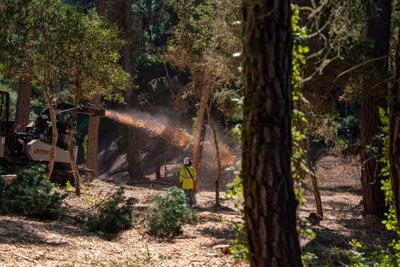
Several are underway across the county. Today, I visited one at Jacks Peak Park, located in the forested area between Carmel Valley and Monterey. The project began Jan. 20 and has about four weeks left.
Jacks Peak Park, if you haven’t been, is a gorgeous day-use county park, with 8.5 miles of hiking trails and now, after some thinning, new views of the ocean.
Looking at the difference between the maintained forest and what it was before, it was clear the project was a significant undertaking. The forest was overgrown and running wild with shrubs and detritus and dead trees, what’s called “ladder fuels”—the wild stuff at the base of the trees that feeds wildfires. More than 500,000 pounds of material have been removed, and nearly 24 acres have been treated.
And surrounding this landscape is a patchwork of subdivisions: Fisherman’s Flats, Monterra, Pacific Meadows and Del Mesa. This project aims to significantly slow the spread of a wildfire between these areas.
“We realized access for any type of fire here was going to be very challenging,” says Greg Leonard, a Cal Fire captain and fuels management specialist. “With all these subdivisions around, this was a very important fuel break to get done. If there’s a fire on either side, crews can access it from here.”
I watched as a number of machines ran through the forested area. A masticator mowed the shrubs in between the trees. A remote-controlled chipper—manned by a person standing 20 feet away—turned wood into wood chips. A flat bed truck will retrieve larger logs and haul them to an “air curtain burner” in Pebble Beach, which reduces wood to ash with minimal smoke.
The project costs about $7,000 per day, with a total nearing $500,000, funded by the Cypress Fire Protection District. Crews cover roughly three-quarters of an acre daily—slower than the average 2-3 acres per day due to the forest’s density.
“It’s a higher cost per acre than we’ve ever seen, there’s just so much to do,” Leonard says. “But doing it right the first time means maintenance will take about a third of the time and cost.”
Many other projects are underway across the county. Officials pointed to work along Corona Road in the Carmel Highlands and a large effort in the Williams Hill area. Time will tell how much these projects influence the next fire—each shaped by its own conditions—but better-maintained land means better preparation.
“I think we’ve learned a lot since the River Fire,” says Bryan Flores, Chief of County Parks. “We’re trying to be proactive.”


(0) comments
Welcome to the discussion.
Log In
Keep it Clean. Please avoid obscene, vulgar, lewd, racist or sexually-oriented language.
PLEASE TURN OFF YOUR CAPS LOCK.
Don't Threaten. Threats of harming another person will not be tolerated.
Be Truthful. Don't knowingly lie about anyone or anything.
Be Nice. No racism, sexism or any sort of -ism that is degrading to another person.
Be Proactive. Use the 'Report' link on each comment to let us know of abusive posts.
Share with Us. We'd love to hear eyewitness accounts, the history behind an article.