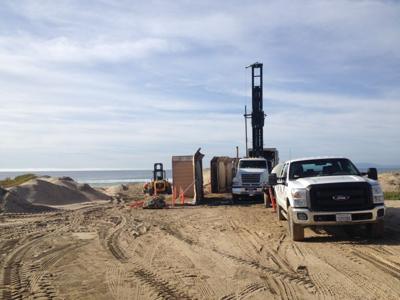

Thirteen holes in the ground, 160 pages of textbook-like reporting on what was in them, and there's still nothing conclusive on exactly whose water it is sitting under the sand where California American Water wants to build slant wells to suck up seawater for its proposed desalination plant.
But the initial tech memo released July 8 is promising for Cal Am.
“We are very encouraged by these findings and look forward to proceeding with the groundwater modeling work and our test well permit application,” Rich Svindland, Cal Am VP of engineering, said in a statement.
Soil and water samples were collected for analysis by hydrogeoloists at possible sites in Moss Landing and the Cemex property in North Marina.
The data is still being crunched to create groundwater models that will play into future environmental studies on Cal Am's proposed desal plant, but initial review delivers good news for Cal Am.
One of the key questions: Is the water Cal Am proposes using for desalination seawater or Salinas River Basin water? The tech memo describes the subsurface soils, and a tell-tale clay layer characteristic of the Salinas Valley aquifer was not present at the Cemex site.
There were also the water samples, which appeared to be ocean water, though seawater intrusion makes it hard to tell.
"[The Cemex site appears to be] directly influenced by the ocean," according to the memo. "This influence decreases inland where the infiltration of precipitation and applied agricultural water provide the greater influence."
The agricultural community, which lays claim to Salinas Valley water, selected two hydrogeologists to participate in the hydrogeologic working group that compiled this tech memo.
The working group was established as a condition of a settlement agreement between 16 parties last year.
Even the good news on the hydrogeology though isn't enough to move the project along. The Marina Planning Commission last week denied Cal Am a permit for a test slant well, which would collect more data about the effectiveness of the proposed project.
It was similarly challenging for Cal Am to get the permits to drill the bore holes. That permit was first denied by the city Planning Commission; Cal Am appealed to City Council which approved the boreholes 3-1 after a lengthy hearing. The borehole results set the stage for the test slant well, which was denied July 10 by the same Planning Commission.


(0) comments
Welcome to the discussion.
Log In
Keep it Clean. Please avoid obscene, vulgar, lewd, racist or sexually-oriented language.
PLEASE TURN OFF YOUR CAPS LOCK.
Don't Threaten. Threats of harming another person will not be tolerated.
Be Truthful. Don't knowingly lie about anyone or anything.
Be Nice. No racism, sexism or any sort of -ism that is degrading to another person.
Be Proactive. Use the 'Report' link on each comment to let us know of abusive posts.
Share with Us. We'd love to hear eyewitness accounts, the history behind an article.