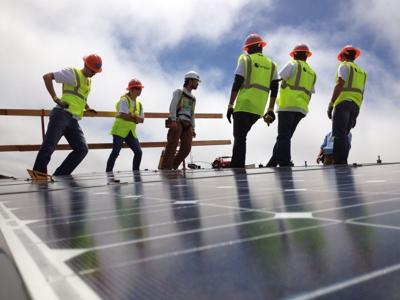
Monterey County recently announced the launch of the CaliforniaFIRST residential PACE (Property Assessed Clean Energy) program, which allows homeowners to finance energy-efficient home improvements through private loans paid off as line items on their property tax bills. The Board of Supervisors heard an update on the program July 29.
Advocates say the program could provide easier access to funding for home efficiency upgrades, particularly solar panels. Regulators, however, remain concerned the lending practices are not strict enough, and that the loans could cause problems for borrowers and mortgage lenders.
Monterey County first approved participation in the program in 2010. But shortly after approval, the Federal Housing Finance Agency (the agency that oversees mortgage securitzers Fannie Mae and Freddie Mac) issued a statement effectively halting the program.
They advised Fannie and Freddie to tighten underwriting requirements and require larger down payments on mortgages issued in communities offering PACE. Additionally, they cautioned, taking out PACE loans could violate the terms of existing mortgages.
FHFA’s logic: Because PACE loans had primary lien status, in the event of a default, borrowers could be required to repay PACE lenders prior to repaying their original mortgage lenders. It was thought that this priority in repayment could simultaneously make the loans risky for mortgage lenders and appealing for PACE lenders who, secure in the knowledge they would be repaid before all other parties, might become lax in their lending standards.
A 2010 Wall Street Journal article quoted a retired FHFA lawyer saying, "It's got all the right economics to take off in a huge way and then cause huge losses."
On the basis of the FHFA’s stance, the California Statewide Communities Development Authority discontinued the program.
In 2011, the FHFA was challenged in court over its decision to advise Fannie and Freddie to implement the stricter standards. The suit argued FHFA was required to conduct a “rulemaking” process to allow public comment before announcing new regulations, and that it had failed to do so. A California district court agreed, and FHFA was instructed to undertake a formal rulemaking process. In May 2013, however, a U.S. Appellate Court reversed the decision, ruling FHFA was justified in stopping PACE.
In an attempt to assuage the FHFA’s worries, Gov. Jerry Brown and the Legislature recently created a reserve fund for PACE programs, which set aside $10 million to repay mortgage lenders in the event of foreclosure. Residential PACE has since restarted in California in hopes Brown’s plan will work.
Homeowners who participate in PACE are required to sign an acknowledgment of the risks, but it remains unclear whether, or how, the FHFA will react. The agency recently stated its position remains unchanged.
The GoGreen Monterey County website advertises CaliforniaFIRST loans with “no down payment,” and the site’s recent update does not mention its risks. The CaliforniaFIRST home page also promises an easy application and fast approval with no money down and no credit score required.
In the end, the FHFA may choose to do nothing and allow the programs to continue. But local borrowers should be aware of the terms, conditions and potential hazards.


(0) comments
Welcome to the discussion.
Log In
Keep it Clean. Please avoid obscene, vulgar, lewd, racist or sexually-oriented language.
PLEASE TURN OFF YOUR CAPS LOCK.
Don't Threaten. Threats of harming another person will not be tolerated.
Be Truthful. Don't knowingly lie about anyone or anything.
Be Nice. No racism, sexism or any sort of -ism that is degrading to another person.
Be Proactive. Use the 'Report' link on each comment to let us know of abusive posts.
Share with Us. We'd love to hear eyewitness accounts, the history behind an article.