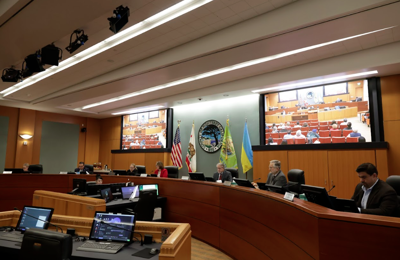

Since 2018, County of Monterey officials have met annually with state and federal representatives to get on the same page about priorities for the community at the local level. It serves as a chance for the county to highlight large projects that present significant funding challenges requiring state and federal dollars, alongside discussion about the state of affairs at the federal level.
Chief among the concerns discussed at the March 6 legislative workshop were the downstream impacts associated with H.R. 1, or the “One Big Beautiful Bill,” concerns over threats to immigrant communities and the uncertainty regarding the war with Iran.
“H.R. 1 will have a devastating effect on health care systems and on all of our residents, because it will affect everybody,” said Supervisor Wendy Root Askew, who sits on the board for the Central California Alliance for Health. “We are anticipating that 28 percent of our members will lose coverage. That’s dollars directly into our health care system that meet the needs of every resident here.”
Health Services Director Elsa Jimenez presented on the critical gaps left by the elimination of two public health programs: the CalFresh Healthy Living Program and the Teen Pregnancy Prevention Program. The bill removes $750,000 in funding used to provide nutrition education and promote physical activity, as well as $500,000 for comprehensive sexual and reproductive health education. Jimenez said some rollover funds will allow the work to continue on a smaller scale into next year.
Roderick Franks, director of Social Services, continued the discussion, outlining changes to eligibility requirements for health care benefits. He also explained they are preparing for changes coming in 2028 related to CalFresh payment error rates. Under H.R. 1, if the state’s CalFresh error rate is more than 10% above the national average, the state must pay up to 15 percent of all CalFresh benefits itself—“that equates to $2 billion annually in benefits,” Franks said.
“We’re working very hard to make sure locally we’re bringing that error rate as low as possible," Franks said. "However, that is a very difficult task considering we are in the process of engaging and implementing many additional requirements that we’ve never had to implement before. Our staff are not trained to do them, and so the possibility of errors in these areas remains quite high.”
Dr. Chad Harris, CEO of Natividad, expressed thanks to U.S. Reps. Zoe Lofgren, D-San Jose, and Jimmy Panetta, D-Carmel Valley, for securing a $14 million extension through September 2027 for the hospital through the Disproportionate Share Hospital program. However, he noted a $7 million annual reduction in funding that will impact the hospital could come as soon as October 2026.
Road, water and climate mitigation projects dominated the remainder of the workshop, including the decades-old problem of securing safe drinking water for San Lucas, repairs and safety modifications to the Nacimiento and San Antonio dams, and updates to Pajaro after receiving $20 million from the state to support communities impacted by the 2023 flood.
“That’ll really make a huge difference,” said Supervisor Glenn Church, thanking Assembly Speaker Robert Rivas and Sen. John Laird for assistance in securing those state funds. “It just shows you that you can really be impactful beyond just infrastructure—providing services and opportunities for people to express what they want and make decisions within their own community.”
There was a hopeful update for San Lucas, a small farming community eight miles south of King City that has suffered from water insecurity for nearly two decades. Randy Ishii, director of the county’s Public Works department, said solutions to secure clean water have been identified, involving a new well and on-site water treatment. The project received a federal earmark of nearly $1 million for this fiscal year, along with an additional $4 million in state funding.
Monterey County also maintains nearly 1,300 miles of roads and 175 bridges, much of which is suffering from deferred maintenance. The cost of that deferred maintenance is north of $1.5 billion, “with a B,” Ishii said, adding that if all county roads were connected end to end they would stretch about a third of the way across the United States. The biggest road project is in Big Sur, totaling $17.2 million for storm-related repairs to Palo Colorado Road.
A new project is on the horizon, which involves the construction of a low-profile wall designed to protect Scenic Road in Carmel. The structure would serve as protection for the road, nearby residents and critical infrastructure. It would also be designed to blend with the natural bluff while protecting against sea level rise, coastal erosion and wave impacts, while stabilizing the bluff and safeguarding sewer and communication lines.
“This is not simply a wall,” Ishii said. “Far from it. It’s a multi-hazard mitigation project whereby the Scenic Road protection structure would not impede the natural flow of the Carmel River out to the ocean.”
The meeting ended on a cautious note, with local, state and federal leaders reinforcing their united efforts to safeguard protections for communities across the county.
“The leadership is not coming from the top down,” Panetta said. “It really is coming from the ground up.”


(0) comments
Welcome to the discussion.
Log In
Keep it Clean. Please avoid obscene, vulgar, lewd, racist or sexually-oriented language.
PLEASE TURN OFF YOUR CAPS LOCK.
Don't Threaten. Threats of harming another person will not be tolerated.
Be Truthful. Don't knowingly lie about anyone or anything.
Be Nice. No racism, sexism or any sort of -ism that is degrading to another person.
Be Proactive. Use the 'Report' link on each comment to let us know of abusive posts.
Share with Us. We'd love to hear eyewitness accounts, the history behind an article.