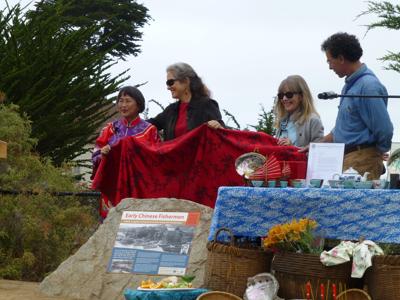

Congressman Sam Farr said this day was “long overdue,” and overdue it was.
Gerry Low-Sabado has been advocating for years to bring recognition to the Chinese fishing village which once existed at Point Alones in Pacific Grove, where Hopkins Marine Station now stands. But for years she felt her efforts were going nowhere.
Things started changing April of 2010, when Low-Sabado and Janet Cohen of the Heritage Society of Pacific Grove met with then-mayor Carmelita Garcia. From that meeting sprung plans for a walk of remembrance better public markers along the Coastal Recreation Trail to commemorate the village. Local libraries, historians and museums also joined the village's cause.
Low-Sabado could hardly be more enthusiastic for unveiling ceremony on Sept. 20, donning a traditional robe and literally pulling people off the street to see it.
Forget San Francisco’s famous Chinatown for a moment—the settlement established in 1853 at Point Alones, near where Hopkins Marine Station sits today, was a major hub of Chinese-American culture, the first settlement of whole Chinese families in the U.S.
They were enterprising fishermen. When competition edged them out during the day, they started fishing at night and established the squid fishing industry. That is, until most of their village burned down under highly suspicious circumstances in 1906, when the Chinese settlers were fighting eviction. The last settlers were edged out, their history buried and almost forgotten even to descendants.
Low-Sabado, a fifth-generation descendent of the Point Alones village, admitted in her speech, “I grew up with the Beach Boys and Beatles, not Chinese history. It’s ironic that I’m presenting this.” Now she points to a green patch of grass sticking out into the blue water, where her family’s house once stood.
Russell Jeung, a fifth-generation descendant, also didn’t know his ancestors lived here until his aunts and uncles dug up Census records and contacted Stanford’s archaeological dig team on the site. For him, finding his roots gives a sense of identity and belonging, and he was proud to bring his young son to see the ceremony.
The unveiling ceremony was a festive celebration, drawing a standing-room-only crowd to a strip of Rec Trail across from the American Tin Cannery. The lion dancers performed on the trail itself, which made a narrow sliver of a stage, but their dance made for an exuberant opener to the ceremony. Afterward, speeches by the Pacific Grove Museum of Natural History staff, P.G. Mayor Bill Kampe, Congressman Farr, Low-Sabado and others stressed how the history of this village reaches far beyond Pacific Grove.
Then came the moment months in the making: the team that created the interpretive panel lifted the red silk off the boulder and revealed the finished plaque. It was a proud moment, and Low-Sabado was beaming and laughing while cameras snapped. Exhibitions curator Annie Holdren, who wrote the text in collaboration with Low-Sabado, put a hand on her shoulder in camaraderie.
To close the ceremony, Low-Sabado performed a tea ceremony utilizing her extensive collection of antique cups. Traditional ceremonies only use three cups, she explained, but this time she was honoring multiple generations, so she used all of them. Candles and incense were lit below the table, and the tea was poured to the ground as a way to honor the land and the ancestors who once owned it. When the special guests had finished paying their respects with the tea, Sabado took a cup and knelt down by the flickering flames and gave the brew back to the earth.
The plaque is colorful, with a balance of imagery and text in both English and Chinese.
Although small, it is eye-catching. As Farr pointed out, more people walk the trail than visit the area’s top attraction, the Monterey Bay Aquarium. With projects like this plaque to bring the village back into public consciousness, Low-Sabado hopes interest will spread, even reaching China, and people will start coming to see the site.
She predicts the city of P.G. and others like it stand to gain both income and respect if they embrace the histories of their minority groups and make a greater effort to tell them. This ceremony stands to be a catalyst for far-reaching change.
“This is very positive,” she says, and already sees it inspiring other heritage projects such as preserving Riverside’s Chinatown.
The next step for Low-Sabado: going to China to seek out her roots there, along with other projects closer to home. The P.G. Museum plans to expand its current exhibit on the fishing village to create a more ambitious and immersive experience in a permanent gallery.
Museum Director Lori Mannel says the current display has the information, but they’re not yet telling the stories of P.G.’s Chinese fishermen. The proposed gallery would incorporate multiple senses, artifacts from the Stanford dig and personal stories of the inhabitants. Currently, the museum is still developing this project and going to apply for a grant, but donations are welcome.
For now, the plaque stands in a prominent position where people will see it and read how the fishermen “settled, struggled, and persevered while raising their families here.”


(0) comments
Welcome to the discussion.
Log In
Keep it Clean. Please avoid obscene, vulgar, lewd, racist or sexually-oriented language.
PLEASE TURN OFF YOUR CAPS LOCK.
Don't Threaten. Threats of harming another person will not be tolerated.
Be Truthful. Don't knowingly lie about anyone or anything.
Be Nice. No racism, sexism or any sort of -ism that is degrading to another person.
Be Proactive. Use the 'Report' link on each comment to let us know of abusive posts.
Share with Us. We'd love to hear eyewitness accounts, the history behind an article.