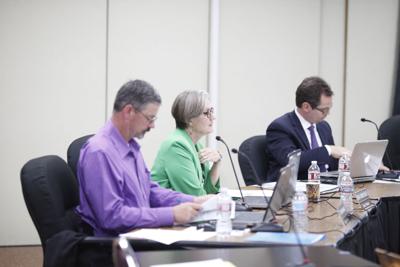

The national debate about whether police presence in schools helps or hinders community relations has been taking place in local school board meetings.
On Aug. 22, it came to the Monterey Peninsula Unified School District. On the agenda: whether MPUSD should renew contracts with local police departments to keep cops on their campuses.
Currently, MPUSD spends $250,000 on police officers, but the board had been mulling over whether to spend the money on other resources, such as therapists or specialists to support kids dealing with family issues.
MPUSD Superintendent PK Diffenbaugh made a brief presentation at the Aug. 22 meeting, showing campus statistics on how many students are served by a family service specialist, counselors, school psychologists, community liaisons, bilingual community liaisons and college and career specialists.
He then broke down what the total costs to the district would be if they hired any of these alternatives. Cost ranged as low as $62,519.57 for a novice family service specialist, to as high as $160,000 for a full-time licensed mental health clinician from Monterey County Behavioral Health.
The MPUSD board had four options: The first option was to renew contracts for the original two-year term, and within that period collect data for analysis and evaluation on the effectiveness of keeping police officers in schools.
The second option was to renew contracts for a single year and to ask cities if they are willing to foot the bill beyond the 2017-18 school year.
The third option would have officially ended the partnership between MPUSD and law enforcement agencies, while asking cities whether they would be willing to fully fund school resource officer programs. The money originally allocated from the discontinued policing program would be redirected for hiring alternatives to campus police, such as counselors and psychologists.
Option four echoed the third: ending the program, but instead of spending the money on new hires, using it to reduce deficit spending.
Board trustees Tom Jennings and Tim Chaney expressed that they were heavily in favor of keeping police on campus. Chaney, who has worked for law enforcement for 27-plus years, said having officers on campus was necessary in the current social and political climate and that he has never once heard of a campus officer mishandling a situation.
“These are not Pollyanna times we’re living in,” Chaney said.
Meanwhile, trustee Debra Gramespacher was completely against having officers on campus, citing a study from The Journal of Criminal Justice that she said swayed her opinion on the matter.
She recalled findings from the study that decreasing a student’s likelihood of going through the so-called “school-to-prison” pipeline had nothing to do with programs with increased positive exposure to law enforcement.
“The number-one teller that sends kids into prisons? Poverty,” Gramespacher said.
Gramespacher spoke in favor of option four—with the addition of using the money in future years to hire for more behavioral health-focused positions.
Trustee Betty Lusk said she wanted to support a multi-tiered system to benefit student well-being, and she thought police departments should be included in that multi-tiered effort.
However, she did acknowledge students' negative experiences with police officers on their own campuses, and said she had doubts that on-campus police could provide the mentorship and guidance students need to stay out of trouble.
Lusk favored option two—but urged for more proactive involvement from school administrators to reroute at-risk students to counselors before police officers.
“[Police] should not be the first line of contact for our kids,” she said.
Community members spoke for more than two hours during the public-comment period. A handful of those comments came from people who spoke in favor of renewing the police contracts.
The overwhelmingly majority of that time was spent listening to public comments from people against renewing the contracts. Many speakers cited the historical use of law enforcement against black people in the United States.
Speakers against school policing included prominent local figures like former Center for Peace and Justice President, NAACP member and National Coalition Building Institute chapter administrator, Steven Goings; former Seaside City Councilmember Helen Rucker; and NAACP lifetime member Ann Todd Jealous.
Jealous shared an emotional story about growing up near the end of the Jim Crow-era South, where newly desegregated black communities were policed by white cops. She recollected how she was never involved in any physical altercations with police, but she was once followed by a uniformed officer as a young girl. The experience, she says, contributes to her anxiety and fear of white uniformed police officers.
“[Uniformed officers on campus] worries me,” Jealous told the board, citing in addition her concern about guns at schools. “If [police] need to come to classrooms, they need to come as human—not in their uniform. Just like the kids know the principal, as human.”
In response, Seaside Police Chief Rob Jackson and Monterey Police Chief Dave Hober tried to address some of the concerns community members voiced.
Jackson ran a year’s worth of statistics recorded at Seaside High School. In total, Seaside High School’s school resource officer made zero arrests and handed out 24 citations. A few of the cited offenses included fighting, marijuana possession and truancy.
Jackson also tried to quell fears of improperly trained police officers, stating that school resource officers get one week of intensive training—a time period that was met with vocal backlash from a few audience members
Hober expressed that hearing the opposing view was a necessary step to improving community and police relations.
“These stories are things [that police] need to hear,” Hober said. “Students need to know that under this uniform, I’m just a normal dude."
In the end, the board voted 5-2, for a combination of option one and two: to renew police contracts for one year, while also collecting a data in order to re-evaluate the issue in the future.
School board members also expressed a desire to sit in on the trainings for school resource officers.


(0) comments
Welcome to the discussion.
Log In
Keep it Clean. Please avoid obscene, vulgar, lewd, racist or sexually-oriented language.
PLEASE TURN OFF YOUR CAPS LOCK.
Don't Threaten. Threats of harming another person will not be tolerated.
Be Truthful. Don't knowingly lie about anyone or anything.
Be Nice. No racism, sexism or any sort of -ism that is degrading to another person.
Be Proactive. Use the 'Report' link on each comment to let us know of abusive posts.
Share with Us. We'd love to hear eyewitness accounts, the history behind an article.