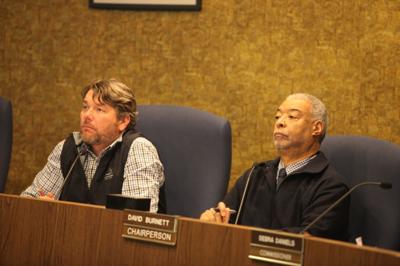
There are no hydrogeologists on the Marina Planning Commission or the staff of the Marina city planning department, a fact that become very apparent at a Wednesday night hearing which focused on the legal and the political far more than science.
The Planning Commission was tasked with interpreting the city's surface mining rules, under which the sand mining company Cemex operates among the dunes in North Marina. The question at hand: Could withdrawing water through a 6-inch-diameter hole be treated as part of a mining operation?
The Marina Planning Commission voted 4-2 to say no, effectively blocking a major step in data-gathering for California American Water's proposed desalination plant.
For context, Cal Am has been busy drilling other holes, on the Cemex property and in Moss Landing. Three other bore holes have already been drilled on the Cemex property, within the city of Marina. Those two holes collected soil samples; the proposed pair 300-foot-deep holes would collect water samples, which contractors would test to see if it’s freshwater or seawater. That’s key information in a water rights dispute with Salinas Valley ag interests as to whether Cal Am’s proposed desal plant would negatively affect the water table in the Salinas Valley groundwater basin.
Here’s what happened leading up to the Marina Planning Commission hearing on Feb. 6: Marina city staff could’ve taken two approaches to letting contractors drill the two bore holes and collect their water samples. One: Apply for a coastal development permit, which the Planning Commission would have to approve, and which could potentially be appealed to the California Coastal Commission. Two: Interpret the city’s mining ordinance, which governs Cemex activities on the property, to include these bore holes and let crews move ahead without a permit.
Staff planning staff and attorney Katherine Jenson, of Costa Mesa-based Rutan & Tucker, went with option two.
Jenson said it was a luxury that city officials even chose to offer public hearings on option two, and they could’ve simply authorized the two bore holes administratively, without a Planning Commission vote.
"We did not want to do it in the stealth of night, we wanted to be transparent," Jenson said.
"Staff could have made this interpretation and never bothered you with it. Perhaps you would've preferred that."
Perhaps yes, because well over a dozen commenters urged the Planning Commission to vote in favor of letting Cal Am and ESA Water proceed with the bore holes, which a drilling crew was prepared to drill on Friday, the day after the hearing.
But the planning commissioners didn’t accept Jenson’s reasoning. She argued the Cemex could go ahead with the bore holes without any permits, thus any contractor of Cemex’s choosing, or an outside entity like Cal Am, could also drill those holes. The crux of the argument: Pulling up water samples from two temporary bore holes is included in the city’s surface mining rules. To prove it, Jenson cited the Webster’s Dictionary definition of “mineral,” and the attorneys and planning commissioners debated whether water is a mineral.
Ultimately, the planning commissioners voted 4-2 against interpreting the definition to include water.
The Monterey Peninsula Regional Water Authority, a joint powers authority comprising each of the six Peninsula city mayors, almost immediately filed an appeal after the Planning Commission vote. Carmel Mayor Jason Burnett scrawled the appeal on a page of yellow legal paper and filed it Feb. 6, just after the meeting.
The Marina City Council is scheduled to hear the appeal in a special meeting on Wed. Feb. 12 at 5:30pm. They'll be the final deciders, as a municipal code interpretation cannot be appealed beyond City Council.
If the City Council accepts the appeal, and Jenson's proposed interpretation of mining—that it does indeed include water—the contractor can move forward with the samples immediately.
If not, they’ll run up against an eight-month delay, due to snowy plover nesting season. The endangered birds begin nesting in March, blocking access of heavy machinery to the site.
Eric Zigas is the project lead for ESA, the consultant preparing the environmental impact report for the California Public Utilities Commission on the desal plant. He says if they lose on Wednesday, they’ll end up with an incomplete EIR for the desal plant.
"It leaves us with an EIR that has the 'best available information,'" Zigas says. "It's disappointing."
That could change if a majority of City Council agrees with Jenson.


(2) comments
I'm betting on the Plover....
This is actually a rather simple issue being compounded, once again, by politics. The culprit here is Cal Am, they could have simply applied for the appropriate permit some time ago and did not. Now they are reduced to trying to re-write the law and forcing Marina to play ball through political coercion and guilt trips.
Let us not forget that it was Cal Am and the County of Monterey (read Lou Calcagno) who dumped Marina Coast when they had a perfectly good water project and a CPCN from the PUC. Now, on property controlled by Marina Coast, with $15M in unpaid bills from Cal Am, Cal Am wants a favor. Payback is a bi...
Welcome to the discussion.
Log In
Keep it Clean. Please avoid obscene, vulgar, lewd, racist or sexually-oriented language.
PLEASE TURN OFF YOUR CAPS LOCK.
Don't Threaten. Threats of harming another person will not be tolerated.
Be Truthful. Don't knowingly lie about anyone or anything.
Be Nice. No racism, sexism or any sort of -ism that is degrading to another person.
Be Proactive. Use the 'Report' link on each comment to let us know of abusive posts.
Share with Us. We'd love to hear eyewitness accounts, the history behind an article.