
According to author and journalist Samuel Freedman, the years 1910-2010 were the lucky era when journalism felt and was broadly consumed as unbiased, a brief and lucky period in human history that seems to be sentenced to miscommunication. “It was a viable industry,” he said. “There was a sense of public trust.” This era will never come back.
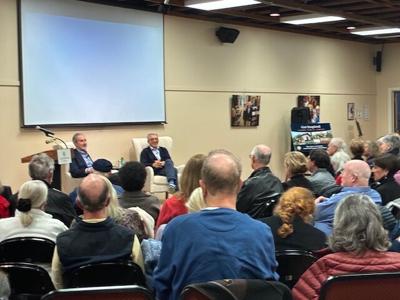
A local live interview with Freedman on the past, the present and the future of journalism attracted over 100 people to Carpenter Hall at Sunset Center in Carmel. The interviewer was Marco della Cava, national reporter for USA Today, hosted by the Carmel Public Library Foundation, responsible for bringing fantastic speakers and authors to Carmel as part of its annual programming.
I decided to attend this particular event because Sam Freedman is a longtime professor at the Columbia University Graduate School of Journalism, from where I graduated in 2018. I remember that we were recommended to read Freedman’s book, Letters to A Young Journalist, at the beginning of the academic year. I remember trying to get into his class, among hundreds of others who were told that he would work with a lucky few to have their first book published. That is Freedman’s specialty at Columbia—taking brilliant student ideas and helping to morph them into ready book projects.
Naturally, I was curious about what he has to say about the current state of journalism. One of the recurring themes in the conversation was the importance of local newspapers and how their steady disappearance has led to an erosion of trust in journalism. Reporters in small towns can go and verify facts in person; they are less likely to be deceived and to deceive the public.
Freedman also mentioned the role that alt-weeklies, led by The Village Voice in the 1950s— Monterey County Weekly is one of them—were responsible for a shift in journalism, admitting to audiences that journalism without an opinion doesn't really exist. “That was exciting,” Freedman recalls. “Don’t pretend you don’t have an opinion.”
Unfortunately, now we “enjoy” extreme subjectivism, or at least that’s how the audiences read today’s journalism. In the digital world, the line between news and so-called opinion pages, carefully divided in a traditional newspaper, disappears. Readers don’t know and can’t tell if they read a news piece and an opinion piece. As a consequence, they don’t know what to think.
Freedman spoke about the difference between truth and the sense of being right. He was asked about the current situation in Minnesota where the local community stands up for the Somali minority, under attack by ICE agents.
The government tries to convince you that “you didn’t see what you saw,” Freedman said about the ICE killing of Renee Nicole Good, a 37-year-old mother of three, that was captured on video. It turns out that even a visual evidence is negotiable in the times where the truth is up for grabs. (This event took place before another fatal ICE shooting in Minneapolis on Saturday, Jan. 24.)
The era of for-profit journalism is over, Freedman announced, even if there are papers, such as the Monterey County Weekly, that simply refuse to stop fighting against the current. He also shared his admiration for young people who still chose a career in journalism in times where intimidating reporters is a norm.


(0) comments
Welcome to the discussion.
Log In
Keep it Clean. Please avoid obscene, vulgar, lewd, racist or sexually-oriented language.
PLEASE TURN OFF YOUR CAPS LOCK.
Don't Threaten. Threats of harming another person will not be tolerated.
Be Truthful. Don't knowingly lie about anyone or anything.
Be Nice. No racism, sexism or any sort of -ism that is degrading to another person.
Be Proactive. Use the 'Report' link on each comment to let us know of abusive posts.
Share with Us. We'd love to hear eyewitness accounts, the history behind an article.