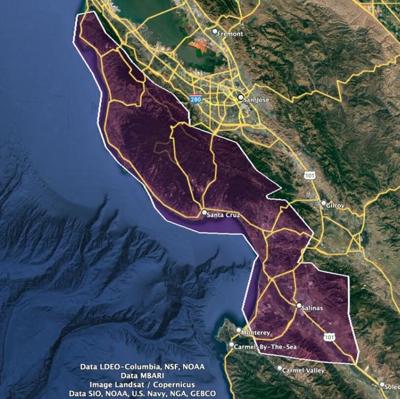

A Santa Cruz-based internet service provider recently received a $5.6 million state grant to bolster broadband services in rural areas of Monterey County and elsewhere.
Cruzio’s Equal Access Summits to the Sea project is the largest of three California Public Utilities Commission grants, totaling a combined $7 million, awarded Feb. 15 to support high-speed internet projects in rural areas across the state.
Cruzio plans to construct a fixed-wireless broadband network that will allow for download and upload speeds of up to 1 gigabit per second to 759 locations in Monterey, Santa Cruz, San Mateo and Santa Clara counties.
“Our region has a problem,” James Hackett, COO at Cruzio, said in a press release. “We’ve got rural communities, farmers, low-income communities out here. Then just a hop away we’ve got Silicon Valley, high-tech and bustling. But getting reliable internet out here? Not so easy with our geography. And that digital divide? It’s real, making life harder for folks. With the Summits to the Sea project, we’re working to level the playing field and give everyone a fair shot.”
The project is expected to be completed in 18 months, according to Cruzio.
In 2022, Cruzio completed a CPUC grant-funded project that provided broadband to more than 250 residents of the San Jerardo farmworker housing cooperative in Salinas.
For Monterey County, Cruzio will install hardware from Pajaro to the Carmel Valley and Gonzales. Big Sur, which notoriously struggles to have reliable internet and cell service due to its remote location, is not covered under the program, according to a map provided by Cruzio.
Before the grant was announced, Rep. Jimmy Panetta, D-Carmel Valley, and the Monterey Bay Economic Partnership organized a Feb. 9 discussion with elected officials, residents, businesses and internet service providers as well as state and federal broadband offices to discuss the expansion of broadband and cellular service in Big Sur.
The group discussed the Bipartisan Infrastructure Investment and Jobs Act, which designates $1.86 billion to California to support projects such as broadband in unserved areas.
“The expansion of reliable, widespread broadband and cellular service is essential to the people of Big Sur and their economy, quality of life and public safety,” Panetta said in a press release. “Last Congress, we made the largest federal investment in history to extend broadband to places that lack service and lower the everyday costs for families. This roundtable made clear that the Big Sur community is united in our efforts to ensure connectivity and ready to take coordinated action to secure the proper amount of investment in our home.”
The Broadband Equity, Access and Deployment (BEAD) Program is currently being implemented by the CPUC, and residents are encouraged to review broadband maps developed by the Federal Communications Commission to target places where infrastructure should be improved. The maps can be viewed at broadbandmap.fcc.gov/home.
Residents can contact Panetta’s office at bit.ly/3uEWYK8 to point out inaccuracies.
“We are a rural community challenged with cell connectivity, internet connectivity and AT&T landlines,” Community Association of Big Sur President Patte Kronlund said in a press release. “All of these need to be figured into the solutions to reach the goal of 100 percent of the households having Broadband for All. The goal of reaching 100% for all households will take local boots-on-the-ground knowledge working with ISP's to design a custom system that will serve the Big Sur area.”
For information about the BEAD Program, visit cpuc.ca.gov/beadprogram.


(0) comments
Welcome to the discussion.
Log In
Keep it Clean. Please avoid obscene, vulgar, lewd, racist or sexually-oriented language.
PLEASE TURN OFF YOUR CAPS LOCK.
Don't Threaten. Threats of harming another person will not be tolerated.
Be Truthful. Don't knowingly lie about anyone or anything.
Be Nice. No racism, sexism or any sort of -ism that is degrading to another person.
Be Proactive. Use the 'Report' link on each comment to let us know of abusive posts.
Share with Us. We'd love to hear eyewitness accounts, the history behind an article.