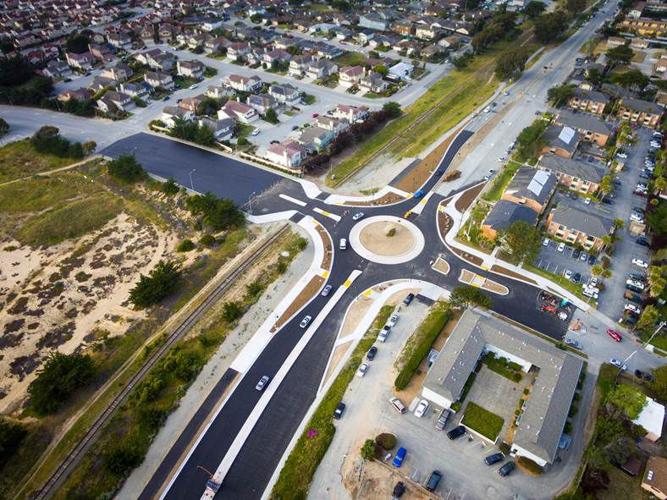

More than any other city in Monterey County, Marina has embraced the roundabout, a traffic-controlling feature that both reduces accidents and greenhouse gas emissions.
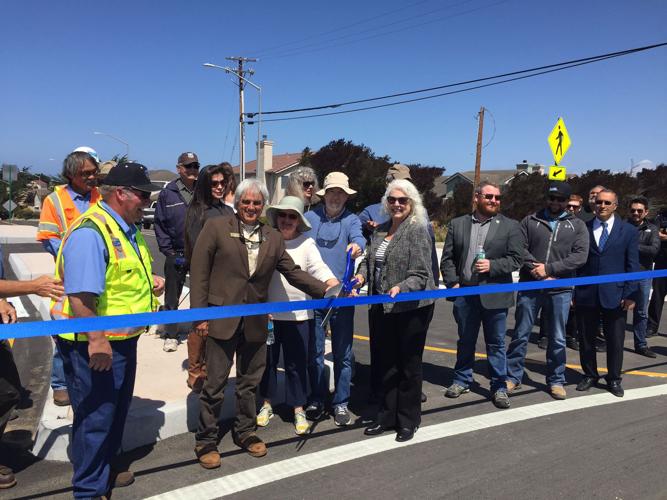
On April 20, two days before Earth Day, the city unveiled it's latest roundabout at Del Monte Blvd. and Beach Road with a ribbon-cutting ceremony led by Mayor Bruce Delgado.
Speaking before a small crowd, Delgado said the intersection, previously, was "arguably one of the most dangerous intersections in town."
Delgado also spoke to concerns some residents voiced at council meetings, where they said roundabouts were more dangerous for pedestrians. Delgado dispelled that notion, and highlights the shorter crossings for pedestrians, which have "islands" halfway through.
"The islands make the crossing so short, you're getting refuge," he said.
He also credited City Manager Layne Long with getting the project off the ground, and highlighted none of the $2.2 million it cost to build the roundabout came from the city's general fund: 60-percent was funded through federal transportation grants, and 40-percent through impact fees.
Delgado also said the roundabout will soon have solar-powered crossing lights—they're on back-order—and added, "A lot of things arounds Marina are happening."
Brian McMinn, Marina's director of public works, highlighted that the landscaping in the center of the feature adds a lot more beautification than an all-concrete intersection, and presented data about the roundabouts many benefits:
- Overall reduction of crashes by 35 percent and injury crashes by 76 percent.
- Lower overall delay than signalized intersections.
- Reduction of vehicle speeds, and with that, potentially safer pedestrian crossing.
- Lower operating and maintenance costs.
McMinn also added the city has two more roundabouts in the pipeline—one at Beach and Reservation roads and the other at Cardoza Avenue and Reservation Road—that are about 60-percent designed.


(7) comments
"Hair-raising?" Complicated? Come on, folks. It's not rocket science. People will figure it out.
I also noticed last week that there's a new roundabout at CSUMB (Inter-Garrison & 8th Ave) which I believe is still on the Marina side of the campus.
People are worried about safety because roundabouts are new to most Americans and not covered in Driver Ed. Driving through the Seaside Auto Mall, where roundabouts were installed 10 years ago ( sorry Bruce, but Seaside did it first for once! ) can be hair-raising. Drivers need educating about who has the right of way etc. and then the benefits will kick in and driving in Marina will be just as easy as Paris or Rome.
https://www.dmv.ca.gov/web/eng_pdf/dl600.pdf page 29.
All the signs and markings for a modern roundabout are standard and have been in existence for more than 20 years.
The first modern roundabouts were constructed in 1990 in Nevada.
Many people confuse other and older styles of circular intersections with modern roundabouts. East coast rotaries, large multi-lane traffic circles (Arc D’Triomphe, Dupont Circle), and small neighborhood traffic circles are not modern roundabouts. If you want to see the difference between a traffic circle, a rotary (UK traffic roundabout) and a modern roundabout (UK continental roundabout), go to
http://www.k-state.edu/roundabouts/photos.htm to see pictures. The Brits even call a merry-go-round a kid’s roundabout.
@Michael
Seaside was actually *really* early to the traffic circle "party." While true that the AutoMall's circles were improved 10 years ago, they were actually first installed more than 40 years ago when the AutoMall was first built. [The very tall lighting pillars at the center of those circles has been in the same place all that time, for example.]
Too bad there hasn't been much cutting-edge planning in Seaside lately!
Hopefully Malin's team will rise to the challenge, but he does seem to indulge the Council's crazy and/or tangential ideas . . . then again, it's probably difficult to educate them and manage at the same time.
It's easier to just raise taxes to "support" their lax public money management efforts.
Roundabouts rule. More efficient, less on-going cost and energy use, far better for the environment and much, much safer than other intersection configurations. Well done, Marina (and Layne).
Modern roundabouts are the safest form of intersection in the world (much more so than comparable signals). Visit the Insurance Institute for Highway Safety for modern roundabout FAQs and safety facts. Modern roundabouts, and the pedestrian refuge islands approaching them, are two of nine proven safety measures identified by the FHWA, http://tinyurl.com/7qvsaem
The FHWA has a video about modern roundabouts on YouTube, or check out the IIHS video (iihs dot org). Links:
IIHS web site: http://www.iihs.org/iihs/topics/t/roundabouts/topicoverview
http://www.iihs.org/iihs/topics/t/roundabouts/qanda
http://priceonomics.com/the-case-for-more-traffic-roundabouts/
http://safety.fhwa.dot.gov/intersection/innovative/roundabouts/
Welcome to the discussion.
Log In
Keep it Clean. Please avoid obscene, vulgar, lewd, racist or sexually-oriented language.
PLEASE TURN OFF YOUR CAPS LOCK.
Don't Threaten. Threats of harming another person will not be tolerated.
Be Truthful. Don't knowingly lie about anyone or anything.
Be Nice. No racism, sexism or any sort of -ism that is degrading to another person.
Be Proactive. Use the 'Report' link on each comment to let us know of abusive posts.
Share with Us. We'd love to hear eyewitness accounts, the history behind an article.