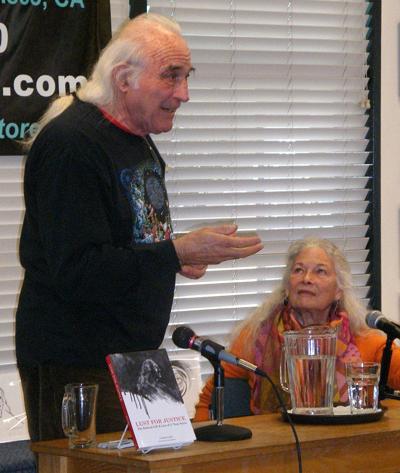


“It’s the madness that keeps me from going crazy,” Tony Serra says from his San Francisco law office.
The 79-year-old has been practicing law for nearly half a century. He’s one of the most renowned criminal defense lawyers in California and beyond. He’s represented the Black Panthers’ Huey Newton (acquitted of murdering a prostitute) and the Hells Angels. Serra’s legendary defense of Hooty Croy, which led to a murder acquittal, was the basis of the 1989 film True Believer. Even with Hollywood’s attention, Serra doesn’t have a dime in the bank—he doesn’t even have a bank account. Wealth has never been important to American Lawyer Magazine’s 1982 “Best Lawyer in America.” Serra took a vow of poverty—he’s lived in the same $420-a-month rent controlled apartment on Telegraph Hill for decades and wears second-hand suits. Low overhead has enabled Serra to work pro-bono, a benefit all his clients receive, even the rich ones.
What are you currently working on?
It’s an assassination case in Modesto [involving] what’s called ‘Sureño gang members stabbing and shooting Norteño gang members.’ The prosecution will categorize it as gang warfare. It’s a gang intervention trial so we’ve been moved to a separate courthouse with the security of eight or nine bailiffs with bulletproof vests and semiautomatic weapons. It’s a display of force. It’s a serious case and [the defendants] are facing life. I believe I have a chance of acquittal, but I’m always optimistic.
Have you ever defended someone you despised?
I don’t believe I have. I do a lot of murder cases where the killing was horrific, brutal and even sadistic, but I have the ability to look for sociological, psychological causation; what were the conditions that created either the madness or the anti-social act? When the mind sees a rational explanation for irrational behavior, that eliminates the moral element and then there’s no condemnation. Even cases involving gang violence and retaliation—that’s easy because most of those are class-struggle, so the anti-social act fulfills a need for food, shelter, respect or psychological balance. The lawyer is a psychologist on one level and a father or big brother on another level. I’ve never represented anyone that in my heart of hearts I have any negative feelings towards.
You’re repping Shrimp Boy Chow, a reputed S.F. gangster who’s been implicated in the corruption case of state Sen. Leland Yee. How’s Shrimp Boy doing?
We’re in pre-motion discovery issues and in that arena, the biggest one from my perspective is we’re fighting a protective order. A protective order means we’re going to give you discovery—the tapes and the recordings and the investigation [files] over a five-year period and the interviews—but you can’t release it, tell the press or any third party, and when you show it to your client, you have to itemize everything. The government, in my opinion, has deprived him of his First Amendment prerogatives. Meanwhile, we have other discovery issues: Our client’s civil lawyers just sued the mayor because he allegedly took $20,000 under the table and wasn’t prosecuted. We feel that’s a political dimension of the case that has to come out. They blinded themselves when it came to the heavy politicians and they want to gag us so we can’t tell what the discovery really says about these politicians and what to protect them from a smeared reputation and ultimately from criminal responsibility.
You have any regrets?
I wanted to be Hemingway, or any expatriate artist living in Tangier, writing poetry and becoming addicted to opium. That was my postulated ideal. I didn’t want to be a lawyer. I despised lawyers. There’s the adage, bad poets make good lawyers; well, I guess that’s what I am.
Do you regret being an absentee father?
Yes and no. I five kids and we’re really tight. They’re all educated in the arts. Was I absent when they were young? Yes. I was a stereotype interested in my own career. I was egotistical, vain and arrogant. It worked out terrifically, mostly because they had a great mother. I was there for them on a continuous basis, but with large spaces in between.
Are you a fan of Henry Miller?
There was a time when San Francisco and Alameda County were considering prosecuting bookstores that distributed Miller’s Tropic of Cancer and Tropic of Capricorn. They thought it was obscene. That’s when I started reading them. My brother [Richard], who’s a famous sculptor, hung for a while down in Big Sur with Henry Miller, Jane Fonda and all the connotations of that location in the late-’50s, early-’60s, so I have that connection. We’d sneak into [Esalen] hot springs and stay in the sulphur baths all night. We’d drop LSD and come out dancing in the morning sunrise. LSD was still legal at that point—I want to say that for publication. I love Big Sur.
Serra will read and discuss three of his books, including The Green, Yellow and Purple Years of a Radical Lawyer.
The event is the first installment of Under the Persimmon Tree, which features writers, artists and lecturers speaking under the persimmon tree about anything that pertains to the art of writing.
Tony Serra 3pm Monday, Oct. 13. Henry Miller Library, 48603 Highway 1, Big Sur. Donations accepted. 667-2574.


(0) comments
Welcome to the discussion.
Log In
Keep it Clean. Please avoid obscene, vulgar, lewd, racist or sexually-oriented language.
PLEASE TURN OFF YOUR CAPS LOCK.
Don't Threaten. Threats of harming another person will not be tolerated.
Be Truthful. Don't knowingly lie about anyone or anything.
Be Nice. No racism, sexism or any sort of -ism that is degrading to another person.
Be Proactive. Use the 'Report' link on each comment to let us know of abusive posts.
Share with Us. We'd love to hear eyewitness accounts, the history behind an article.