
Like all California cities and counties, Monterey has a tall order to fill when it comes to planning for future housing, thanks to a state requirement to plan for more units between 2023 and 2031. In Monterey's case, officials must draw up 3,654 units at all income levels—what's known as the city's Regional Housing Needs Allocation, or RHNA.
A draft housing plan, called a housing element, has been out for public review since Aug. 2, and comments are due by 5pm, Monday, Sept. 4.
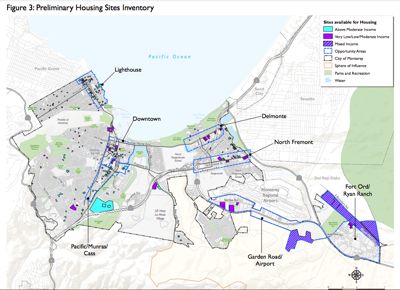
The housing element includes a site inventory showing where the city might be able to incorporate more housing across income levels—including 1,117 very low-income units, 769 low-income units, 462 moderate-income units and 1,246 above moderate-income units.
Planners identified possible areas of infill development among vacant and underutilized properties downtown and along commercial corridors such as North Fremont Street and Garden Road, among others, according to the notice of preparation that was issued Aug. 2.
They are also proposing housing on the former Fort Ord and Ryan Ranch area—up to 2,100 units—which would require additional planning and identifying of infrastructure needs, chief among them water.
Other options include encouraging the building of accessory dwelling units and the development or redevelopment of larger sites.
All total, planners identified up to 5,802 potential units, leaving a buffer of 1,498 units above the RHNA requirement.
Monterey's plan has come under criticism by the group LandWatch for the city's reliance on using the Fort Ord area as part of its designs.
"Although in other instances the city has shown leadership in addressing climate change and other environmental impacts, the plan to locate 2,100 housing units on the former Fort Ord—approximately 60 percent of the city's RHNA allocation—is a significant step backward," said LandWatch Executive Director Michael DeLapa in a letter dated Aug. 22.
DeLapa said allowing such "sprawl" would contribute to climate impacts by creating more vehicle miles traveled, affect sensitive biological resources, disturb a hazardous materials site and worsen groundwater overdraft.
A link to the draft housing element can be found on the city's public policy information and feedback website, haveyoursaymonterey.org. Written comments should be sent by Monday to Monterey Associate Planner Christy Sabdo at sabdo@monterey.org.
The Monterey City Council is scheduled to review the draft housing element and written comments on Tuesday, Sept. 19. The council will listen to public comments during the meeting as well.


(0) comments
Welcome to the discussion.
Log In
Keep it Clean. Please avoid obscene, vulgar, lewd, racist or sexually-oriented language.
PLEASE TURN OFF YOUR CAPS LOCK.
Don't Threaten. Threats of harming another person will not be tolerated.
Be Truthful. Don't knowingly lie about anyone or anything.
Be Nice. No racism, sexism or any sort of -ism that is degrading to another person.
Be Proactive. Use the 'Report' link on each comment to let us know of abusive posts.
Share with Us. We'd love to hear eyewitness accounts, the history behind an article.