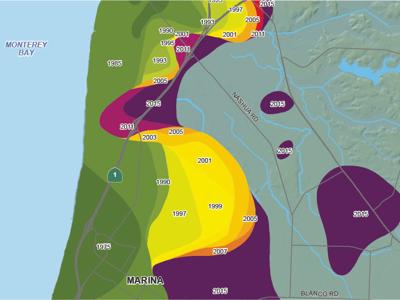

In an effort combat seawater intrusion in the Salinas Valley—which is threatening agricultural and municipal water supplies—the board of the Monterey County Water Resources Agency is set to consider a series of strategies at a meeting Monday, Oct. 16. One of those includes a moratorium on new wells in certain areas.
The recommendations come after MCWRA senior hydrologist Howard Franklin unveiled the county's 2015 seawater intrusion maps (the most recent) to the County Board of Supervisors and the MCWRA board at a meeting in July.
Those maps revealed significant advancement of intrusion in the 400-foot aquifer—named for its depth—which is the primary water source for many growers in the lower Salinas Valley.
The MCWRA staff are making several recommendations to their board today. Those include issuing a moratorium on all new wells in the 400-foot aquifer in areas being impacted by seawater intrusion.
They also call for an expansion of the Castroville Seawater Intrusion Project service area—where growers are supplied with irrigation water that is diverted and cleaned from water trapped behind the Salinas River's rubber dam—and a moratorium on all pumping within the expanded service area.
Abandoned wells are also thought to play a role in the intrusion—intruded water can leak through the wells into deeper aquifers—and MCWRA staff recommends destroying some wells.
Also recommended is that the board vote to issue a moratorium on all new wells in the "deep aquifer"—a finite water source around 900 feet deep that contains water thought to be many thousands of years old—until "an investigation determines its long-term viability."
Initiating that investigation is another recommendation on today's agenda.
Marina Coast Water District—which supplies the city of Marina and the former Fort Ord—pumps roughly half its water from the deep aquifer.


(0) comments
Welcome to the discussion.
Log In
Keep it Clean. Please avoid obscene, vulgar, lewd, racist or sexually-oriented language.
PLEASE TURN OFF YOUR CAPS LOCK.
Don't Threaten. Threats of harming another person will not be tolerated.
Be Truthful. Don't knowingly lie about anyone or anything.
Be Nice. No racism, sexism or any sort of -ism that is degrading to another person.
Be Proactive. Use the 'Report' link on each comment to let us know of abusive posts.
Share with Us. We'd love to hear eyewitness accounts, the history behind an article.