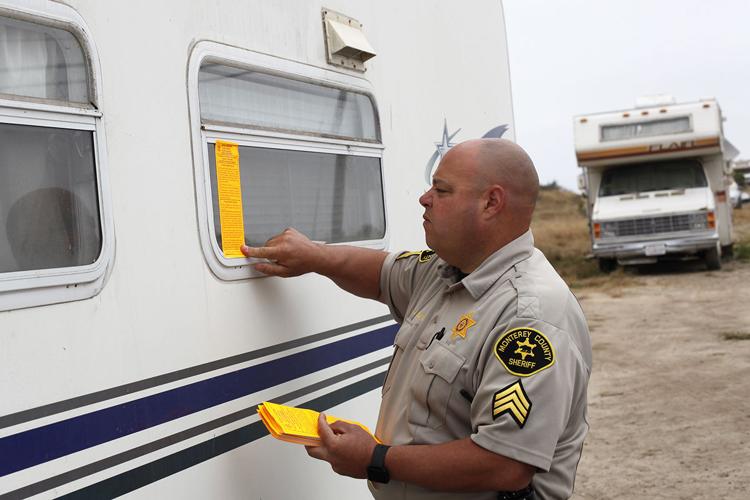
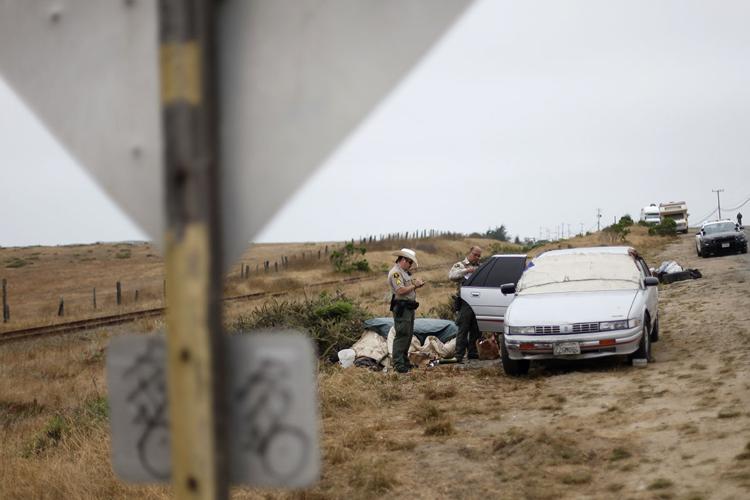




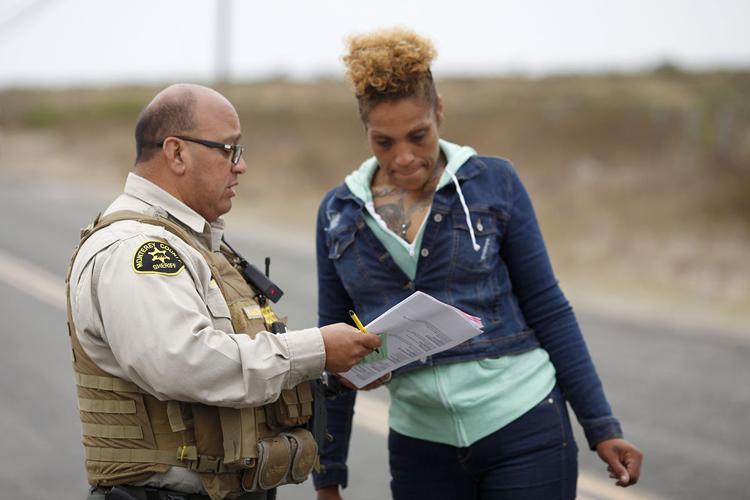







On a cold foggy day, an RV with papered-over windows remains parked on the southern end of Lapis Road, a county road just outside the city limits of Marina. Monterey County sheriff's deputies walk toward the vehicle, record the license plate numbers and knock firmly on its walls. It seems empty.
Suddenly there’s a hint of movement. The person occupying the vehicle peels back blue painter's tape that's holding the window together. “I’m sick," a voice says. "I don’t want to get you sick.”
Sheriff's Abatement Officer Tammy Young approaches, and hands the occupant a packet of paper through the opening alongside the window. On top of the packet is a notice to vacate the illegal campsite.
Overnight parking and camping are illegal on this stretch of road.
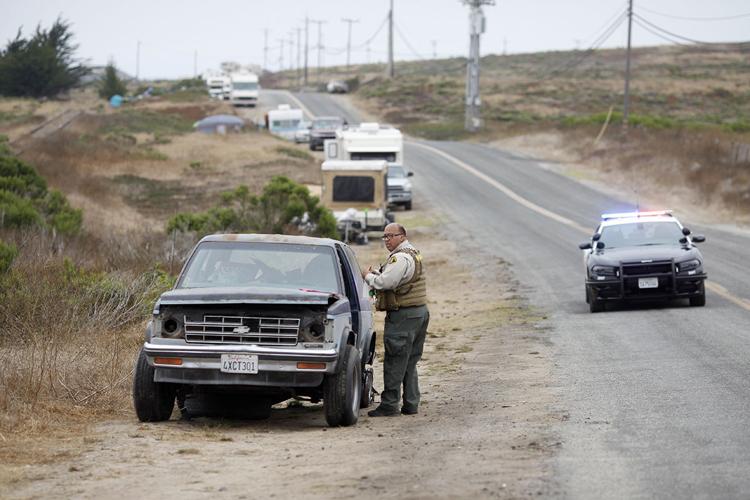
But for years, Lapis Road has been a defacto RV camp for the homeless. But due to a growing number of complaints received by separate county departments, code enforcement action has been long overdue, according to the Sheriff’s Department.
Beginning around 10am on Aug. 10, the Sheriff’s Department, alongside officials from a number of other county departments including Social Services, Environmental Health and the Office of Military and Veterans' Affairs, joined forces in an effort to clean up and clean out the area.
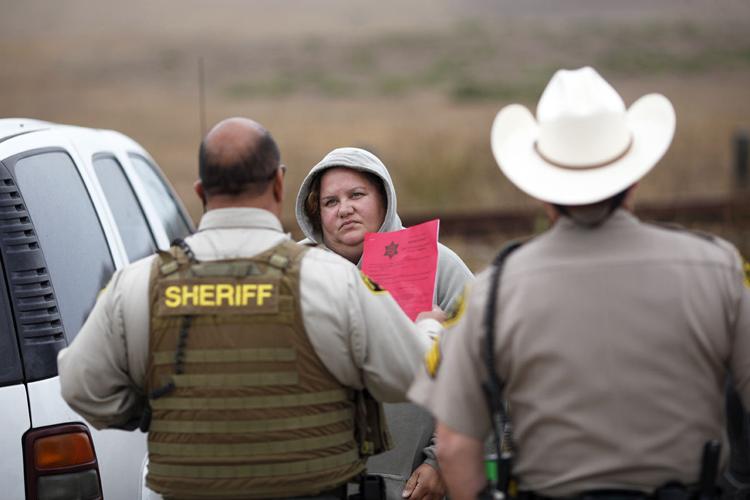
Vehicle by vehicle, deputies marked cars with orange vehicle abatement stickers and checked for occupants. They gave information packets to campers, like the person who reached through the taped-up window. Social Services followed code enforcement officers, gathering personal information and hoping to redirect occupants to homeless services.
Health officials came after, taking pictures and taking down notes of health hazards. They noted leaking septic tanks (an arrestable offense), scattered bags or filled buckets of human feces and urine, and abandoned gasoline and propane tanks.
“At some point, it not only becomes a public safety issue, but a health issue for those living here,” Sheriff's Cmdr. Mark Caldwell says.
Some vehicles were in such disrepair—rusted, doors ripped out, tires shredded —they were towed within 45 minutes of being marked.
Unlike recent sweeps in Chinatown in Salinas, where protests erupted as occupants' belongings were removed, the notifications to campers appeared to be made without incident, and campers were compliant with the deputies Thursday morning.
They are being given three weeks to vacate, or until Aug. 31.
Those who did answer the doors took notices to vacate and thumbed through the social services pages. Many took the time to answer questions from Social Service and Veterans Affairs representatives.
But for campers like 59-year-old Bella Maddox, who has been camping on Lapis Road for six months, local social services aren’t enough to help her out of her homelessness. Maddox has been disabled since 2003 because of degenerative disc disease. She is also diagnosed with manic depression and bipolar disorder.
Though her medications are paid for through Medi-Cal, her disability payments only total up $450, not enough for the average $75 per night fee for RV parking she says.
“$450 doesn’t go far,” Maddox says. “How does anyone expect me to move into an RV park when I can barely afford to feed myself or pay for a night?”
Maddox also says she’s exhausted her resources for transitional housing and says that the terms of many social services are strict. She claims that after living in subsidized housing for five years, she missed one house showing with housing officials and was immediately kicked out. “I tried calling them back and nothing," she says. "They wouldn’t give me a chance.”
Jorge Rojas, the Veterans Affairs representative on the ground Thursday morning, echoed that sentiment. Around the half-mile mark on Lapis Road he had already spoken to four veterans, most of whom know they are eligible for benefits, but were disqualified in some way or another.
“I’m not surprised,” Rojas says. “Keeping benefits is like walking a fine line.”
Currently, Maddox is looking into the updated services that she received in her packet but doubts that she’ll find a place to stay.
“I have no idea where to go and I will not have any gas money until the first [of next month],” she says.
The Monterey County Board of Supervisors has been scrambling to finalize temporary and permanent solutions for a growing homeless population. Supervisor Luis Alejo has led the charge to establish a year-round shelter, and in July the supervisors approved two North Salinas sites: One is a long-term plan on Natividad Road that may not be ready for occupants for several years. The shorter-term plan is a temporary year-round shelter on North Main Street, intended to be up and running by Nov. 1.
Meanwhile, the county is seeking to launch a safe overnight parking program. On Aug. 9, the county put out a call for bids to potential operators of such a program; the deadline for their proposals to provide services is Aug. 18.
Even on that timeline, it's unlikely there will be a solution in place for the Lapis campers by their deadline to move out on Aug. 31.


(2) comments
People move here for the nice weather. Even those who have jobs are finding it hard to afford the rents. There is a whole wide world out there that is affordable. It may be a big change for you and scary too but dont get caught up in the system. Any system. This includes the non profits who actually run at a profit with the boss in charge usually making a living off your pain. Just say no and gain control of your life. Look around. What can you really afford? Will you always be at the mercy of the county? or some non profit? Stand tall and dont let anyone tell you that you are less than. Reach out to family members and ask for help. You might be surprised by how they only want the best for you. Make the effort to change. Live a life you will love.
In 2013 I attended a fundraiser for a new group called One Starfish - they raised money to provide safe parking for women in vehicles overnight. Their website states
that "The Monterey City Council approved an ordinance February 2nd that allows parking for homeless women on a city lot. For months supporters of the One Starfish program have urged the city council to take action so this is a welcome development... the city parking lot will be available to six women forced to sleep in their cars who meet the program criteria. It is anticipated that more parking options will be opened up in the future. Learn more about One Starfish. What Is The Problem? In the course of a year over 300 women are homeless on the Monterey Peninsula. Some use their cars for shelter but it is illegal to park overnight in your vehicle any where in Monterey County. In 2013 Pacific Grove and Monterey passed ordinances that prohibited overnight sleeping in vehicles. Those who were caught were awakened and forced to move. Repeated violations result in fines ($500) and can lead to impoundment of the vehicle, another huge expense for the person without housing." I've emailed them a link to this article in the hopes that they are still active and can help the woman in the article and perhaps others being 'relocated'. These programs are active and working in other communities, the parking lots are monitored, porta potties are provided and police cooperate in those places.
Welcome to the discussion.
Log In
Keep it Clean. Please avoid obscene, vulgar, lewd, racist or sexually-oriented language.
PLEASE TURN OFF YOUR CAPS LOCK.
Don't Threaten. Threats of harming another person will not be tolerated.
Be Truthful. Don't knowingly lie about anyone or anything.
Be Nice. No racism, sexism or any sort of -ism that is degrading to another person.
Be Proactive. Use the 'Report' link on each comment to let us know of abusive posts.
Share with Us. We'd love to hear eyewitness accounts, the history behind an article.