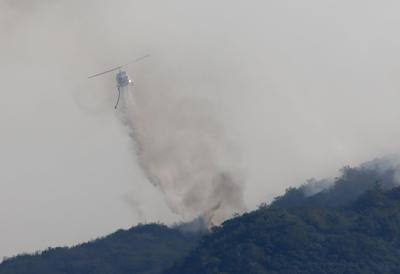

Update Jan. 23, 10:20am: As of Sunday morning, Cal Fire reported Big Sur's Colorado Fire was 1,050 acres and 25 percent contained.
Original post: Big Sur’s famous ridges were no longer glowing with fire by the time Saturday morning rolled around, but smoke continued to billow over a massive shuffling of helicopters and planes, fire and utility trucks and state and local volunteer firefighters as the effort to contain the Colorado Fire within its first 24 hours intensified.
All local jurisdictions sent fire trucks to the scene on Friday night. By Saturday afternoon, fire squads from as far as Ventura County joined in to battle the fire.
The blaze was first reported around 7:24pm on Friday night, Jan. 21, in the Palo Colorado region of Big Sur. Officials say the fire began behind the MidCoast Fire Station, a brigade of local volunteers. Cheryl Goetz, MidCoast Fire’s chief, says no lives have been lost and, although the fire initially threatened homes on both sides of Highway 1 on Friday night, by Saturday afternoon, one yurt was the only reported structural damage.
Goetz says the fire reached between 1,500 and 1,700 acres by Saturday afternoon. The fire’s growth had slowed down considerably by daybreak, as the region was no longer experiencing the 50mph winds that helped spread the wildfire to multiple ridges, canyons and both sides of Highway 1 in only a matter of hours on Friday evening.
There has been no official word on how the fire began.
The windy weather, combined with dark skies and steep terrain made for a precarious situation on Friday evening, with crews largely unable to cut fire breaks—a critical containment strategy that requires boots on the ground, clearing vegetation and fire fuel. By Saturday afternoon, work on building fire breaks had begun but progress was slow, says Marc Bontrager, Cal Fire Battalion Chief with the Fresno unit.
“Right now, the fire is doing what we call fingering, which is just rolling off the sides of the hill,” Bontrager says from his Cal Fire truck, stationed atop a private road behind the Mid Coast Fire Station, where the fire was still active. “The terrain is so steep and the vegetation is so thick, so it’s been slow progress.”
Bontrager says he is hopeful as the weather forecast for Saturday night “is nothing like it was last night,” when it comes to wind. As Bontrager explained the situation, Cal Fire helicopters were dropping thousands of gallons of water over the billowing hillsides, sucked up from Rocky Creek and the Pacific Ocean, and S-2T air tankers, dropped thousands of gallons of red fire retardant, which Bontrager described as fertilizer that temporarily smothers the flames and allows crews to hike in and begin building fire breaks.
Goetz says as long as the wind stays calm, the fire should remain manageable, but the wind and the terrain will remain the largest challenges. Goetz is concerned about the fire reaching Palo Colorado Canyon, where dozens of homes are located and a mandatory evacuation order remains in effect.
“When you have these local fire departments like us, it's not a job we go to. It's a love for our community—it’s not someone else's home that is going to burn, it's our home, it's our friend’s, our family’s, our neighbor’s,” Goetz says. “The community needs to know how hard we are working. We’re going to get there. We haven’t lost any homes and no one, so far, has gotten hurt.
“But anything can change in the blink of an eye. Until it is 100-percent contained, there is no guarantee.”


(0) comments
Welcome to the discussion.
Log In
Keep it Clean. Please avoid obscene, vulgar, lewd, racist or sexually-oriented language.
PLEASE TURN OFF YOUR CAPS LOCK.
Don't Threaten. Threats of harming another person will not be tolerated.
Be Truthful. Don't knowingly lie about anyone or anything.
Be Nice. No racism, sexism or any sort of -ism that is degrading to another person.
Be Proactive. Use the 'Report' link on each comment to let us know of abusive posts.
Share with Us. We'd love to hear eyewitness accounts, the history behind an article.