
What distinguishes the good ol’ USA from other countries?
Baseball, you say? Well then, how come so many stars come from the Dominican Republic and Venezuela? Maybe our interstate highway system? Nah, we borrowed that idea from Nazi Germany. Freedom? The quality of our health care system? OK, enough—although perhaps the highways response comes closest.
You see, Americans developed a unique car culture. Individualism and mobility have always been a part of our national character—Natty Bumppo, the Oregon Trail, “Go west, young man” and all of that—but Henry Ford and other manufacturers willing to exploit brand new ideas like mass consumption and planned obsolescence set us apart.
At the end of the Great War there were some eight million cars on mostly rutted roads. By the beginning of the Great Depression just a decade later, there were 23 million and paved routes like the Lincoln Highway criss-crossed the nation.
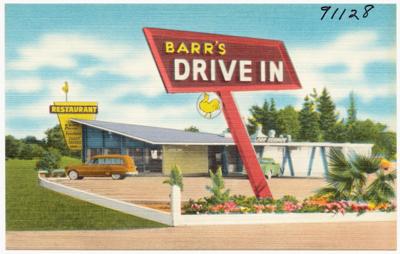
And with that came what truly separated us from the rest of the world: drive-in restaurants and drive-thru windows.
“Drive-ins were the perfect place to show off cars and meet people,” says John Kraman of Mecum Auctions. “Oh, yeah—food too.”
Just about all of us have settled in behind the wheel for a burger and fries, ground beef tacos or perhaps just a bag of Doritos. A survey by ExxonMobil found that 83 percent of Americans drink and drive—meaning coffee, juice or soda—while 70 percent admit to eating while they drive.
Charlie Kuhn of Worldwide Auctioneers recalls his parents loading all seven kids into the family station wagon—perhaps not a car to show off—and heading out for a drive-in dinner.
“I can remember going to A&W” he says. “They would put a tray in the window. But with seven kids they had to use two trays.”
A&W (“the greatest root beer in the world,” according to Kuhn) was one of the early drive-in brands. Roy Allen’s first root beer stand opened on a street corner in Lodi, California in 1920. By 1933, the company operated 171 drive-ins around the country—most with car hop service, a feature copied from the very first drive-in. Texas Pig Stand first welcomed drivers along the Bankhead Highway in 1921. “Tray boys” scurried from the restaurant to take orders.
One of the owners of Texas Pig Stand reportedly chimed “People with cars are so lazy they don’t want to get out of them to eat.”
Perhaps. But I think Kraman’s observation is more on the mark. As we know from American Graffiti and Happy Days, life for teenagers—even nerds—in the Baby Boom era revolved around cars and drive-ins.
But can you really enjoy a meal from behind the wheel?
“It’s tough to dine in a car, but much better if not moving or driving,” Kraman says.
Yeah, he’s a TV personality on Mecum broadcasts, so he has to be cautious. But the drive thru does add another degree of difficulty. According to the National Highway Traffic Safety Administration, 80 percent of all accidents and 65 percent of all close calls involve drivers distracted by their burger and fries. Another study, this time by Lytx, calculated that dining while driving ramps up the likelihood of mayhem on the roads by 3.6 times.
So in percentage terms...forget it. Writers can barely add, let alone take a stab at secondary school math.
Perhaps the chance of carnage is a reason drive-thru windows were slower to catch on. In-N-Out was one of the first, opening in 1948 with no seating indoors or out. Although smaller chains followed suit, McDonald’s waited until the the mid-70s before making space for a window.
Of course, they promoted the hell out of drive thru after that.
With no place to set plates and the issue of utensils, drive-in and especially drive-thru menus tend toward the basics: burgers, tacos, the nugget portion of the chicken and such. Even then, it can be hazardous—both outside and inside the car.
“You have to have things that don’t drip,” observers the Weekly’s distribution guy Kevin Jones. “A hardshell taco sucks. Mustard stains don’t come out easily.”
That same NHTSA report highlighting the damage caused by distracted drivers ranked the worst food and drink for a vehicle. Coffee took the top spot, which in this case is not good (remember that McDonald’s lawsuit?). Soda, chili dogs, wings, burgers, jelly doughnuts and fried chicken also made the list—sorry, Colonel.
Other foods unfit for the road? Chocolate, burgers, tacos—the report didn’t specify shell type—and soup.
Uh...yeah.
Jones owns a 1967 Camaro RS that has been in his family since 1977. “It’s gone through times when it was OK and it was not OK” to eat behind the wheel, he says. “Right now nobody eats in it.”
But it served as his daily ride in high school, so: “There was a lot of stuff I found under the seat.”
He didn’t elaborate, but by “stuff” let's just assume he means petrified food remains. That’s something those in the classic car industry encounter far too often.
“A long standing tradition in cleaning car interiors is to be on the lookout for that rogue french fry or two,” Kraman reports. “Been that way for 60 years and counting.”
So fast food has been part of the American way of life—and death, and auto detailing—for decades. Restaurants cluster around freeway exits. Auto manufacturers add dining-related conveniences like cup holders to new models. But can you really enjoy the meal?
Kuhn recently visited a drive-in near Chicago with his family. They opted to leave the car and dine inside. As for his A&W memories, he says “For my mom and dad it was easier to keep us in the car with our seat belts on than let us in the restaurant,” Kuhn says.
The answer to this week’s Burning Question is pretty straightforward. It is difficult to enjoy a meal in the car, unless perhaps you are at a full stop and the place grills up a pretty damn good burger.
At least the drive-in is safer than the drive-thru. A few older establishments are still around. And thanks to chains like Sonic, they are still a part of the American roadscape, for they are what makes us unique in the world.
“Sonic is leading the way and hopefully others will follow,” Kraman says. “Pure Americana for nostalgia fans.”






(0) comments
Welcome to the discussion.
Log In
Keep it Clean. Please avoid obscene, vulgar, lewd, racist or sexually-oriented language.
PLEASE TURN OFF YOUR CAPS LOCK.
Don't Threaten. Threats of harming another person will not be tolerated.
Be Truthful. Don't knowingly lie about anyone or anything.
Be Nice. No racism, sexism or any sort of -ism that is degrading to another person.
Be Proactive. Use the 'Report' link on each comment to let us know of abusive posts.
Share with Us. We'd love to hear eyewitness accounts, the history behind an article.