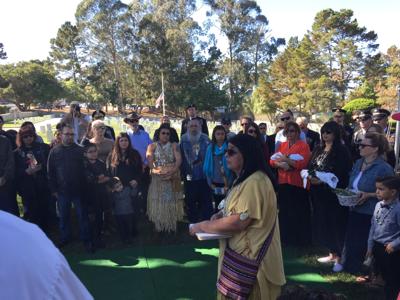

On the bright blue Sunday afternoon of Oct. 22, a group of 60 or so people gathered in a parking lot next to the Army cemetery in the Presidio of Monterey. From there, the Pacific Ocean could be seen through curtains of Monterey pine and eucalyptus trees. Although most of the gathered were civilians, they had been issued security clearances to pass through the guarded Presidio gate to attend a special ceremonial burial.
Many of them were fully or partly Native American descent. Some wore formal funeral black. Others, everyday jeans, sneakers and jackets. A contingent of soldiers wore crisp dress uniforms. One woman, a black windbreaker that read on the back “My dad is a Native American Vietnam Veteran.” Many wore seashell or bead necklaces, a few wore ribbon shirts. All shared the same bearing of respect and awareness for the gravity of the event before them.
Bones, remains and artifacts of Ohlone/Costanoan-Esselen Nation (OCEN) tribal members, some dating thousands of years, have been uncovered on the land occupied by the Presidio since 1910.Those remains had been lent, over the decades, to museums throughout California, including the Pacific Grove Museum of Natural History. That’s been a source of consternation for living members of the OCEN tribal council, in particular tribal chairwoman Louise J. Miranda Ramirez.
“When cities, counties or homeowners disturb our ancestors with new building projects,” Louise explains days after the ceremony, “we ask for an area where we can rebury, and an acknowledgement that the ancestors will never be disturbed again according to the law.”
The OCEN is recognized by the Native American Heritage Commission of the State of California, but not by the federal government, partly because it does not possess land to call its own. So although the U.S. Army wanted to return Ramirez’s ancestors to her care and offered to lay them to rest in Presidio ground, and various museums were willing to return them to the Army, the OCEN could not formally accept the remains themselves—federally recognized tribes were needed to come in and act as intermediaries.
Through two years of negotiations, in accordance with the Native American Graves Protection and Repatriation Act, a plan was born to return the remains to the land from which they had been removed, land once known as the Esselen village of Achasta. The culmination of that plan is what brought that group of 60 people together last Sunday at the Army cemetery.
On that fateful afternoon, Ramirez wore a leather top and skirt with abalone shells tied to the hems, a longer grass skirt underneath, bunches of seashell necklaces around her neck, a rabbit skin half-cloak over her shoulder and dark sunglasses, while carrying a carved staff in her hand. The regalia, she says, is based on drawings by Jose Cardero from the 1789-1794 Malaspina Expedition.
She directed the proceedings. She told one teenager to go and retrieve a package of tobacco as a gift to the ancestors, the remains of which were contained in four ornate green boxes.
Smudge sticks—tightly bound leaves of burning sage, tobacco, cedar and mugwort—were passed around the gathering. People fanned the sweet smoke toward themselves, inhaled it, waved the bundled sticks across their body, even over the soles of their shoes, the smoke caressing, cleansing and wafting away, carrying prayers up to the Creator.
“We do smudging for good thoughts,” Ramirez told the gathering. “To hear good things, to speak good things, to walk in the good way, so that our heart is good. You are welcome to participate, to ask the Creator to protect you.”
The smoldering smudge sticks were shared, people helped cleanse each other with them, and then they were waved over the boxes of the ancestors—17 of them, uncovered on Presidio land from 1910-1985. Ramirez asked that pictures not be taken of the contents of the boxes.
When it was time, the gathering began to slowly march down the street. In front was a lone man, Joseph Garfield, spiritual leader and council member from the Tule River Indian Tribe, who wore all black including a black Stetson hat. He incanted a chant as he led the procession, carrying a pair of raptor wings in one hand and shaking a feathered stick in the other hand.
Behind him walked a Native American color guard bearing various flags including two for the Native Nations, comprised of eagle feathers tied to carved staffs. Earlier, a soldier had offered them advice about bearing and carrying flags as part of such a formation.
Behind the six men of the color guard (one of whom bore his flag on his walker), four of the younger OCEN members carried the four boxes of the ancestors.
“It is our belief that we must teach our young people our customs, that way they can carry on when we are gone,” Ramirez says.
Everyone else walked solemnly behind. Quite a few kids and teens were present. Also present were county supervisors Mary Adams and Luis Alejo, as well as Sand City Mayor Mary Ann Carbone, who is descended from several generations of Chumash and Esselen people.
Presidio police cars blocked off traffic as the procession made its way to the cemetery and congregated around a freshly dug grave at the corner of a grassy field lined with uniform headstones. A Marine saluted as the people made their way in. An American flag on a pole in the middle of the cemetery was at half-mast. The sun gleamed off the metallic eagle insignias atop the flags of the color guard.
Anyone looking up at the Presidio from the outside, through the fortress of trees, would have no idea of the ceremony taking place within. It was closed to the public.
When all had assembled around the grave, a soldier played a mournful taps on a horn. Then Ramirez’s grandson played a melancholy song on Native American flute that mixed with the wind and sparse traffic to cast a hushed and reflective atmosphere.
The four bearers of the ancestors set the boxes down. Garfield walked around the grave, shaking the feathered stick, which clacked like a chattering skeleton.
Then Ramirez said a prayer in the Esselen language, before initiating the presenting of gifts. The assembled were invited to take some jewelry, tobacco, seashells and sage from several baskets and place them in each of the four boxes. Almost everyone did this, including the uniformed military members, children (some of whom were guided by adults), a couple of people relying on walkers, even the cemetery workers.
One Marine paused ceremoniously for a few seconds of reflection after depositing gifts into each box. One man dipped into his pouch of Bugler tobacco and sprinkled his gift over the ancestors’ bones, which were resting among feathers, abalone shells and flowers. Ravens cawed and flew about.
According to their literature, Ohlone/Costanoan-Esselen Nation “represents over 600 enrolled tribal members of Esselen, Carmeleno, Monterey Band, Rumsen, Chalon, Soledad Mission, San Carlos Mission (Carmel) and/or Costanoan Mission Indian descent from at least 19 villages from a contiguous region surrounding Monterey Bay.”
Karen Durham-Aguilera, the executive director of the Arlington National Cemetery, dressed in black and dark shades, later explained the significance of the ceremony for a tribe like the OCEN.
“The Army team has been working with the Ohlone/Costanoan-Esselen Nation for several years to return their ancestors to these grounds,” she said.
“We are the first federal agency to use the recently promulgated rule [Native American Graves Protection and Repatriation Act] to return remains to an unaffiliated tribe. It’s a historic day and we’re so honored.”
After the laying of gifts, two large stone urns filled with soil, sourced from the original place the bones were uncovered, were brought over, and the gathered were invited to place handfuls into each box and into the grave.
“We want the ancestors to return to soil,” Ramirez said. “To go back to the earth.”
To speed this process, cotton cloth was placed on top of the remains before the boxes were closed. Then the boxes were placed on a redwood slab suspended over the grave, cut from a fallen redwood tree in Porterville and brought down by the Tule River Tribe. Also placed on the slabs were two dead white owls, wrapped in a muslin-like cloth, given to the OCEN as gifts. The owls are messengers, Ramirez said, and needed to accompany their ancestors.
Then she incanted: “Our people danced here. We will dance here. We have always danced here. We are here. We exist. We exist. We exist.”
Some of the assembled responded “Ho-wah!”
Then four cemetery workers carefully lowered the slab of redwood, bearing the four boxes of ancestors, into the ground to be covered with dirt.
And it was over. Ramirez gave a gift to one of the soldiers as a proxy for the U.S. Army, then urged everyone to meet at the Weckerling Center social hall for a reception, food and addresses. (It is customary for the OCEN to feed guests.)
Col. Lawrence Brown, garrison commander for the Presidio of Monterey, said in statement following the ceremony, “This cooperative effort has resulted in appropriate respect being rendered to these long-departed American Natives and is now the model for other U.S. Army installations across the country.”
“I cried my tears,” Ramirez said, “because we succeeded and the ancestors were back in the earth, out of the museums. It is the greatest responsibility I have to the ancestors, my people and our culture.”
After their years of upheaval, captivity and journeys, the ancestors will be protected by the U.S. military in a scenic plot of hallowed ground, under the shade of a giant Monterey cypress tree, overlooking the pristine Monterey Bay.


(0) comments
Welcome to the discussion.
Log In
Keep it Clean. Please avoid obscene, vulgar, lewd, racist or sexually-oriented language.
PLEASE TURN OFF YOUR CAPS LOCK.
Don't Threaten. Threats of harming another person will not be tolerated.
Be Truthful. Don't knowingly lie about anyone or anything.
Be Nice. No racism, sexism or any sort of -ism that is degrading to another person.
Be Proactive. Use the 'Report' link on each comment to let us know of abusive posts.
Share with Us. We'd love to hear eyewitness accounts, the history behind an article.