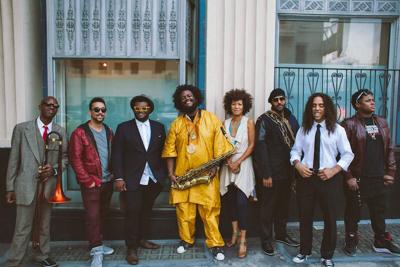

Kamasi Washington is one of the hottest jazz cats in the game right now. The tenor saxophonist played and arranged music on Kendrick Lamar's 2015 album To Pimp a Butterfly. His own solo album, The Epic, is a nearly three-hour, three disc masterpiece created with his 10-person band The Next Step, and a full string orchestra and a choir. He's part of an L.A. music collective called The West Coast Get Down. He and his band are making their debut on the Jimmy Lyons Arena stage at the Monterey Jazz Festival on Sunday.
All this musicality flows from a moment in Kamasi's youth, when he was 13, as explained on his website:
"One night, his father left his soprano saxophone lying on the piano. Kamasi, filled with curiosity for all the beauty he heard from the instrument, picked up his father’s horn. Even though he didn’t know anything about the saxophone – in fact, never even touched one – he played Wayne Shorter’s composition 'Sleeping Dancer Sleep On,' his favorite song at the time."
He comes from the diaspora of black Los Angeles music and culture that’s been overlooked and underestimated. But he's looking to change that. He spoke to the Weekly last Tuesday, Sept. 13, having just gotten off the road from a world tour.
Weekly: Where are you now and what were you doing?
Washington: I'm at home in Inglewood. Cleaning up my room. I was on the road not long ago.
You titled your solo debut album The Epic. Where does that confidence and ambition come from?
From my intention. I'm just trying to express myself through music. I’m not trying to do anything more or less than that. What comes from that is what comes. I can't really control how people respond to my music. I can try to make music that's sincere and comes from me.
Artists have merged jazz and hip-hop from the days of Stetsasonic, Gang Starr and Branford Marsalis, to Kendrick Lamar, The Roots, Robert Glasper and yourself. Is there a new wave of jazz and hip-hop?
I think jazz and hip-hop have been intertwined. Ron Carter played on Tribe [Called Quest]. The first tour I did was with Snoop. Kendrick is definitely incorporating jazz. Kanye West had a hit that incorporated Ray Charles. Hip-hop, to me, is a music that pulls from all different genres. It’s so steeped in sample culture. It's like a collage to create something new and jazz is one of the big pieces of that.
What did you learn in your ethnomusicology studies at UCLA, and how do you use it in your music?
I learned a lot. I was exposed to different cultures, thought processes as to what music is, what its purpose is. It's different in different cultures. Music theory, how they were able to create their music, the instruments, the scales they use. All those things, some of them spoke to me and [influenced] the way I make music and play my instrument.
People have referred to John Coltrane and A Love Supreme when describing you and your music. Who else and what else do you call upon in your music?
So many records. So many musicians. Too many to name in one setting. Pharoah Sanders, Stravinsky, Ravel, Mahalia Jackson, James Brown, Michael Jackson, Marvin Gaye, Roberta Flack, Gerald Henderson, Billy Morgan, Gerald Wilson. I'm a fan of music. When I have a day off, I’ll probably go to Amoeba and find music. Every time you hear something, when it connects to you, it affects you. My music is [made] of a collage.
You've played Bonnaroo and Coachella, which seems like crossover platforms for a jazz band. What makes for a successful crossover, and do you welcome the designation?
Mm. I think it's a good thing. I think it shows people are becoming more open and choosing the music they like based off of them hearing it, as opposed to being told what to like. Over the years there was a lot of jazz that could have crossed over, but the times didn't get caught up [to it]. My music, it's definitely a product of that. I grew up listening to lots of music. My own music is rooted in jazz, my foundation, but there are so many other styles of music that have influenced me. Music is not separate. It intertwines. Rock, gospel, R&B, it all intertwines. Music fans have always listened to jazz but haven't realized it. It's all made of the same pieces. Some just had a little more of this or that.
Can you tell us about the set you have planned for the Monterey Jazz Festival? The set list, the ensemble you're bringing, etc.
The ensemble is an eight-piece band. The set comes together when we're there. It happens pretty spontaneously. I try to leave it open and free, whatever direction it will go. I don't try to force it. [We] follow where the music wants to go. I'm very affected by the vibe, the place and the time.
Who do you plan to check out at the Monterey Jazz Festival?
I like to hear people I don’t know. For me the exciting thing is to hear something I wasn't expecting. I try to find something I'm not familiar with.
Did you encounter any music out there on the road that made you say “I want to explore this more?”
There's a group, two twins, called Ibeyi. I met them in Bonaroo. Really amazing. While on the road we [saw] LCD Soundsystem for the first time. That was really cool, the way they recreate those psychedelic sounds. Seeing them do it live was cool. Ben Staples was really really cool. Lots of artists have really moved us.
Is there something like a Harlem Renaissance happening in L.A.?
Yeah. There’s definitely a moment in music happening in L.A. But it's been overlooked. There's been several that have happened. It’s not always discovered. Like my dad. When I was a kid, I came up around older musicians, all of them were so talented, but never got a chance to be exposed to the world on a large scale. They've definitely influenced the musicians coming out of L.A. now. I think what people are seeing is something that's been generations in the making.
Wearing a dashiki, knit hats, an afro…these can be interpreted as political or social statements. Is your presentation more than a style thing? What are you conveying through your style?
It's both. My dad instilled [in me] a love for African culture and history, a sense of ownership of African culture and style. In one sense, I like the way the clothes look. I appreciate the aesthetics of all Africa, the whole diaspora. I feel like it's a healthy thing for people of African descent to have pride. Historically there's been such a force for us to be ashamed of it. There's something weird or backwards about [Africa]. For me it's like I see the beauty in it. I hope people seeing me see the beauty in it as well. I think it's beautiful. The fabric, the place they come from, is beautiful.
What are you working on next?
I had a little break in May. I recorded some music. I’ve been listening back to it. I’m doing more writing to work on my next album. I have a graphic novel project. A story I came up with a while back. I’m trying to figure out how to keep pushing the music, find ways to help other guys in band to get their music out.
Anything else you would like to say about playing the Monterey Jazz Festival?
It's a real honor to play the Monterey Jazz Festival. L.A.’s been overlooked. It's beautiful that the music coming from L.A. is now getting a chance to be heard. I think we got something significant and worthwhile to add to this rich history of music. I’m thankful to be part of it. I grew up every year trying to get to Monterey to see somebody.


(0) comments
Welcome to the discussion.
Log In
Keep it Clean. Please avoid obscene, vulgar, lewd, racist or sexually-oriented language.
PLEASE TURN OFF YOUR CAPS LOCK.
Don't Threaten. Threats of harming another person will not be tolerated.
Be Truthful. Don't knowingly lie about anyone or anything.
Be Nice. No racism, sexism or any sort of -ism that is degrading to another person.
Be Proactive. Use the 'Report' link on each comment to let us know of abusive posts.
Share with Us. We'd love to hear eyewitness accounts, the history behind an article.