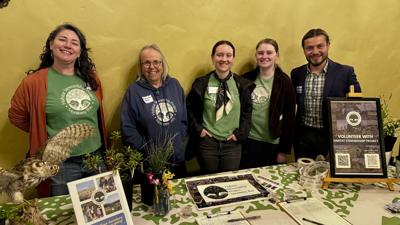

As people waited in line for the Banff Mountain Film Festival at the Golden State Theatre on Friday evening, April 10, Habitat Stewardship Project, Monterey Bay's director Laura Lee Lienk made her way through the crowd to hand out raffle tickets. “This is going to be fun, you guys!” she said.
Now in its 50th year, the Banff Mountain Film Festival shows selections by the Banff Centre for Arts and Creativity across the globe, with a stop in Monterey. Crowds gathered at the Golden State Theatre for screenings of six films ranging from two minutes in length to 47 minutes. Formerly, REI Coop would co-host the screenings, but the local showing is now in the hands of Habitat Stewardship Project, an environmental education and restoration organization. The nonprofit has been co-hosting screenings for Banff Mountain Film Festival locally for just under a decade.
“I love to see the spark that happens when people get out in nature,” says greenhouse restoration coordinator Christina McKnew, who was tabling in the lobby ahead of the screenings.
Getting out in nature is the tip of the iceberg for the subjects and themes of the films shown. This year’s screenings touched on a wide range of topics affecting outdoorsmanship.
The festival opened with a six-minute film about a ski trip throughout Japan titled Cold Calls and directed by Alex Godbout. The film was simple and akin to well-edited home movies showcasing some of the beauty that Japan’s mountains have to offer. A 12-minute exposé, The Hive Architect, about a man named Matt Somerville followed. The mini-documentary follows Somerville’s mission of creating native bee hives out of logs and placing them around England. Unlike farmed bees, the honey from Somerville’s hives is never harvested.
Highlighting the festival was the recipient of Banff Centre’s 2025 Best Film: Mountain Sports recognition and the 2025 Audience Choice awards, Best Day Ever. The 47-minute film tells the story of Greg Durso, a mountain biker who was injured and paralyzed from the waist down after an accident. Durso and his friends find other paralyzed mountain bikers like Allie Bianchi, who was also injured in a similar way, and build the first-ever fully adaptive mountain biking trail in Vermont called "The Driving Range." The name is fitting because riders are set in a kneeling position on motor-driven tricycles with mountain bike tires. The tear-jerking film prompted a few tears in the audience during the screening.
Following a brief intermission came three more films, including one about Indonesian twins Ravianto and Raviandi Ramadhan paying their way with what little they had to compete as professional climbers in France, then attempting the 5.14b-rated—that's pro-level difficulty—route in La Balme called “Dissidence.” The film is named for the route, and showcases how two climbers are able to prove themselves, despite having no sponsors, little money and training with hand-built equipment.
The festival closed with A Baffin Vacation, Love on Ice, a 26-minute film about boyfriend-girlfriend adventurers Erik Boomer and Sarah McNair-Landry as they journey across the unforgiving Baffin Island to kiteski, alpine ski, mountain climb, whitewater raft and hike through the arctic circle—an epic test of human capabilities that leave several audience members wondering why on earth someone would do that.


(0) comments
Welcome to the discussion.
Log In
Keep it Clean. Please avoid obscene, vulgar, lewd, racist or sexually-oriented language.
PLEASE TURN OFF YOUR CAPS LOCK.
Don't Threaten. Threats of harming another person will not be tolerated.
Be Truthful. Don't knowingly lie about anyone or anything.
Be Nice. No racism, sexism or any sort of -ism that is degrading to another person.
Be Proactive. Use the 'Report' link on each comment to let us know of abusive posts.
Share with Us. We'd love to hear eyewitness accounts, the history behind an article.