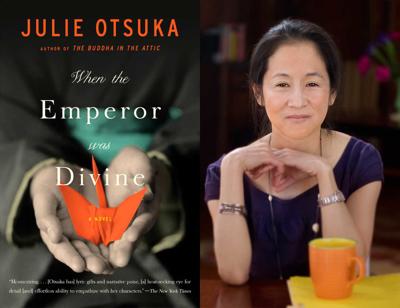

Author Julie Otsuka grew up in Palo Alto for her first 9 years, then Palos Verde for the next 9 years, and she says her upbringing influenced her subsequent writing voice.
“I grew up in the ‘60s, before there were as many Asians as there are now,” Otsuka says. “It formed my sense of being different, non-white, especially in elementary school. It was quite formative in terms of the writer I turned out to be.”
Before she got into writing, she studied painting as an undergraduate at Yale University, then in a grad program for painting at Indiana University, where she says she was unable to produce under pressure and got self-conscious about the act of painting.
“It was paralyzing."
She dropped out, moved to New York, got a job doing word processing, and took solace in reading contemporary short fiction. She fell in love with it. She took writing workshops and played with words, which she found came easier than painting.
She enrolled in a grad program at Columbia University and wrote short comedic stories, sometimes autobiographical. One winter, she wrote what would later become the first chapter of her first novel, When the Emperor Was Divine (Knopf, 2002), the story of a Japanese-American family’s internment by the U.S. government during World War II.
“It came out of nowhere,” she says.
Well, part of it came from her own family’s experience. Her grandfather had been arrested by the FBI as a suspected Japanese spy the day after the bombing of Pearl Harbor, and her mother, uncle and grandmother spent three years in an internment camp (Otsuka calls them “prison” or “concentration” camps) in Topaz, Utah.
She heard stories of this as a child, but their full meanings didn’t occur to her until later.
“I would hear bits and piece from my mother," she says. "As a kid I thought she was talking about summer camp. They were light-hearted [discussions]. I didn’t’ realize until we were older what ‘camp’ was.”
She did a lot of research for her book. As an adult, she found letters exchanged between her then-10-year-old mother and her mother’s father, starting with one he wrote from a detention center in San Francisco, just days after his arrest. In response, her mother wrote him a letter as they’re about to leave their home for the internment camp in Topaz, Utah.
“They’re heartbreaking,” Otsuka says.
The subsequent first novel made the lists for New York Times Notable Book and San Francisco Chronicle Best Book of the Year, has been translated into 11 languages, and is assigned reading at more than 45 colleges and universities.
Although she finished its manuscript in June 2001, before 9/11, she says that scenario seems closer to re-emerging.
“I feel like the emotional climate now is very similar to the roundup of the Japanese Americans after Pearl Harbor,” she says. “The rhetoric, the vitriol to scapegoat people who don’t look like ‘us.’ The language is so similar. The photos of these children in the news in these tents cities…it’s very reminiscent.”
She says she won’t explicitly draw those parallels in her talk at 6:30pm on Thursday, Oct. 18, at CSU Monterey Bay (it's part of the university’s Common Read series). But as time passes, she finds that the story of Japanese-American internment during World War II, downplayed in history books, is fading from young people’s consciousness.
(There is an exhibition titled Courage and Compassion, about the Japanese-American experience during World War II, nationally and in Monterey County, at Casa Gutierrez, 590 Calle Principal, Monterey, viewable 10am-4pm Thursday-Sunday, through October.)
Otsuka sees her role as that of a storyteller, and leaves it to her audience to find those relationships. She will talk to the audience about the process of writing her books, will read some of her family’s letters, as well as from the book When the Emperor was Divine.
Julie Otsuka will speak and read 6:30-9pm Thursday, Oct. 18, at CSU Monterey Bay's University Center, 4314 6th Ave., Seaside. Free to attend. https://csumb.edu/traditions/events/julie-otsuka-common-read-author-visit.


(0) comments
Welcome to the discussion.
Log In
Keep it Clean. Please avoid obscene, vulgar, lewd, racist or sexually-oriented language.
PLEASE TURN OFF YOUR CAPS LOCK.
Don't Threaten. Threats of harming another person will not be tolerated.
Be Truthful. Don't knowingly lie about anyone or anything.
Be Nice. No racism, sexism or any sort of -ism that is degrading to another person.
Be Proactive. Use the 'Report' link on each comment to let us know of abusive posts.
Share with Us. We'd love to hear eyewitness accounts, the history behind an article.