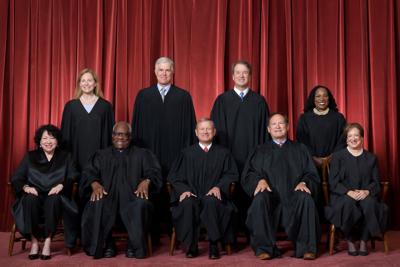

Sara Rubin here, thinking back to the principles the founders of the United States held dear as they built a grand experiment in democratic self-government. I think about these principles because I love celebrating the Fourth of July, a patriotic occasion to reflect on the beginning of this country as an act of self-determination.
On July 4, 1776, the Continental Congress adopted the Declaration of Independence, which declared: “We hold these truths to be self-evident, that all men are created equal, that they are endowed by their creator with certain unalienable rights, that among these are life, liberty and the pursuit of happiness. That to secure these rights, governments are instituted among men, deriving their just powers from the consent of the governed.”
Deriving their just powers from the consent of the governed. What happens when, 248 years later, government leaders derive their powers from a judicial branch stacked with political allies? It’s a different world than the one envisioned in 1776, and a different world than we celebrated this week—but it is the world we live in.
Given the high stakes and remarkable nature of the federal election interference case against Donald J. Trump, we at the Weekly decided to mark the holiday this year with a cover story outside of our usual territory. In the sea of legal documents, one brief stood out, filed on behalf of 14 national security professionals in defense of the government’s case.
The brief makes an effort to show some potential real-life scenarios that may unfold if presidential immunity from criminal prosecution is granted in our armed forces, showing how easily a president with illicit motives could control a chain of command. It’s almost cinematic—but now, given the Supreme Court’s 6-3 decision on July 1 to grant immunity for official acts taken by a president, it is not the stuff of movies, but reality.
This underlying case as it relates specifically to Trump is not yet decided. The Supreme Court sent the case back to the lower court to determine whether Trump’s actions at the heart of the federal indictment pertaining to his actions seeking to obstruct the certification of the 2020 vote on Jan. 6 were official or unofficial acts.
But the case has implications for our country and institutions far more broadly than Trump. As Justice Sonia Sotomayor wrote in the dissenting opinion: “[The] decision to grant former presidents criminal immunity reshapes the institution of the presidency. It makes a mockery of the principle, foundational to our Constitution and system of Government, that no man is above the law.”
Those are principles—in theory, at least—that we honor and celebrate especially on Independence Day.

(3) comments
The majority decision was proper, and well-reasoned. It does not place a President above the law. A President can (and would be) immediately impeached/convicted for any of the 'normal' crimes people are prosecuted for (murder, arson, burglary, etc.). It prevents subsequent 'lawfare' (after the end of her/his term) by precluding prosecution for activities found within the ambit of the presidential functions.
MCN: since the 2000 POTUS election...the SCOTUS hasn't been so supreme
Funny that the only thing ever quoted are legally unsound quotes from Sotomayor. But in all honesty, this is a horrible thing for our democracy, almost as horrible as persecuting a political opponent for cooking the books during an election year, while also failing to give adequate due process, all overseen by a judge who committed an endless amount of judicial errors.
Welcome to the discussion.
Log In
Keep it Clean. Please avoid obscene, vulgar, lewd, racist or sexually-oriented language.
PLEASE TURN OFF YOUR CAPS LOCK.
Don't Threaten. Threats of harming another person will not be tolerated.
Be Truthful. Don't knowingly lie about anyone or anything.
Be Nice. No racism, sexism or any sort of -ism that is degrading to another person.
Be Proactive. Use the 'Report' link on each comment to let us know of abusive posts.
Share with Us. We'd love to hear eyewitness accounts, the history behind an article.