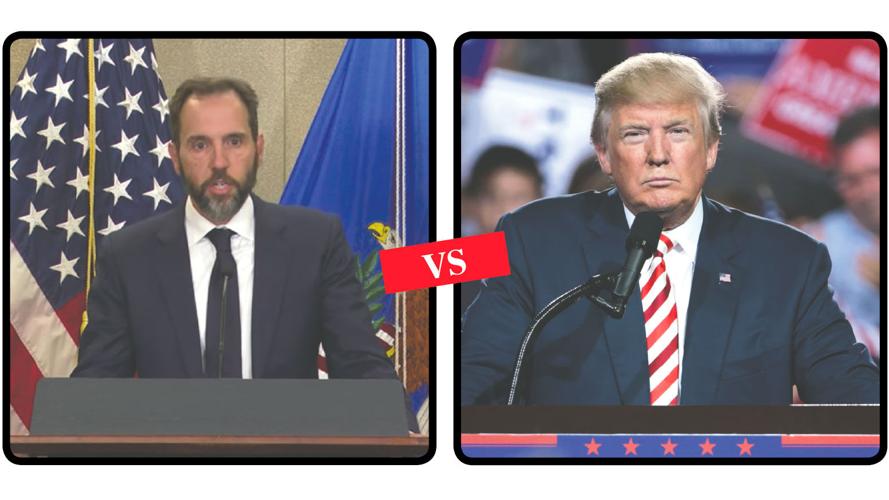
PETITIONER (DONALD J. TRUMP) argues that as former president of the United States, he is immune to all criminal charges, even after leaving office. He asks this court to embrace a theory of presidential authority, according to which no prosecutor or court can hold a former president accountable for either private or official capacity crimes committed while he is in office, and he claims this blanket immunity should endure permanently, including after a president has left office.
This court must unequivocally reject the proposed doctrine of presidential immunity and leave no doubt in the minds of petitioner, the public, and all future occupants of the Oval Office that the president, like all individuals subject to the reach of the U.S. legal system, is not above the law. Of particular concern is the potential adverse impact of presidential immunity on the principle of military obedience to civil authority, the foundation for our civil-military relations since the inception of the Republic. Allowing a president to issue orders requiring subordinates to commit criminal acts or omissions would wreak havoc on the military chain of command and result in an erosion of confidence in the legality of presidential orders. It would also create the potential for disparate interpretations of the duty to obey orders, thereby risking military discipline. While the duty of obedience does not extend to patently illegal orders, an order issued by the president himself would exert a powerful gravitational pull and thus even if of dubious legality would create uncertainty in the ranks. Holding everyone in the chain of command, including the president, to the same principles of accountability under the criminal laws of the United States is essential for assuring the legality of military orders and for providing the reassurance for all levels of the chain of command of that legality.
Any form of immunity doctrine is both unnecessary to protect the interests of the presidency and ultimately dangerous for U.S. national security. This court should reject petitioner’s theory of absolute criminal immunity and should resist any temptation to adopt a weaker version of this same doctrine in the form of a qualified immunity doctrine.
THE PRINCIPLE THAT “NO PERSON IS ABOVE THE LAW” is the bedrock of U.S. national security.
To protect against enemies, both foreign and domestic, the Framers of the U.S. Constitution imbued the office of the presidency with extraordinary powers. Important among these is the president’s role as Commander-in-Chief of the armed forces and state militias when called into federal service. As this court has recognized, it is the rare case in which it would be appropriate for the judiciary to interfere with exercises of Commander-in-Chief authority. This court has rightly adopted a broad attitude of deference towards executive branch action in matters of war powers. However, when that authority is turned “inward” and exercised toward domestic ends, federal courts have been more than willing to reject the legality of presidential action.
The U.S. Constitution establishes two primary safeguards to protect against the risk of a runaway presidency. First, a president cannot continue in office without being reelected. Second, the Constitution provides that a president may be removed from office by a vote to impeach in the House and a two-thirds vote to convict in the Senate. Yet these two safeguards are not sufficient to protect the country from the risk of dictatorship, since a truly corrupt president might attempt to commit crimes to manipulate the vote as well as to deprive the impeachment process of effect. This suggests that the basic principle that the president must comply with the law, on pain of criminal sanctions following conviction for an alleged offense, is an even more fundamental check on the presidency than either the vote or impeachment, since it serves as the protection for those two constitutional safeguards. Put otherwise, the principle that no person is above the law serves as the ultimate protector of U.S. democracy, since it underpins the constitutional safeguards against destruction of the Republic by authoritarian forces within.
The concept of immunity is antithetical to that critical principle.
On at least four occasions justices of this Court have articulated the critical principle that no person, including the President, is above the law. The first time was in 1807 in the case of United States v. Burr, in which Chief Justice Marshall held that President Thomas Jefferson was amenable to criminal subpoena issued in the treason trial of his former vice president, Aaron Burr. The second time was in 1974, at the height of the Watergate crisis, where this court said that President Richard Nixon must comply with a prosecutor’s subpoena of White House tape recordings. The third time was in 1997, where this court held that President Bill Clinton is amenable to civil suit for personal conduct involving sexual harassment while he previously held a state office. The fourth time was in Trump v. Vance, in which this court held that a New York State grand jury was entitled to subpoena a third party accounting firm regarding President Trump’s personal financial records as part of a criminal investigation into possible crimes.
The current case, however, presents an issue never previously before this court because, as petitioner points out, no president before petitioner has ever been criminally prosecuted for official acts allegedly committed in office.
The question is whether this court will decide the matter of criminal indictment of a former president for official capacity crimes in the same way it has decided the foregoing four immunity cases.
Making a former president immune from criminal prosecution could make the presidency itself a profound threat to national security, as it would permit a president to use the great power of the office to further personal interests, such as securing reelection or attempting to avoid accountability for criminal abuse of power. As national security professionals, we emphatically reject the sweeping proposition that all U.S. presidents enjoy legal immunity from criminal prosecution to the “outer perimeter” of their official duties.
It is no exaggeration to say that this proposition is potentially the most dangerous that has ever been advanced in a court of law by any U.S. official. Indeed, it is a proposition that would convert the presidency from the greatest protector of the nation to its single greatest threat.
It is also a profoundly unethical proposal. To establish the president as singularly unfettered by the same generally applicable criminal laws that apply to every other member of society erects an example of lawlessness among the nation’s highest officials. Such lawlessness erodes rule of law values where such values are most needed.
That the president of the United States is subject to the law is clear from the Constitution itself. The Supremacy Clause of the U.S. Constitution, Article VI, provides: “This Constitution, and the laws of the United States which shall be made in pursuance thereof… shall be the supreme law of the land,” making clear that it is the law, not the president, that is supreme.
The constitutional supremacy of the law, not the president or any other person, is consistent with the intent of the Framers. As James Iredell explained in his 1788 speech to the North Carolina convention ratifying the Constitution, it was not necessary for the United States to have a privy council imposing constraints on the exercise of presidential power, as it was to constrain the King in Great Britain. Unlike the King, the President is not above the law: “Under our Constitution we are much happier… No man has an authority to injure another with impunity. No man is better than his fellow-citizens, nor can pretend to any superiority over the meanest man in the country. If the president does a single act by which the people are prejudiced, he is punishable himself, and no other man merely to screen him. If he commits any misdemeanor in office, he is impeachable, removable from office, and incapacitated to hold any office of honor, trust or profit. If he commits any crime, he is punishable by the laws of his country, and in capital cases may be deprived of his life.”

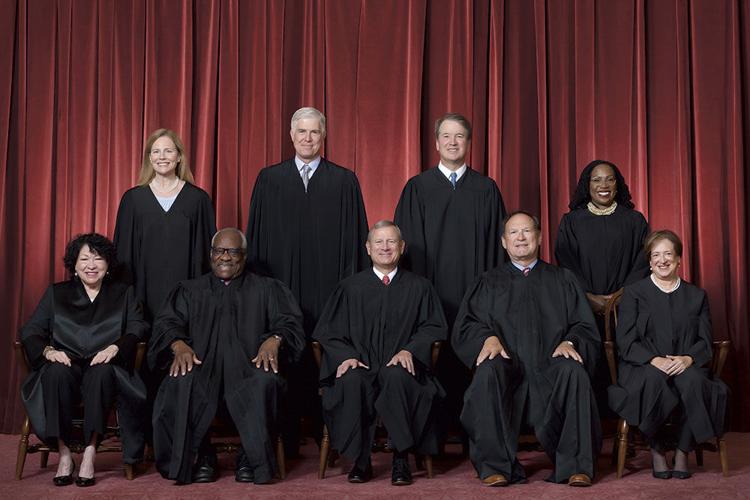
The nine Supreme Court justices heard oral arguments in Donald Trump’s immunity case in April and issued their 6-3 ruling, along partisan lines, on July 1. The conservative-leaning majority includes three justices Trump appointed.
ONE OF THE MOST SERIOUS RISKS OF PRESIDENTIAL IMMUNITY for official capacity acts arises from the potential that the president may abuse his Commander-in-Chief authority, thereby placing the integrity of the armed forces at risk. Imagine a president determined to use the U.S. military to commit crimes against political opponents; to constrain and control domestic civilian populations in violation of federal criminal law; to coerce foreign nations into supporting his bid for reelection by engaging in criminally proscribed corrupt practices; to falsify domestic election results in an effort to criminally defraud the United States; and to coerce the legislative and judicial branches of government into supporting his friends and punishing his enemies.
What would become of impeachment as a check and balance if a president could order SEAL Team Six to intimidate members of Congress and then enjoy immunity unless he was impeached by a majority of the House and convicted by two-thirds of the Senate? Who in Congress would even dare to try to impeach the president under such circumstances?
Likewise, the judiciary could be cowed into submission and the independence of this very court threatened by fear of violence inflicted on its members. The rule of law will be threatened unless federal courts have protection against intimidation by a criminal president in command of SEAL Team Six or any other unit of the U.S. Armed Forces.
The risk of a president who commits crimes to avoid the transition of power is one of the gravest our democracy may face.
The president might deploy troops to control polls, for example. A criminal president could use military force to coerce voters, to coerce state officials counting ballots, or to obstruct the official proceedings in which state legislatures and Congress certify results of elections.
Moreover, a president who has committed crimes while in office has incentive to remain in office to deter or entirely thwart the moment at which he is brought to justice. The risk to democracy, and hence to U.S. national security, is gravest from a sitting president who seeks to undermine the transfer of power, and even greater from a president already under scrutiny for criminal acts. By removing liability for the criminal misuse of official capacity acts, this court could be eliminating the last protection from dictatorship cognized by our constitutional system.
PRESIDENTIAL IMMUNITY FOR OFFICIAL CAPACITY CRIMES would create an untenable dilemma for every member of the military chain of command ordered to execute an order, particularly if officers disagree as to its legality under criminal law. Because any order issued by a president carries with it a presumption of legality and exerts a powerful gravitational force on its recipients, the risk of such disparate interpretations of the duty to obey – even if the order appears on its face to violate federal criminal law – would be exacerbated if the president were unrestrained in the orders he could issue and could therefore violate the law with impunity.
Failure to obey a lawful order for any individual in the military chain of command whose duty it is to obey such order is a serious offense, subject to prosecution by general courts martial.
Any soldier receiving illegal orders has a duty to refuse to carry out those orders. It is presumed that orders are lawful, and a defendant charged with disobeying orders bears the burden of establishing illegality. Any subordinate inclined to disobey an order issued by the president assumes a grave risk of prosecution with a heavy burden to establish the order was in fact illegal.
In the case of an illegal order, the mere fact that it was issued by a president would guarantee uncertainty as to its legality, with the result that obedience could provide a complete defense to any criminal prosecution arising therefrom. This sharply reduces the likelihood that a subordinate officer will refuse to obey a president’s orders, even though immunity from prosecution increases the incentive of the president to issue illegal orders.
Military personnel who instinctively rely on the validity of an order that is passed through the chain of command can nonetheless be prosecuted for obeying the order if it turns out to be illegal. This suggests that presidential immunity from criminal prosecution would create multiple problems for the command function and good order and discipline of the armed services.
First, if subordinates in the chain of command are aware that the Commander-in-Chief is immune from prosecution, some may assume this renders any order legal for purposes of their duty to obey. Others may reach a different conclusion. This could easily result in chaos, with different commanders in the same chain reaching disparate conclusions.
Second, the mere knowledge that the president enjoys immunity may lead subordinates to question their duty to obey presidential orders, something that almost never normally occurs.
Third, because petitioner emphasizes that the immunity he asserts would in no way protect subordinates who commit crimes in obedience to presidential orders, they may fear liability for executing illegal orders, thus causing hesitation to execute other lawful commands of the president and civilian officers. Often there is little time to assess whether an order is legal; a subordinate must be able to rely on the legality of all presidential orders, yet this reliance would be unavailable were petitioner’s theory to hold sway. Worry within the command chain about unconstrained presidential crime could thus have devastating consequences for discipline within the ranks.
Finally, there are always those who will follow presidential orders even if they believe doing so will violate federal criminal law. Illegality from the top does not come with a label marking it as such.
Military and civilian officers might see presidential immunity as a constitutional blank check to issue any order, even orders requiring subordinates to commit crimes, including crimes that endanger national security.
Absolute or qualified immunity of a president could also be mixed with improper use of the pardon power to enable a corrupt president to use the military to accomplish otherwise unlawful objectives. For example, in the SEAL Team Six assassination scenario, the team members would not need to fear the consequences of committing murder if the order to commit the murder were coupled with the promise of a pardon.
Many other scenarios, including torture of prisoners and detainees, could be realized in which the pardon power is used by a legally unbound, immunized president to subvert the military’s allegiance to the Constitution, the rule of law, and military discipline.
PETITIONER SUGGESTS that in the absence of immunity for official acts, any number of presidents throughout history might have been prosecuted for war crimes, based on political accusations that they were committing “crimes.”
However, being “prosecuted” is not the same as being convicted. Even setting aside the exaggerated nature of petitioner’s argument, a conviction for war crimes requires both the judgment of a grand jury that a crime was committed, denial of a motion to dismiss by a judge, and a unanimous finding of guilt beyond a reasonable doubt by a jury.
But if these prosecutorial burdens are satisfied, there is no plausible reason a president should be immune from the criminal consequences of ordering a war crime. Examples cited by petitioner are inherently misleading, as none involve orders that were so clearly unlawful as to support criminal prosecution. He points to President Franklin Delano Roosevelt’s relocation and detention of Japanese Americans during World War II; President Clinton’s launching of military strikes in the Middle East on the eve of critical developments in the scandal involving his affair with a White House intern; the George W. Bush Administration providing what was subsequently understood to be false information to Congress about weapons of mass destruction in Iraq; and President Barack Obama’s targeted killing of U.S. citizens abroad based on a determination they were enemy belligerent operatives, among others. Petitioner points out, “In all of these instances, the president’s political opponents routinely accuse him, and currently accuse President Joe Biden, of ‘criminal’ behavior in his official acts. In each such case, those opponents later came to power with ample incentive to charge him. But no former president was ever prosecuted for official acts – until 2023.”
For this reason, petitioner is convinced that criminal prosecution of a president of any sort “presents a mortal threat to the presidency’s independence.” Yet in trotting out this parade of horribles, petitioner completely ignores the fact that there is a difference between acts that are actually criminal and acts that are merely said to be criminal by political adversaries. None of these decisions resulted in criminal indictment or prosecution for the obvious reason that there was a substantial gap between political hyperbole and evidence indicating violation of federal criminal law. Moreover, it is not necessary for the president to have blanket immunity to be protected from criminal prosecution for acts ordered, solicited, or committed in times of war. Nor would such blanket immunity be desirable. The My Lai massacre in which U.S. troops killed as many as 500 unarmed villagers in Vietnam in 1968 is a reminder that U.S. troops have committed atrocities in warfare and that criminal liability is a critical part of holding anyone accountable who would engage in such acts. Any president who ordered or encouraged a massacre of civilians would rightly be subject to prosecution for his role in such a heinous act.
WE URGE THIS COURT to strengthen, not weaken, the legal and moral authority of the president, particularly as Commander-in-Chief of the armed forces, by holding the president, like every other American, accountable under the criminal laws of the United States.
We urge this Court to reject petitioner’s absolute and qualified immunity theories which would be exceedingly dangerous for both our constitutional framework and for U.S. national security.
(2) comments
U.S. democracy has been teetering (i.e. disappearing) for the last several decades. The main problem is that big money controls our political system. The U.S. Supreme Court, in their 2010 Citizens United ruling, declared that billionaires and corporations can spend as much money as they want to buy politicians and influence elections. Democracy doesn't work if only the wealthy have the power. Big Money will rule until we figure out a way to neutralize it. Some form of campaign finance reform (e.g. public financing) is the only way to take back our democracy.
MCN: im from NYC...we knew 40 years ago EXPOTUS Trump was trouble...a high roller with the LAW...he's still crapping out today.
Welcome to the discussion.
Log In
Keep it Clean. Please avoid obscene, vulgar, lewd, racist or sexually-oriented language.
PLEASE TURN OFF YOUR CAPS LOCK.
Don't Threaten. Threats of harming another person will not be tolerated.
Be Truthful. Don't knowingly lie about anyone or anything.
Be Nice. No racism, sexism or any sort of -ism that is degrading to another person.
Be Proactive. Use the 'Report' link on each comment to let us know of abusive posts.
Share with Us. We'd love to hear eyewitness accounts, the history behind an article.