
Agata Popęda here, inviting you to a lesson in history. This one is special because it’s local and national, personal and historic, all at the same time.
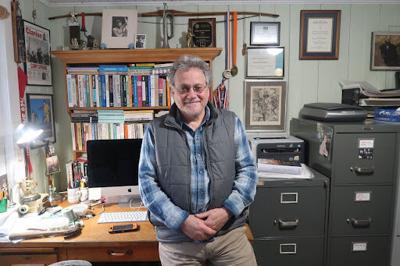
Professor Vincent DiGirolamo is known to many in Monterey, where he was born and where he first embraced journalism—initially as a profession and later as a subject of decades of study. He is a historian of journalism and labor now, particularly interested in the intersection of the two.
“I still recognize faces when I visit,” DiGirolamo says. He travels from the East Coast to the Peninsula three times a year, including obligatory Christmas holiday visits. Now, with arguably the biggest task of his professional life complete, he says he’s ready to return to Monterey permanently.
That task is his book Crying the News: A History of America’s Newsboys, published in 2019 by Oxford University Press. It is, so far, the most complete history of American newsboys. It is also the subject of the cover story in this week’s print edition of the Weekly.
For DiGirolamo the topic is personal. His father was a newsboy—both in Boston and in Monterey. Not in any serious sense of a full-time occupation, but as an easy “gig” within the “penny economy,” where children (until the 1930s) were considered little adults and aspired to provide for the family as soon as they could. DiGirolamo, who also embraced work early (at his family’s restaurant), always wondered if the newsboy experience made his ancestors who they were—business-savvy and entrepreneurial. Was the newsboy experience something quintessential to American character, something that made Benjamin Franklin and Thomas Edison (both former newsboys) titans of work ethic?
Don’t expect an easy answer to these questions. Instead, DiGirolamo presents a systematic study in child labor in journalism from the 18th century to the official (and forced) end of it in the 1930s—in a proper chronological and geographical order.
“I didn’t plan it,” he says, about the geographical span of his scholarship. “But then we were getting more and more materials from all over the United States and decided that there might be people who want to know how many newsboys were active in—let’s say, 1890—in their city.”
Newsboys were part of life in each city; living a street existence that children don’t experience these days. Not in terms of freedom, and not in terms of ability for collective action. The newsboys' strike of 1899, a youth-led grassroot campaign, forced a change to the way that Joseph Pulitzer and William Randolph Hearst's newspapers compensated their workforce of newsboys. As a result of the strike, the papers (The New York World and The New York Journal) gave in and started to buy back unsold newspapers. It was a small victory.
DiGirolamo thinks that people deserve to know and remember the past, just like American newsboys (and newsgirls) deserve to have their story told. Not only those who—like Edison and Franklin—became symbols of American success, but also those who never made it, except for coming back home and giving their mother a coin for tomorrow’s milk.

(0) comments
Welcome to the discussion.
Log In
Keep it Clean. Please avoid obscene, vulgar, lewd, racist or sexually-oriented language.
PLEASE TURN OFF YOUR CAPS LOCK.
Don't Threaten. Threats of harming another person will not be tolerated.
Be Truthful. Don't knowingly lie about anyone or anything.
Be Nice. No racism, sexism or any sort of -ism that is degrading to another person.
Be Proactive. Use the 'Report' link on each comment to let us know of abusive posts.
Share with Us. We'd love to hear eyewitness accounts, the history behind an article.