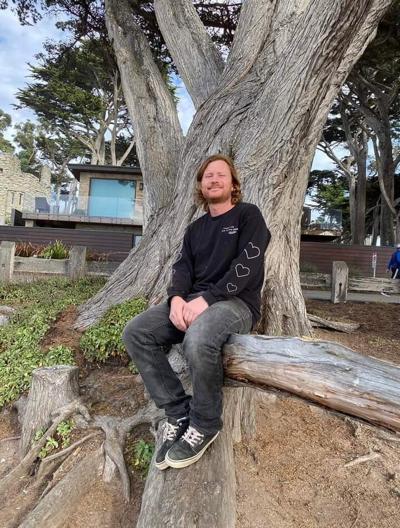

Pam Marino here, acknowledging that heartbreaking stories are never easy to report or share, but I believe they are important for the community to know about. They may serve as cautionary tales that help save other people from heartbreak. Maybe they can help save an entire generation from heartbreak.
That’s perhaps a bit too optimistic. But it was an idea I was struck with while reporting one of my latest stories about two fentanyl overdose deaths that took place on May 15 and May 16 in Monterey.
I was able to connect with one victim’s family, Forrest Eggleston, 41, who was well-known on the Monterey Peninsula as an artist and within the skateboarding community as a pioneer of off-road skateboarding.
Eggleston’s family and a family friend wanted to speak with me because they wanted people to know that he was so much more than his addiction. I hope you will read Eggleston’s story, available on newsstands now, or online.
In talking with Eggleston’s cousin, Zarosh Eggleston, he said something to me that really stood out.
“The best way to beat drug addiction is to have a generation that does not open that door,” he said.
That same sentiment is something I’ve heard from other addiction experts in the county, because opioids like fentanyl—and other much stronger drugs making their way into the street supply—are so addictive, it’s extremely hard to get off of them without a lot of help, including drugs like buprenorphine, which I’ve reported on. It’s an older opioid used to treat opioid use disorder.
Those counterfeit pills we used to report about? They’re still around, but gone are the days when people didn’t know they were getting fentanyl in their drugs. Now users know what they’re using and they know they could die, one drug counselor told me. The pull of the drug is just that strong.
The answer I’ve heard from people like Dr. Susan Swick, executive director of Ohana, Montage’s child and adolescent behavioral health center, is that we as a community need to help children learn to be resilient, to achieve mental fitness, so that using drugs or alcohol doesn’t become the way to cope with life’s challenges.
Zarosh was critical of older generations which he believes normalized using drugs and alcohol to cope with life and discouraged people talking openly about their issues.
“We need a generation that normalizes therapy,” he said.
I heartily agree with him. I also believe the old ways of warning kids about drugs (DARE, Just Say No) didn’t work. The approach of Swick and others in the community of teaching resilience and mental fitness is probably our youngest generation’s best hope to avoid opening that door to substance abuse.
Do you agree? Have another idea? I’m always open to hear what readers have to share.

(0) comments
Welcome to the discussion.
Log In
Keep it Clean. Please avoid obscene, vulgar, lewd, racist or sexually-oriented language.
PLEASE TURN OFF YOUR CAPS LOCK.
Don't Threaten. Threats of harming another person will not be tolerated.
Be Truthful. Don't knowingly lie about anyone or anything.
Be Nice. No racism, sexism or any sort of -ism that is degrading to another person.
Be Proactive. Use the 'Report' link on each comment to let us know of abusive posts.
Share with Us. We'd love to hear eyewitness accounts, the history behind an article.