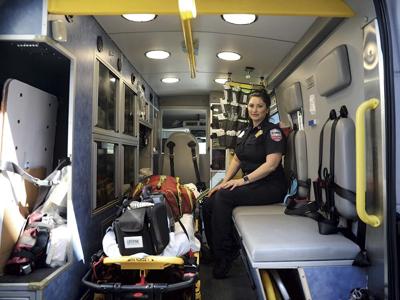

In the anxiety over the never-ending war on drugs, one opioid called buprenorphine was caught up in the fervor, severely restricting its availability. This, despite the drug’s ability to stop the pain of withdrawal, save people from overdoses and help them regain stability in their lives. In December, Congress loosened restrictions, and just four months later, on April 1, paramedics in Monterey, Santa Cruz and San Benito counties will have the ability to administer buprenorphine to patients suffering from the pain of withdrawal in the field – the first region in California to have that ability.
“I’m excited to make people feel better so they don’t feel so awful,” says Rachel Kneeland, a paramedic and the clinical education supervisor for American Medical Response, the ambulance contractor for Monterey County. Kneeland says the patients they encounter in opioid withdrawal are in a lot of pain, and moving forward she and other AMR paramedics in the tri-county region will be able to relieve that pain using “bupe,” as it’s been nicknamed, in the field after communicating with doctors.
Dr. Reb Close, an emergency physician at Community Hospital of the Monterey Peninsula and co-founder of Prescribe Safe, an initiative to curb drug use, led the charge in bringing buprenorphine to the region after Contra Costa County was the first county in California to train paramedics to use it. Close says patients in withdrawal will no longer have to wait for pain relief while being transported to an emergency room. “Withdrawal is agony. Leaving someone in agony for 10 minutes when you have a safe and effective treatment like this, I can’t follow that thought process,” Close says.
The drug works by tightly binding to opioid receptors in the brain, partially activating the receptors, but not fully, and in the process blocking other opioids from getting to the receptors. “It has a sealing effect. It’s just a wild medicine,” Close says. It’s been successfully used for years to help people stop using other dangerous opioids.
Another benefit is that it prevents people from overdosing on another opioid like fentanyl, says Dr. Casey Grover, also a CHOMP emergency physician, a co-founder of Prescribe Safe and Close’s husband. He says parents of children with opioid use disorder are grateful. “They know if their child is on it they’re not going to have an overdose,” he says.
Kneeland says all 170 people in AMR’s regional workforce have been trained to use the drugs, including emergency medical technicians, who cannot administer it themselves but can assist paramedics. All seven regional hospitals are on board, and each has substance abuse experts who will refer patients for treatment.

(0) comments
Welcome to the discussion.
Log In
Keep it Clean. Please avoid obscene, vulgar, lewd, racist or sexually-oriented language.
PLEASE TURN OFF YOUR CAPS LOCK.
Don't Threaten. Threats of harming another person will not be tolerated.
Be Truthful. Don't knowingly lie about anyone or anything.
Be Nice. No racism, sexism or any sort of -ism that is degrading to another person.
Be Proactive. Use the 'Report' link on each comment to let us know of abusive posts.
Share with Us. We'd love to hear eyewitness accounts, the history behind an article.