
David Schmalz here. I’ve never much liked the term “Lettuce Curtain,” the oft-used metaphor to describe the divide between the Salinas Valley and the Monterey Peninsula—in my view, the more people believe it’s real, the more it becomes self-fulfilling. It’s a term that presumes division, an us vs. them mentality.
Yet, what are the differences between the average resident of Seaside, where I live and work, and the average resident of Salinas? I would argue they are few.
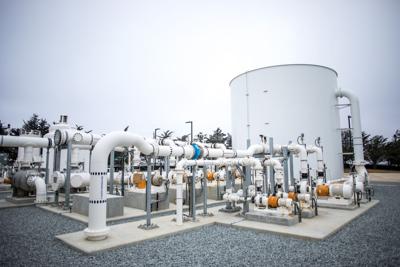
But one thing that seems to perpetuate the term are squabbles over water, and as a result, Monterey One Water, the regional sewage treatment agency whose infrastructure straddles the curtain, often finds itself facing heightened scrutiny from both sides.
For nearly 30 years, the agency has provided recycled and treated water for growers in the northern Salinas Valley through a series of projects with the Monterey County Water Resources Agency. Their aim is to both provide growers with water while also stemming the march of seawater intruding into the aquifers, which is brought on by excessive pumping.
Tomorrow, the MCWRA Board of Supervisors (i.e. the county board of supervisors), will be presented with a financial audit commissioned by MCWRA last year to assess the accuracy of expenses M1W has billed to MCWRA over the fiscal years 2018-19 to 2021-22 for the projects they partner on.
The audit produced seven “findings,” some of which M1W argues are redundant or inappropriate, or arguably inaccurate. And the findings don’t make M1W look good: According to the auditors, GPP Analytics, Inc., M1W overcharged MCWRA an estimated $1.11 million over the course of the four audit years, more than half of which came in fiscal year 2021-22. GPP recommends that M1W return the “overcharged” amount.
But also included in the documents before the supervisors is a response letter from M1W signed by General Manager Paul Sciuto, who writes, “the report’s conclusions are almost exclusively based on a narrow interpretation of an ambiguous agreement.”
The response also makes clear that M1W has implemented new time-keeping procedures to “better define when and how to record project-based hours.” It also states M1W has already initiated meetings with MCWRA staff to build trust, transparency and to work through any misunderstandings there may be.
Broadly, M1W’s response pushes back on all the findings, and it’s not clear where things go from here other than to talk things through and find common ground. Both agencies have long been tied at the hip to each other due to a handful of vital regional groundwater projects, and that will continue to be the case for many years to come.
For his part, MCWRA General Manager Ara Azhderian says he plans to meet with Sciuto and others in the coming weeks to discuss or work through whatever differences the two agencies might have, but stresses that ultimately the two agencies are committed to being partners.
Sciuto, meanwhile, admits that M1W “could have done better,” and that the agency started implementing procedural changes after seeing the first draft of GPP’s audit.
“It's frankly a good, open discussion,” Sciuto says of the conversations sparked by the audit, and that some of the two agencies’ joint projects—like the Castroville Seawater Intrusion Project (CSIP)—have been around for 26 years. “Obviously [it’s] done some good for this community. I hope there's another 26 years in it.”
I hope so too—seawater intrusion continues to worsen despite those mitigation efforts, but it would unquestionably be worse without them.
And while I won’t be surprised if M1W takes some arrows from the public as a result of the findings, I hope they don’t come from an us vs. them footing.
We may not all drink from the same milkshake, but in Monterey County, we are all part of a regional community with broadly shared goals.
We’re a team, if you will, and from a regional perspective, I think it’s best for local agencies and their constituents to start thinking as one—myriad challenges yet unknown are sure to face us going forward, but as the saying goes, “teamwork makes the dream work.”

(1) comment
The audit is more incriminating than described here. For instance, M1W chose to not use the agreed upon accounting methods and the one they used was laughable. Highly placed people at M1W haver deservedly lost their job. What is most concerning is the possibility that in the reach for source waters needed to make Pure Water Monterey look good, M1W used water to which they do not have rights. A water audit has been called for as well and M1W needs to begin cooperating so we have a real picture of the waters supply for the Salians Valley and the Monterey Peninsula. This second audit is far more important.
Seems too often the Peninsula expects Salinas to give them water to prove what good neighbors they are. Among other reasons, the Groundwater Sustainability Act won't allow that to happen. For years we've been told how M1W and MPWMD have this all figured out. You would be surprised if you knew what has really been going on and this audit is a solid indicator. Let's not sweep this under the rug.
Welcome to the discussion.
Log In
Keep it Clean. Please avoid obscene, vulgar, lewd, racist or sexually-oriented language.
PLEASE TURN OFF YOUR CAPS LOCK.
Don't Threaten. Threats of harming another person will not be tolerated.
Be Truthful. Don't knowingly lie about anyone or anything.
Be Nice. No racism, sexism or any sort of -ism that is degrading to another person.
Be Proactive. Use the 'Report' link on each comment to let us know of abusive posts.
Share with Us. We'd love to hear eyewitness accounts, the history behind an article.