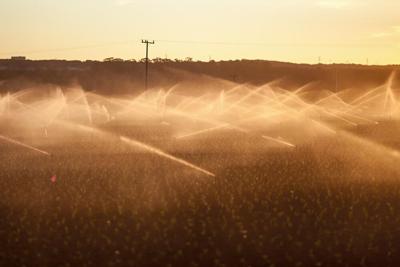

In the driest years for Monterey County, the water available in the Salinas River is not enough to supply a single household. In the wettest year of the past three decades, 1995, there were 100,000 acre-feet of water available, more than the total urban usage in the county. Although the flow fluctuates wildly, the average amount is far more than what is needed, for example, for thirsty coastal cities desperate for housing.
The water has been available for decades – the right to use it is protected, encouraged and even required by state law – but it’s been flowing into the ocean, a casualty of Monterey County’s political deadlock.
In 2013, for example, water leaders on the Monterey Peninsula proposed to end the overpumping of the Carmel River by pumping just a small fraction of the excess flows of the Salinas River. That proposal lost steam quickly compared to aspirations to build a small desalination plant for the Peninsula, a plan whose biggest proponents acknowledge could send the area’s already high water rates skyrocketing.
Now, as the desalination plan appears to be falling apart, the Weekly interviewed more than a dozen engineers, experts and elected officials about this untapped source of water. The goal: To figure out why the farmers of the Salinas Valley appear content to watch that water flow past them as they drill wells for irrigation, and why leaders on the Monterey Peninsula seem to have forgotten about it while focusing on imperfect alternatives.
What the interviews show is that Salinas River water could have gone long ago to serve the unmet needs of the Monterey Peninsula. It would take cutting through some red tape and building the appropriate infrastructure. The real reason that it has never been done is that certain groups of people can’t or won’t work with each other.
“The issue isn’t that we don’t have enough water in Monterey County,” says Howard Franklin, a senior hydrologist with the Monterey County Water Resources Agency. “It’s that we don’t have it where we need it. It’s an infrastructure issue. That can be solved.”
When state authorities issued Permit 11043 in 1949, they recognized a right to draw a portion of the Salinas River, 169,000 acre-feet, for irrigation and urban use. California requires water right holders use it or lose it. By 2010, the water had gone unused for so long that the state was moving to take away the permit. The holder of the permit, the Monterey County Water Resources Agency, fought to keep the water right, and a compromise was reached with an amended permit for slightly less water, 135,000 acre-feet.
Back then, Dave Stoldt had recently come on as general manager at the Monterey Peninsula Water Management District, whose overarching goal is to develop a new water supply for the region. He helped come up with a plan known by the clunky acronym MC2WS2, for Monterey County Cooperative Water Supply Solution.
The idea was to lease a portion of the 11043 water right for 30 years. The water would be drawn at the Salinas River’s rubber dam north of Marina, treated near the existing wastewater plant and then piped over. This arrangement was projected to cost $14.5 million a year, about half of the projected cost for desal at the time. In return, cash-strapped MCWRA would get money for needed water infrastructure elsewhere in the Salinas Valley.
It was supposed to be a win-win, but the pitch died almost immediately. “The concept was rebuffed by MCWRA staff and representatives of the agricultural industry,” Stoldt says.
Lew Bauman, the former County Administrative Officer, explains why: “There was pretty strong emotion among many Salinas Valley folks that it’s ‘their water,’ and it’s limited. And they don’t want to use it for urban purposes – other than the urbanization in the Salinas Valley.”
George Riley, a board member of the Peninsula water district, says he’s also come up against that emotion. “[The idea of exporting water from the Valley to the Peninsula] gets shut down and so fast it’s not a viable option,” Riley says. “There’s a history of ag interests saying ‘not one drop of this water is going to leave our area.’”
Opponents refer to a condition on Permit 11043 that says the water can only be used in Zone 2 of MCWRA, and the Peninsula is not in Zone 2. Meanwhile, an appendix to the State Water Code, known as the Agency Act, says no water pumped out of the ground can leave the valley.
There’s good reason for the ag industry to be reluctant about changing the rules and helping the Peninsula, says Norm Groot, executive director of the Monterey County Farm Bureau.
“What it really boils down to is that the Salinas Valley has spent seven decades building various different projects and spending their money, improving their water resources, and the Peninsula has not,” he says. “They’ve had several opportunities and have voted down and turned down numerous projects. And I think most people in the Salinas Valley, at least the farming and ranching community, feel that it’s not something that we can spare, nor is it something that we want to help with at this point.
“The Peninsula has worked itself into a corner. If they think they’re going to look at that particular water permit to solve their problem, then, yes, it would become a water war between the Salinas Valley and the Monterey Peninsula.”



(0) comments
Welcome to the discussion.
Log In
Keep it Clean. Please avoid obscene, vulgar, lewd, racist or sexually-oriented language.
PLEASE TURN OFF YOUR CAPS LOCK.
Don't Threaten. Threats of harming another person will not be tolerated.
Be Truthful. Don't knowingly lie about anyone or anything.
Be Nice. No racism, sexism or any sort of -ism that is degrading to another person.
Be Proactive. Use the 'Report' link on each comment to let us know of abusive posts.
Share with Us. We'd love to hear eyewitness accounts, the history behind an article.