
David Schmalz here. One thing I’ve been thinking a lot about lately is that, while most voters frame elections in terms of who wins or loses in a race—president, governor, senator or even a city councilmember—some of the most impactful votes relate to citizen-driven ballot propositions.
My father, when I was growing up, was the general counsel for Spreckels Industries—Spreckels Sugar was a subsidiary—so I always trusted his wisdom when it came to legal matters. He was of the opinion that California’s system of putting measures on the ballot, as opposed to professional lawmakers doing the work of hashing out laws that function as intended, was not a smart way to run a government.
As I’ve grown older, I’ve come to appreciate that wisdom more every day, and it’s been on my mind lately because I’m trying to understand how California is going to weather the climate crisis in the years ahead while insurance companies flee for the doors.
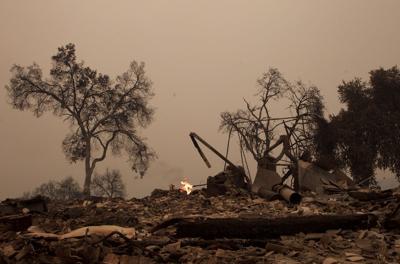
And after reading a story recently about State Farm not renewing homeowner’s policies in various parts of the state, I perked up. My hometown is Orinda, in the East Bay, a literal bridge-and-tunnel suburb that is a hilly, oak-studded community with plenty of fuel to burn—the house I grew up in is surrounded by trees on all sides, as is the neighborhood. It’s also one of the communities statewide that’s been hit hardest by the cancellation of insurance policies.
So I called my dad this morning to check in on the insurance status of his home—the one I grew up in—and he told me that yes, his State Farm insurance will not be renewed, and will expire in December. That means he has to enter the state’s FAIR insurance plan, which will likely be double the cost—maybe $5,000 per year? (he was just spitballing)—but he’s still trying to figure that out.
Did this all come to bear because of Prop. 103, which voters passed in 1988 to prevent insurance companies from pricing risk into their policies? Maybe.
Folks in California have had it good for a long time—Prop. 13 capped their property taxes in 1978, Prop. 103 controlled their insurance rates in 1988, but both have had downstream impacts, and the flow doesn’t seem to be stopping anytime soon.
On its face, Prop. 103 seems insane, and I’m not trying to devalue the home I grew up in, but I’ve long told my two brothers that if we ever inherit the house, we must sell immediately—Orinda is a tinderbox. Lovely, though.
Yesterday I talked to Michael Soller, a spokesperson with the California Department of Insurance, to suss out how much of an impact Prop. 103 has had on insurance rates, and why companies are leaving the state. (Broadly speaking, Prop. 103 dictates that insurance companies must get permission from the state to raise rates, and cannot base them on future risk.) He believes insurance companies need to be doing more to communicate the risks homeowners have, and not just with a price signal, but with local governments—the more information the better, and insurance companies have good information.
Because I have an instinctual sense of their information, at least in places I’ve lived, I can’t blame them for bailing out, and thankfully, the state is making this current insurance crisis a priority as well—last September, Gov. Gavin Newsom issued an executive order that spoke to the current challenges, and called on CDI, among other things, to expand coverage for consumers, expedite review and ensure the FAIR plan—which is paid into by insurers—remains solvent.
But the bottom line is this: the system is broken, and all the homes in the wildland-urban interface are why. So, if you live in one of those places, make sure you’re part of a Firewise community, and, Soller says, clear any plant within 5 feet of your house.
It’s not an if, but a when situation, so harden up.

(1) comment
Propositions are a necessity when the Legislators don't act. Government loved the high revenus on property, when Proposition 13 took the wind out of their sails, and they scrambled looking for alternatives. Many people lost their property, unable to pay their taxes, until Proposition 13 was passed. I'm sure many of the others were well received.
You come from an interesting background: Claus Spreckels formed not only the town of Spreckels in California (https://www.spreckelssugar.com/history.aspx) but also Spreckelsville in Hawai'i (https://en.wikipedia.org/wiki/Spreckelsville,_Hawaii).
My mother worked for Spreckels Sugar, though as a chemist for only a few years, before she was burdened with raising kids.
People should ditch wooden/asphalt shingles, and go with fire-resistant materials, And yes, keep a good fire-perimeter around your abodes. Perhaps legislation could be enacted to provide financial incentives for such, as well as reduction in insurance premiums for such.
Welcome to the discussion.
Log In
Keep it Clean. Please avoid obscene, vulgar, lewd, racist or sexually-oriented language.
PLEASE TURN OFF YOUR CAPS LOCK.
Don't Threaten. Threats of harming another person will not be tolerated.
Be Truthful. Don't knowingly lie about anyone or anything.
Be Nice. No racism, sexism or any sort of -ism that is degrading to another person.
Be Proactive. Use the 'Report' link on each comment to let us know of abusive posts.
Share with Us. We'd love to hear eyewitness accounts, the history behind an article.