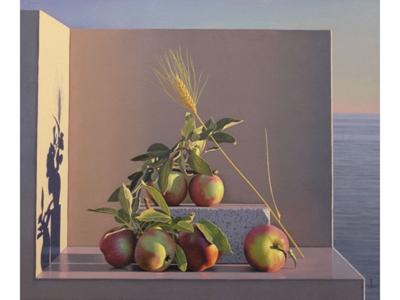
Thanksgiving seems like an especially American holiday, particularly since its modern form celebrates the rites of football and pre-Christmas sales. But in fact, it has ancient roots that I first discovered in Katmandu, Nepal. I noticed that rice, fruit and other foodstuffs were left at the small street-side shrines and that feral chickens and sparrows would peck at the offerings.
Those scenes reminded me of still-life paintings that I had seen from ancient Pompeii and Herculaneum, the cities destroyed in the eruption of Mt. Vesuvius in 79 CE.
The paintings were of fruits, vegetables and nuts left on altars with chickens and birds pecking at them, just as I had seen in Nepal. I discovered it was commonplace in ancient times to honor the good fortune of the harvest by leaving a portion of the bounty on an altar or shrine in thanks. The offerings were called Aparchai in Greek and Primitiae in Latin.
These activities of metaphysical communion with the gods date back to neolithic times when life and death meant entering into the story of whatever vague or specific forces they believed in. These inclinations run deep in the human psyche. In early cultures all elements of life, including inanimate objects like rocks, had meaning and spirit. The 20th-century Carmel poet Robinson Jeffers sees the soul of a “living rock” and describes its “silent passion… deep nobility and childlike loveliness: this fate going on outside our fates.” To be truly thankful toward nature is to wish for its integrity and its preservation.
In addition to food offerings, I further learned that gold sheaves of wheat, ceramic fruit or even paintings might be left as substitutes for the real thing. The temples must have been hung inside with hundreds of those paintings projecting the idea of gratitude in the dim light. But the paintings hung or painted on the walls in homes would have represented that particular family’s sense of generosity and thankfulness. These works of art had more than aesthetic value – they metaphysically connected with the spirit of the sustaining harvest and with nature itself.
The idea of extending the concept of Thanksgiving into the whole of the year has a great grace and beauty to it. It need not have a particular (or any) religion attached to it. In ancient times, it was a household shrine that daily drew attention. That attention is a spiritual act that reaffirms our humanity. I believe in the famous quote by the 13th-century mystic, theologian and philosopher, Meister Eckhart. He said, “If the only prayer you say in your entire life is ‘thank you,’ it will be enough.”
(1) comment
MCN: Thanksgiving the holiday? overrated i prefer a simple thanks.
Welcome to the discussion.
Log In
Keep it Clean. Please avoid obscene, vulgar, lewd, racist or sexually-oriented language.
PLEASE TURN OFF YOUR CAPS LOCK.
Don't Threaten. Threats of harming another person will not be tolerated.
Be Truthful. Don't knowingly lie about anyone or anything.
Be Nice. No racism, sexism or any sort of -ism that is degrading to another person.
Be Proactive. Use the 'Report' link on each comment to let us know of abusive posts.
Share with Us. We'd love to hear eyewitness accounts, the history behind an article.