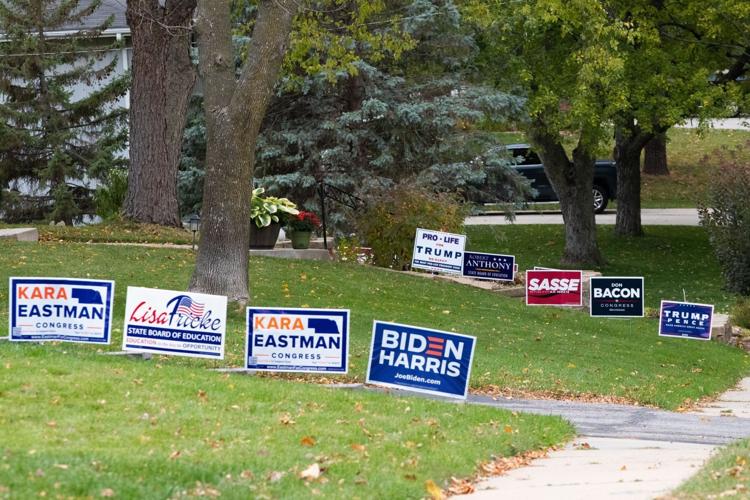
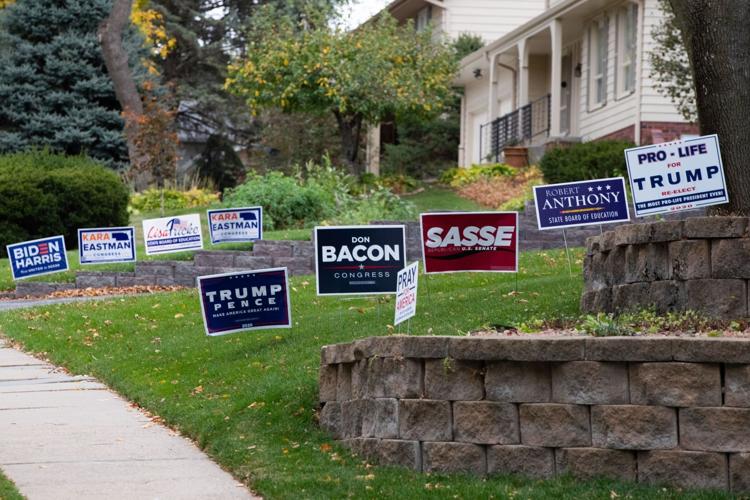
Don Bacon and Kara Eastman are facing off for Nebraska's 2nd congressional district seat.
In a hyperpartisan election year — in what can seem like a hyperpartisan world — Jonathan Snover is a unicorn. He’s an undecided voter.
The 19-year-old Omahan grew up in a politically mixed home, is still forming his own opinions and registered as an independent when he became old enough to vote.
Neither candidate representing the two major political parties — Republican President Donald Trump or Democrat Joe Biden — gets him particularly jazzed.
Snover, a student at Metropolitan Community College who works at a QuikTrip convenience store, doesn’t think his political beliefs square neatly with either party’s platform.
Like many Democrats, he supports some modest gun control reforms. Like many Republicans, he generally approves of having states, rather than the federal government, lead the way on the response to the COVID-19 pandemic. He tends to agree with Trump on immigration. He’s also willing to see some police funding — but not all — shifted to other community needs, such as mental health support.
“I really consider myself moderate and don’t necessarily lean one way or the other,” Snover said recently. “That’s why I’m having such a tough time deciding who to vote for. I’m just kind of all over the place.”
For die-hard Trump or Biden fans who had their minds made up long ago — and the tens of millions of Americans who have already taken advantage of early voting — it may be hard to fathom that some people are still deciding. The two candidates have very different stances on many issues, including tax cuts, Supreme Court justices and immigration policy.
But in a recent New York Times/Siena College Research Institute poll, 6% of respondents said they still didn’t know who they were going to vote for in the presidential race or refused to divulge their pick.
Trump will almost certainly cruise to victory in Nebraska, a GOP stronghold where voters in 2016 embraced his tough talk, tax policies and support for the Second Amendment. Statewide, registered Republicans easily outnumber Democrats, and Trump signs are a fixture in many yards and cornfields.
But in Nebraska’s 2nd Congressional District, which covers Douglas and western Sarpy Counties, undecided or independent voters might be the difference in deciding whether Trump or Biden wins the district’s potentially significant electoral vote. The district previously broke from the rest of Republican-leaning Nebraska in 2008 to side with Barack Obama.
The district has more than 166,000 registered GOP voters, about 161,000 registered Democrats, 6,800 Libertarians and just over 110,000 registered nonpartisans.
The World-Herald talked to several undecided and independent voters about the issues driving their ballot decisions, particularly in the presidential race.

The response to the ongoing coronavirus pandemic, which has infected millions of Americans and killed more than 220,000, is at the forefront for many.
“I feel neither candidate has clearly stated how they will deal with the ongoing pandemic issues,” said Andye Serflaten-Lamm, a 37-year-old registered independent from northwest Omaha who works part time as a nanny and fitness instructor. “I feel like the current administration has handled it poorly so far. My hope is that whomever wins the election gets a better handle on things. I feel America needs clear guidelines on how we should move forward. One clear message, instead of every state or person deciding for themselves.”
Affordable and accessible health care is a big issue for her, too. She remembers being a single mom making minimum wage and going without health insurance for three years.
She prefers voting by mail, so she can pore over her ballot and research the different races and candidates. She has turned in her ballot already, but declined to say how she voted.
“I choose to be independent because I agree and disagree with a number of core beliefs on both party lines,” she said.
Randall Adkins, a political science professor at the University of Nebraska at Omaha, said recent polls and surveys are showing that for many voters, the pandemic and issues related to it, such as health care and the economy, have squeezed out other concerns that may have dominated past elections.
“It’s taken issues like crime and foreign policy and gun control and immigration and pushed them all down the ladder,” he said. “How much are you hearing about climate change? Abortion? Race and equality — that’s been a big issue, driving the Democrats in the primary. (But) as we’ve moved into the general election season, it’s really not registering the way it was before.”
Adkins said most people have already made their decision, and the idea that undecided or swing voters may radically change the course of an election is largely a myth.

Various Democratic and Republican candidate yard signs are seen in two neighbors’ front yards along Leavenworth Street in Omaha on Wednesday, October 14, 2020.
“It’s very rare you find somebody who’s a true independent,” he said. “If we push them in survey research, most people lean toward one party over another. … Most people who are leaners, more often than not, do vote with the party that they lean toward.”
Bennington resident Brian Logan, 33, works for an alcohol distribution company and spends a lot of time in grocery stores for his job. He knows what it’s like to still have to report to work every day, often out in public, even while the coronavirus continues to spread. He doesn’t think the Trump administration’s response has been effective.
He’s a prime example of how people’s beliefs and voting patterns can shift over time, or how voters may not feel truly aligned to any one party platform.
“Both parties have their issues,” he said.
Logan voted Republican in the 2008 and 2012 presidential elections. He would have likely voted for Republican congressman Paul Ryan if he had run in 2016, but ultimately voted for Libertarian candidate Gary Johnson. He didn’t find Trump or Democratic nominee Hillary Clinton particularly appealing.
“I didn’t think he was going to win,” Logan said of his vote for Johnson. “Ultimately, it may seem like throwing a vote away, but I didn’t want to vote for either of the two parties.”
This year, he said he’s more plugged into politics and current events — he listens to a lot of podcasts while driving. He switched his registration to Democrat so he could vote for Bernie Sanders in the presidential primary, appreciating Sanders’ years-long crusade for a single-payer health care system. And now he has voted for Biden.
“This year you can’t really afford to vote third party, you kind of have to vote one way or the other,” he said.
“He’s not awful,” Logan said of Biden. “I think it’s a very … establishment is I guess the word I’m looking for. He’s a very establishment pick.”
That’s not the most ringing endorsement, and Logan doesn’t consider himself a Democrat. Still, he acknowledged that Democratic candidates like Biden and 2nd District congressional candidate Kara Eastman are closer to his views on health care and climate change.
Gino Ormond, 49, lives in Omaha and was a graphic designer until he was laid off in April as the economy flatlined due to the pandemic.
He’s a registered independent who’s still deciding, but he’s leaning toward Libertarian candidate Jo Jorgensen.

For die-hard Democrats or Republicans who had their minds made up long ago — and the tens of millions of Americans who have already taken advantage of early voting — it may be hard to fathom that some people are still deciding.
“Honestly, Biden scares me. Just watching some of his comments on live TV makes me wonder if he isn’t suffering from memory issues,” he said. “I would vote for Trump just purely looking at the facts of the things he has changed and done in office. But his Twitter stuff and the things he says sometimes is just mind-blowing.”
Ormond, who also voted Libertarian in 2016, said he’d like to see more viable third-party candidates.
“(I’m) also disappointed that the Dems had a lot of good young men and women running for president, but they seem to push all them out and in the end you have two old white guys,” he wrote in an email. “They talked about how they are the party of change, and in the end they really didn’t deliver.”
Omahan Ryan Depaz, 29, has already heard the groans from friends and family who can’t believe he’s voting third party again this year.
“There are absolutely some friends who are voting Republican or Democrat who ask, ‘Why are you wasting your vote on a third-party candidate?’ ” he said. “That comes up pretty frequently.”
But Depaz is confident that he’s making the right decision and believes he is a fully informed voter. He works for a financial technology company but was previously a high school social studies teacher and has a master’s degree in political science. He’s used to digging into issues.
He entered college as a Republican but is now registered as a Libertarian, describing himself as kind of a classic social progressive-fiscal conservative. He voted for Johnson in 2016 and will vote for Jorgensen this year, based largely on her criminal justice reform platform that includes ending qualified immunity for police and decriminalizing nonviolent drug offenses.
“I definitely don’t vote along that party line,” he said. “For example, last congressional run between (Republican U.S. Representative) Don Bacon and Kara Eastman I voted for Don Bacon, and now I’m switching to Kara Eastman. I’m not too happy with the way Rep. Bacon has been voting.”
Omaha World-Herald Election Guide 2020
He’s liked little about Trump’s presidency, aside from some modest steps to curb the cost of insulin. Biden is uninspiring, he said, a status quo candidate whose 1994 crime bill led to more people being incarcerated.
Jorgensen has “a history of sticking to the core values she’s been promoting,” he said.
As election day draws near, Snover, the uncertain 19-year-old, is feeling the pressure to make a decision.
He knows a lot of young people identify as progressive Democrats, but he knows passionate Trump voters, too. This is his first time voting in a presidential election, and he doesn’t want to screw it up.
“There’s a lot of pressure — ‘You’re not going to vote for this guy, you’re not going to vote for that guy,’ ” he said. “I want to be myself, too. I don’t want to mold into someone I know.”
Trump’s bombastic personality can be grating, Snover said, and Biden is a bit of a cipher. He watched about an hour of the first presidential debate but said he didn’t learn much — the two just seemed to be talking over each other.
By last week, he had received his mail-in ballot. The deadline for a decision is fast approaching.
A little more than a week to go until Election Day.
World-Herald staff writer Aaron Sanderford contributed to this report.
Our best staff images of October 2020
Photos: Our best staff images of October 2020
Roses
Updated
People smell the flowers in the Memorial Park Rose Garden in Omaha on Tuesday, September 29, 2020.
Friday Night Lights
Updated
Omaha Skutt's Sam Scott scores a third-quarter touchdown against Gretna.
Vice President
Updated
Vice President Mike Pence arrives at Eppley Airfield in Omaha on Thursday, October 01, 2020. The vice president spoke at PVS Structures, a metal fabricator, in Carter Lake, Iowa as part of a Make America Great Again! campaign event.
Touchdown
Updated
Gretna quarterback Zane Flores lucks up after rushing for a third quarter touchdown against Omaha Skutt.
Pet Parade
Updated
Dawn Forney, left, and Jolynn Keplinger, both of Omaha, wear Tigger and Winnie the Pooh costumes as their dogs Bitsy, a 6-year-old Maltese poodle mix and Scarlet, a 3-year-old Great Dane, wear Piglet and Eeyore costumes for the pet parade during Farnam Fest along Farnam Street in Omaha on Saturday, October 3, 2020.
First Day Back
Updated
Students arrive for the first day of in-person class for OPS elementary schools at Springville Elementary School in Omaha on Monday, October 5, 2020. Families that have opted for in-person teaching will follow a 3-2 model, with students in the classroom every other day.
Pumpkin Paint
Updated
Reagan Garvey, left, and Sarah Babe, both 19 and of Omaha, paint pumpkins at Elmwood Park in Omaha on Monday, October 12, 2020.
Nature Color
Updated
A tree changes colors at Elmwood Park in Omaha on Monday, October 12, 2020.
20201013_new_wildart_ar05
Updated
Siblings Juan Jesus Alvarez, 10, and Shantaly Alvarez, 9, of Omaha build a structure modeled after a Native American tent with branches at Elmwood Park on Monday.
Enter
Updated
Millard West takes the field before the start of the Millard West vs. Bellevue West football game at Bellevue West High School on Friday, October 9, 2020. Bellevue West won the game 42-7.
Harvest
Updated
Zach Benes harvests soybeans on farm east North of Lincoln, just east of North 40th Street, north of Interstate 80 on Wednesday, September 30, 2020.
Jump
Updated
Elkhorn South's line backer Makhi Nelson-Douglas (2) and defensive lineman Maverick Noonan celebrate after sacking Gretna quarterback Zane Flores (not pictured).
High school first day
Updated
Students return to school for their first day of in person classes for the 2020-2021 school year at South High School in Omaha on Monday, October 19, 2020.
Softball Champs 1
Updated
Papio pitcher Jordyn Bahl hugs head coach Todd Petersen after winning the Class A Championship over North Platte.
Softball Champs 2
Updated
Omaha Skutt Catholic second baseman Alexa Rose reacts after scoring against North Platte.
Drum
Updated
The Southern Boyz drum group strikes a drum during a memorial ceremony for Zachary Bear Heels at Schroeder Vogel Park in Omaha on Saturday, October 17, 2020.
Stiff Arm
Updated
Omaha Westside quarterback Cole Payton runs 60-yards as he stiff-arms Kansas City St. Thomas Aquinas’ Jacob Bittner in the first quarter for Westside’s third touchdown of the first quarter against at Omaha Westside on Friday, October 16, 2020.
Renovate
Updated
Renovation work continues on the site of the historic former Logan Hotel, located at 1802 Dodge St.on Monday, October 12, 2020.
Jump
Updated
Millard North’s Jimmy Quaintance, left, Charlie Quaintance, center, and Barrett Luce celebrate a first-quarter touchdown against Norfolk. Jimmy threw the scoring pass to his brother, Charlie.
Ready
Updated
Kearney Catholic's Gavin Drumheller (53), Kale Murphy (52) and Seth Moore (66) line up as their team is introduced before the start of the Cozad vs. Kearney Catholic football game at Kearney Catholic High School on Friday, October 23, 2020.
Cold
Updated
Kearney Catholic cheerleaders huddle for warmth in the fourth quarter of the Cozad vs. Kearney Catholic football game at Kearney Catholic High School on Friday, October 23, 2020. Kearney Catholic won the game 31-0.
Opposite Worlds
Updated
The Elkhorn student section storms the field as Omaha Skutt Catholic players walk off the field.
Eye on Ball
Updated
Elkhorn South's Katie Galligan (6) competes in the Elkhorn South vs. Papillion-La Vista South Metro Conference championship match at Papillion-La Vista South High School on Thursday, October 22, 2020. Elkhorn South won in five sets. Elkhorn South won in five sets.
Spooky Vote
Updated
A spooky reminder to vote in a home's yard near 72nd and Cass Street in Omaha on Thursday, October 22, 2020.
Colorful Run
Updated
Leaves start to change color on trees as a jogger runs down the south side of the Dodge Street Pedestrian bridge, as viewed from Memorial Park on Wednesday, October 21, 2020.
Cheer
Updated
Elkhorn South fans cheer from the stands during a timeout against Bellevue West.
Guard
Updated
Security personnel oversee a rally supporting President Donald Trump at Eppley Airfield in Omaha on Tuesday, October 27, 2020. President Trump spoke as part of a Make America Great Again! campaign rally later in the evening.
President Trump Visits
Updated
Supporters cheer as President Donald Trump speaks at Eppley Airfield in Omaha on Tuesday, October 27, 2020. President Trump spoke as part of a Make America Great Again! campaign rally.
Snow
Updated
Yemin Zeng, right, pushes Yechun Zeng, both 5, on a sled down a hill at Memorial Park early Monday afternoon. Overnight, snow fell in the Omaha area but had mostly melted by the afternoon.


(0) comments
Welcome to the discussion.
Log In
Keep it Clean. Please avoid obscene, vulgar, lewd, racist or sexually-oriented language.
PLEASE TURN OFF YOUR CAPS LOCK.
Don't Threaten. Threats of harming another person will not be tolerated.
Be Truthful. Don't knowingly lie about anyone or anything.
Be Nice. No racism, sexism or any sort of -ism that is degrading to another person.
Be Proactive. Use the 'Report' link on each comment to let us know of abusive posts.
Share with Us. We'd love to hear eyewitness accounts, the history behind an article.