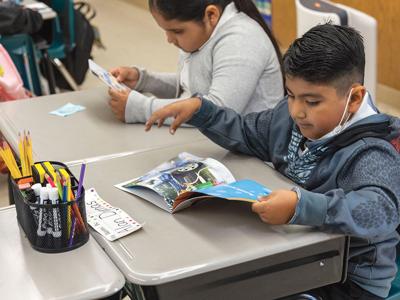
Starting this school year, K-2 students are taking an additional test designed to find out if they are having difficulty reading. Assembly Bill 130 calls for an annual, mandatory reading test, the first time the state is requiring universal literacy screening.
Parents will receive the results within 45 days, including suggestions on how to support students at school and at home to improve their reading skills.
Ron Dillender, associate superintendent of education services at Salinas City Elementary School District, notes literacy testing isn’t new. “The assessment that they’re asking us to give is an assessment we haven’t given before, but the content of it is very similar to other assessments we’ve used in the past,” Dillender says.
The focus is on K-2 students because third grade is a key point for students. It’s the time when they transition from learning to read to reading to learn. During the 2023-2024 school year, only 42.8 percent of California’s third-graders were reading at grade level, and only 28.1 percent in Monterey County.
The state designated four screeners districts can choose from for the test including Multitudes, a free state-funded assessment tool developed by the UC San Francisco Dyslexia Center; mCLASS with DIBELS Edition 8 and mCLASS Lectura by Amplify Education; Amira by Amira Learning; and Rapid Online Assessment of Reading (ROAR), created by Stanford University’s Brain Development and Education Lab. The first three offer testing in English and Spanish.
Students from Salinas City Elementary were part of a Multitudes pilot program. Educators provided feedback to diversify the vocabulary included, especially for the Spanish test, with recommendations of adding words to reflect the local lingo such as using “durazno” instead of “melocotón” for peach, or “computadora” instead of “ordenador” for computer.
Experts hope that across-the-board testing will propel data-driven instruction to close the literacy gap.
In the short term, the reading tests may help teachers tailor their instruction. They may also use it to refer a student for additional support or testing to find out why the student is struggling, such as reading disorders like dyslexia or a visual impairment.
Dillender notes the testing itself won’t diagnose disorders, “but could definitely be used with a number of other observations and other exams to help a doctor make that determination,” he adds.
SCESD students will be tested in either English or Spanish based on their primary language or the educational program they are enrolled in. (Students in the dual-immersion program will take the test in Spanish.)
Dillender says the district will wait a few months before testing students, especially for those who are in kindergarten. “We want to be able to give students enough knowledge of letters, sounds, phonics and phonemic awareness to be able to actually take the assessment,” he says.



(0) comments
Welcome to the discussion.
Log In
Keep it Clean. Please avoid obscene, vulgar, lewd, racist or sexually-oriented language.
PLEASE TURN OFF YOUR CAPS LOCK.
Don't Threaten. Threats of harming another person will not be tolerated.
Be Truthful. Don't knowingly lie about anyone or anything.
Be Nice. No racism, sexism or any sort of -ism that is degrading to another person.
Be Proactive. Use the 'Report' link on each comment to let us know of abusive posts.
Share with Us. We'd love to hear eyewitness accounts, the history behind an article.