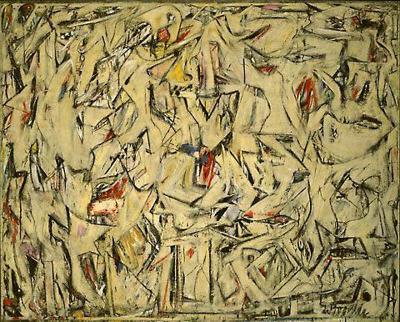
When Jackson Pollock died in 1956 at age 44, he was at the zenith of his celebrity. He has since been the subject of several full-length biographies. Had Willem de Kooning died at age 44 in 1948, the year of his first one-man show, he would have been a long footnote in histories of 20th-century American art. Had he died at 50, he would have been esteemed for two great paintings, Excavation and Woman I. But de Kooning would probably not have received the 700-plus pages of attention given to him by Mark Stevens and Annalynn Swan in their long-winded but valuable biography: de Kooning: An American Master (Alfred A. Knopf).
De Kooning became an American master late in his life. Unlike his colleagues Gorky, Pollock, Kline, Rothko, and Guston, none of whom saw 70, he painted into his 85th year. At his death in 1997 at age 93, from the cumulative effects of Alzheimer’s, he was acknowledged as the greatest American painter ever, and he remains so today. Although there is a shelf of catalogues produced for various retrospectives and other shows from his work, this is the first biography.
Born in Rotterdam, Holland, de Kooning was raised by a sharp-tongued and quick-with-the-back-of-her-hand mother who ran a bar. His father split early and remained distant. By 12, de Kooning had left school to become an apprentice in a Rotterdam decorating firm. His abilities as a draftsman led his employers to send him to what he sometimes called the “Royal Academy.” The Academie van Beeldende Kunsten en Technische Wetenschappen gave him four years of solid academic training—training that his fellow Abstract Expressionist painters did not have.
In 1926, de Kooning arrived in America, a stowaway who knew one American word: yes. He worked as a house painter and a commercial artist, trades that he honored, and before long came in contact with three decisive influences: the painters Stuart Davis, John Graham and—for de Kooning the most important—Arshile Gorky. Over the next 20 years, he lived cheaply and worked hard at his art but produced little.
The biography’s description of de Kooning’s struggle with Women I conveys his method: “He believed in fighting his way into intimacy with an image; the broken, convulsive, and awkward must be conveyed, if the truth was to be served.” For de Kooning, destruction was a creative act, and his paintings are, among other things, a record of their making. He could spend as long as three years on a painting and still have it look fresh: “first hand,” his friend, painter Fairfield Porter, called this quality. Stevens and Swan are intelligent if redundant in their understanding of these paradoxes and contradictions.
For de Kooning, work came first. This is one of the book’s three themes; the other two are women and alcohol. De Kooning wanted only to paint, and for all his struggles in the studio, he never said otherwise. He often worked all day and into the night, wearing a hat and coat in unheated lofts and painting naked in the heat of summer. Several beautiful women participated in this life, but they did not exactly share it. They mostly lived apart from him except for the few years he lived with his wife, Elaine Fried, at the beginning of their marriage and the end of her life. Although he could be courtly, generous, funny, and loving, his art came before conventional responsibilities.
De Kooning became famous in the late 1950s, a fame that at first did not cross Manhattan’s 14th Street. When it did, this high-strung, anxious man, often mired in a painting that resisted his attempts to finish it, became a binge drinker in his 60s and 70s. De Kooning’s record of this is sordid, exhausting, and almost unbelievable. It seems impossible that he not only survived his drinking, but also at several points stopped long enough to paint, and as he never had before. After Fried moved back into his life, things settled down enough for him to execute his spare, and to these eyes, beautifully unraveling and summing-up paintings. Stevens and Swan acknowledge that he accomplished at least some of these works while suffering from Alzheimer’s disease and with the help of his assistants.
One of the pleasures of this book is de Kooning’s conversation. His accent—he said “void” for word and “fate” for faith—and his original intelligence brought forth sentences much prized and oft-quoted by his friends. And he knew his own work better than any critic: “Miles Davis bends the notes. He doesn’t play them, he bends them. I bend the paint.”


(0) comments
Welcome to the discussion.
Log In
Keep it Clean. Please avoid obscene, vulgar, lewd, racist or sexually-oriented language.
PLEASE TURN OFF YOUR CAPS LOCK.
Don't Threaten. Threats of harming another person will not be tolerated.
Be Truthful. Don't knowingly lie about anyone or anything.
Be Nice. No racism, sexism or any sort of -ism that is degrading to another person.
Be Proactive. Use the 'Report' link on each comment to let us know of abusive posts.
Share with Us. We'd love to hear eyewitness accounts, the history behind an article.