As well preserved as a flatworm in formaldehyde, John Steinbeck’s Cannery Row turns 60 this year. Less a novel than an inter-related series of vignettes about the characters which lurk and drink and whore around the Monterey sardine canneries in the ‘30s, Cannery Row’s lack of any real linear narrative has always posed a problem to those who would adapt it to the stage or screen.
The mawkish 1982 film adaptation starring Nick Nolte and Debra Winger, for instance, relied heavily on narration by John Huston and some traditional Hollywood contrivances—i.e., Suzy, Debra Winger’s heart-of-gold prostitute, who’s billed in the film’s press materials as a “spunky, husky-voiced wanderer who makes Doc’s life on the Row a whole lot brighter.” Ouch.
J.R. Hall, the writer who adapted The Western Stage’s current production of Cannery Row, found a less radical, more theatrical solution to the book’s problematic structure than the overblown love interest. In an effort to incorporate the book’s exposition without a traditional narrator or long-winded dialogue, Hall has the characters deliver lines of third person prose directly from the novel.
It’s a very, very literary device that is tremendously distracting, especially when the actors are referring to themselves and switching back and forth from a first to third person narration. For example, the Chinese grocer Lee Chong yells, “Hey boy!” and then throws a pack of gum to the boy before saying, “Lee Chong passes a pack of spearmint to Frankie.” It’s an unnatural theatrical mechanism for one of the most natural novels ever written. When Henri, the Salinas-born French artist, tells us that Cannery Row is “unencumbered by logic and pretense,” we can’t help wondering why the play’s dialogue is so stiff and pretentious.
In its defense, this third-person device does import Steinbeck’s blissfully resonant prose intact from the page to the stage. In addition, it resonates with the Ricketts theory of non-teleological or “Is” thinking. To paraphrase Ricketts, Hall’s adaptation is not concerned with what should be, or could be, or might be, but rather with what actually is. Plainly stated, the monologues are not particularly natural representations of life, but they are objective evaluations and they do manage to retain the book’s classic flavor. Set against a wonderful set of corrugated metal, wharf pilings and crates, the play also does a good job of illustrating the Ricketts/Steinbeck metaphor of society as inter-related tide pool.
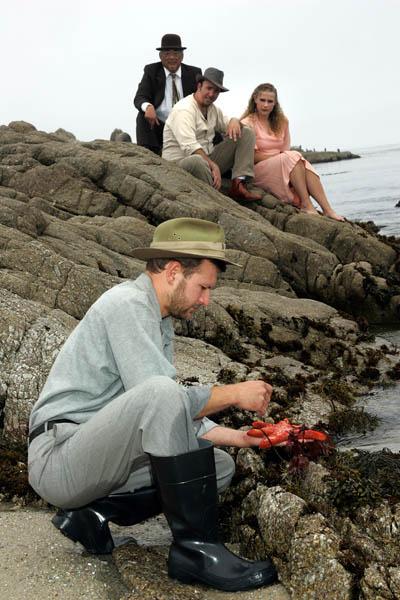
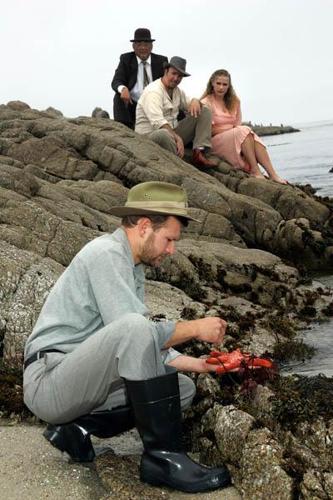
The action opens with Doc and Hazel picking their way across the exposed rocks at low tide, talking and gathering starfish. When, like a wave, the cast floods the stage, they occupy the same space as the tide pool. It’s a wonderful example of how great literature can be great theater.
Some very strong acting also buoys the production, especially from Kent Burnham, the Equity ringer brought in to portray Doc. Burnham is given the nearly impossible job of bringing to life a character with which many people have cultivated a very personal, very intimate internal relationship. Both Ed Ricketts and his literary doppleganger, Doc, enjoy a rabidly devoted congregation of admirers, all of whom probably have a very singular idea of how he talks and walks and drinks his beer.
And to be honest, when Burnham first opens his mouth, I thought, “No, no, no, Ricketts’ voice wouldn’t sound like that.” Of course, by intermission I had totally accepted Burnham as Doc and even deepened my appreciation for the character. It’s a wonderfully natural and powerful performance that carries the whole production and grounds it with authenticity.
Chris Graham as the hapless but well-meaning Mack, Ron Cacas as Lee Chong, Nina Capriola as the brothel queen Dora and William J. Wolak as Henri also do their beloved characters justice. Graham is especially touching as a man who, despite all his desire and heart, realizes he’ll never be any better of a man than he already is. It’s an entertaining and evocative portrayal that really captures Steinbeck’s words.
Most of the scenes work wonderfully as vignettes. For example, when Ricketts finds the body of a girl out on the tide, he is too distraught to deal with the tragedy. Instead, he points her out to a beach walker (Gary Flemming) who, with a wonderfully haunted expression, picks his way out through the low tide to claim the bounty on the corpse.
In the end, Hall and The Western Stage have an impossible job. Cannery Row defines the Peninsula as much as any piece of art or history can. It’s one of the great works by one of America’s great writers. It is full of characters so beloved that many feel like we own the rights to their portrayal outside our heads as well as in them.
Steinbeck writes, “When you collect marine animals there are certain flatworms so delicate that they are almost impossible to capture whole, for they break and tatter under the touch. You must let them ooze and crawl of their own will onto a knife blade and them lift them gently into your bottle of sea water.”
To paraphrase the rest of the passage, perhaps the best way to see this remarkable and entertaining play is to leave your knife and your preconceptions at home, sit down and just let the characters crawl in by themselves.



(0) comments
Welcome to the discussion.
Log In
Keep it Clean. Please avoid obscene, vulgar, lewd, racist or sexually-oriented language.
PLEASE TURN OFF YOUR CAPS LOCK.
Don't Threaten. Threats of harming another person will not be tolerated.
Be Truthful. Don't knowingly lie about anyone or anything.
Be Nice. No racism, sexism or any sort of -ism that is degrading to another person.
Be Proactive. Use the 'Report' link on each comment to let us know of abusive posts.
Share with Us. We'd love to hear eyewitness accounts, the history behind an article.