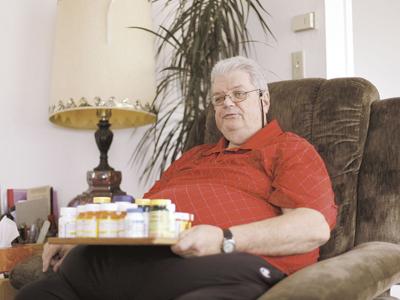
Lyle Toole is a U.S. Air Force veteran who served in Vietnam. In 1967, he trained as an air traffic controller and was stationed at Hamilton Army Airfield in Marin County for six years. Now retired, Toole lives in Marina on a fixed income and volunteers at the Veterans Transition Center. At 67, he relies on prescription medications to treat high blood pressure, diabetes, arthritis and high cholesterol.
Toole’s prescriptions are paid for by the Veterans Benefits Administration (within the U.S. Department of Veterans Affairs) except his co-pay, which is covered by Medi-Cal.
The VA pays the lowest price for medications of any federal agency, and Proposition 61, also called the California Drug Price Relief Act, would prohibit California state agencies from paying more for drugs than the VA.
Its supporters – including the California Nurses Association, AIDS Healthcare Foundation and AARP – say it would lead to taxpayer savings with reduced drug costs for public health institutions, UC and CSU students, state hospitals and prisons. On a recent California tour supporting Prop. 61 as a way of standing up to Big Pharma’s runaway drug prices, Senator Bernie Sanders said, “[It] will reverberate all over America.”
But opponents – chiefly the pharmaceutical industry, as well as medical associations and veterans groups like the American Legion and Veterans of Foreign Wars – say Prop. 61 won’t actually lead to lower drug prices. If the measure passes, drug companies will “likely take actions that mitigate the impact of the measure,” according to the Legislative Analyst Office. (That means raising prices elsewhere to make up for any reductions in revenue from state agencies.)
Toole is among the veterans who worry that pressure on other agencies to meet the VA’s pricing standard will just translate to higher prices for the VA. “I refuse to take this sitting down,” he says.
But his medication prices are unlikely to change. Federal law requires pharmaceutical discounts for veterans. The Veterans Public Healthcare Act of 1992 mandates 24-percent wholesale discounts for the VA, which averages out to 50-percent retail discounts. Backers of the ballot measure say Prop. 61 would not supercede the 1992 federal law.
Opponents, with donations from pharmacuetical companies including Merck, Pfizer and Johnson & Johnson, have spent $109 million and counting to defeat the measure, which is shaping up to be the costliest election out of 17 California initiatives on the ballot Nov. 8.
But combat veteran Gordon Smith, who served as a mission controller for the U.S. Air Force in Vietnam, thinks the pharmaceutical industry is unfairly targeting and scaring veterans with its campaign. He’s particularly mad about a TV commercial in which a Fallujah-wounded veteran talks about the fear that his co-pays will go up – untrue, Smith says, because “service-connected combat veterans” – those whose injuries or illnesses are directly linked to wartime service – don’t pay co-pays.
“The commercial is a big lie from Big Pharma,” Smith says, “because service-connected combat veterans do not pay co-pays for medicine, and never will.”


(0) comments
Welcome to the discussion.
Log In
Keep it Clean. Please avoid obscene, vulgar, lewd, racist or sexually-oriented language.
PLEASE TURN OFF YOUR CAPS LOCK.
Don't Threaten. Threats of harming another person will not be tolerated.
Be Truthful. Don't knowingly lie about anyone or anything.
Be Nice. No racism, sexism or any sort of -ism that is degrading to another person.
Be Proactive. Use the 'Report' link on each comment to let us know of abusive posts.
Share with Us. We'd love to hear eyewitness accounts, the history behind an article.