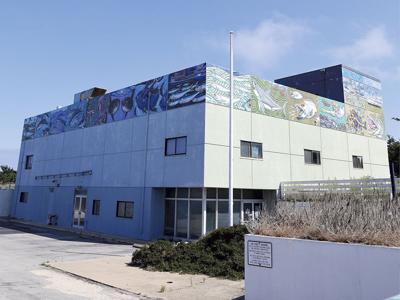

Like the waves crashing into the coastline along Point Pinos in Pacific Grove, a chorus of conflicting wants and needs are now crashing together just feet from the shoreline, on a four-acre strip of land occupied by a research building of the former National Oceanic and Atmospheric Agency. The city’s requirement by the state to plan for more housing is coming into direct conflict with those who want to preserve the building and its beloved Ray Troll mural, as well as the sensitive dunes habitat and land that ancestors of Indigenous peoples lay claim to that the building sits on.
Not long after P.G.’s draft housing plan, known as a housing element, was released on Sept. 18 for public review, members of the COAST steering committee discovered that the property at 1352 Lighthouse Ave. – where the NOAA building they’ve been working to save for the past few years is located – was suggested as one that could be rezoned from open space to high-density residential, with up to 84 units. According to the draft housing element, those units could be divided into 28 very low-income, 28 low-income and 28 moderate-income units.
“We were stunned,” says COAST committee member Lora Lee Martin. Committee members rang alarm bells, launching a change.org campaign (bit.ly/COASTPetition) and urging people to ask the city to remove the property from the housing element’s site inventory.
The draft element was created in a hurry by Rincon Consultants, hired by the city a few months ago after the original consultant was fired in February for failing to meet deadlines. It put P.G. behind in a race to meet the state’s deadline to complete the draft element, part of the Regional Housing Needs Allocation (RHNA) process that has all cities and counties amending their housing elements to include more housing between 2023 and 2031. In P.G.’s case, the city has to plan for 1,125 residential units.
Curiously, Rincon’s plan states that there are “no known environmental constraints on sites identified in the site inventory that would preclude development,” when, in fact, the NOAA building property is well known for its constraints: It’s located in a sensitive dunes habitat potentially home to threatened plant species and tightly regulated by P.G.’s Local Coastal Plan and the California Coastal Commission; the Ohlone Costanoan Esselen Nation claims it as a sacred site.
In addition, members of COAST and others have been fighting to have the building declared a historic resource by the city to prevent it from being torn down by out-of-state, private owners who purchased the property last year after a controversial federal surplus land sale. The P.G. City Council voted on Feb. 15 to hire an independent historic consultant to assess the building, but no request for proposals was released until Sept. 29, after the draft element was completed.
The P.G. Planning Commission is scheduled to review the draft housing element at 6:30pm, Thursday, Oct. 5, at P.G. City Hall (and online at bit.ly/PGPlanningCommissionMeet). The P.G. City Council is expected to review the element on Oct. 18.
UPDATE: The Planning Commission voted 7-0 to recommend to the City Council that the NOAA site be removed from the housing element site list, after hearing from a long line of speakers urging its removal.



(0) comments
Welcome to the discussion.
Log In
Keep it Clean. Please avoid obscene, vulgar, lewd, racist or sexually-oriented language.
PLEASE TURN OFF YOUR CAPS LOCK.
Don't Threaten. Threats of harming another person will not be tolerated.
Be Truthful. Don't knowingly lie about anyone or anything.
Be Nice. No racism, sexism or any sort of -ism that is degrading to another person.
Be Proactive. Use the 'Report' link on each comment to let us know of abusive posts.
Share with Us. We'd love to hear eyewitness accounts, the history behind an article.