
On a Sunday morning, soccer players line up on opposing sides for a game in the park at the center of the Moro Cojo neighborhood near Castroville. Friends and family members set out folding chairs along the sidelines, while nearby young parents walk alongside little ones riding trikes and older kids play.
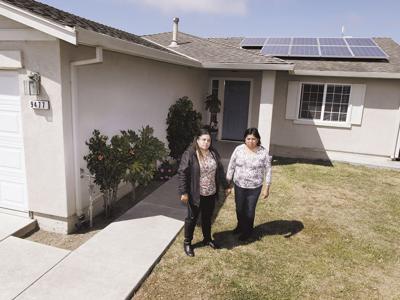
Just a short walk from all the activity is the Cuentas family home, a tan three-bedroom, two-bathroom single-story house, where Rosa and Francisco Cuentas have been raising four children for the last 15 years.
The family is proud of the house, especially because the two parents spent hundreds of hours over a period of a year and a half – in addition to working 72 hours a week each in the fields – helping to build their home and others in the neighborhood, as part of a program through CHISPA (Community Housing Improvement Systems and Planning Association, Inc.) to help farm workers purchase affordable homes with a combination of sweat equity and subsidized government loans.
The Cuentas family was able to buy the home for approximately $125,000, using loans through the Rural Housing Service branch of the U.S. Department of Agriculture.
“It’s great compared to where we were living, in a trailer in the middle of a field,” daughter Araceli, 25, says. “This is everything for us. We’re so thankful for this home.”
Yet, despite the feeling of pride, there is also anger over what homeowners say is unfair treatment because of a deed restriction placed on the 161 Moro Cojo homes as part of a 1995 legal settlement that designates them as affordable housing “in perpetuity.” Under that restriction they must sell their homes for around $300,000. If the homes were sold at market rate, they could go for as much as $500,000.
CHISPA CEO Alfred Diaz-Infante calls the restriction “unheard of,” saying affordability restrictions on other CHISPA developments phases out after only 15 years.
Residents say the restrictions created unintended consequences, like making it difficult to refinance loans, and possibly being blocked from passing on homes to adult children.
“I see that as unfair, unequal and it almost seems discriminatory,” Araceli says. “It almost feels like we’ve been cheated.”
It’s a message the graduate of CSU Fresno – she’s the first in her family to graduate from college – plans to take to the California Coastal Commission during its meeting on July 14 at CSU Monterey Bay. The commission is set to vote on whether to reverse the deed restrictions. The Coastal Commission vote comes after a Pacific Grove attorney appealed a 2016 decision by the Monterey County Board of Supervisors to lift the affordability requirement.
That attorney, Jane Haines, has garnered support of groups like the land-use watchdog LandWatch, the Ventana chapter of the Sierra Club, and local leaders like Monterey City Councilmember Alan Haffa.
The issue turned into a controversial flashpoint with racial overtones after leaders of CHISPA, the Center for Community Advocacy, Latino political figures and the Diocese of Monterey’s Bishop Richard Garcia argued in letters to the commission that the “discriminatory” deed restrictions were a result of neighboring residents who did not want farm workers living near them.
Haines takes issue with those letters, which she calls inaccurate. She also says she is mystified why affordable housing advocates are arguing in favor of taking 161 affordable units out of the county’s already-limited stock of homes for low – to moderate-income people.
Back in the ’90s, Haines represented a group of neighbors near Moro Cojo who sued primarily over concerns about their source of water, which is shared with Moro Cojo. She says she never would have taken the lawsuit if she thought that was her clients’ motivation.
There were three lawsuits over the project, two of which Haines was involved in, and in one suit her clients agreed to settle with CHISPA if the Moro Cojo homes remained affordable housing in perpetuity.
All sides agreed to the stipulation, and Judge Harkjoon Paik issued a stipulated judgment.
Diaz-Infante theorizes that the restriction was a ploy by opponents to block CHISPA from getting bank loans for the development. Haines says it came out of a fear that CHISPA would eliminate the affordable housing requirement within a few years.
The Coastal Commission staff recommends overturning the deed restriction. Michael DeLapa, LandWatch’s executive director, plans to ask the commission for an extension in hopes of working out a compromise. (The suggestion was rejected by commissioners.)
In a letter to the commission, he points out that Monterey County’s unincorporated area has only 608 permanently affordable housing units out of total housing stock of 38,783 – only 1.6 percent. Letting Moro Cojo become market rate, he argues, will only hurt people who need housing.
UPDATE: The motion to lift the Moro Cojo deed restrictions failed at the July 14 meeting, after a divided Coastal Commission was split 5-5 in its vote.
Commission staff recommended lifting the restrictions, mainly because of the unique situation created by the homeowners' sweat equity in constructing the homes.
Commissioner Mark Vargas supported the staff's recommendation, arguing, "It boils down to people put their blood, sweat and tears into it, and it's a different kind of project because of that," Vargas said.
"The idea is to help people get up and move up and help families move up in this world," Vargas continued. "It's not to lock them into perpetual poverty and lock them into a perpetual caste system of having to depend on affordable housing."
Many commissioners were moved by testimony by residents, some of whom spoke in Spanish. (The commission provided a team of interpreters for the day to accommodate a large number Spanish-speaking residents in attendance.)
However, while some argued in favor, saying it was a social justice issue, others argued that it would violate the North Monterey County Local Coastal Plan by removing the 161 units from the area's affordable housing stock without replacements.
"What I'm thinking about are the future residents of these homes," said Commissioner Steve Padilla. "Ten or 20 years from now, I'm thinking of families that want to buy homes, but won't have the advantages you had."
Padilla also pointed to the fact that the original homeowners benefited from public programs and monetary credit specifically designed to provide affordable housing.
County Supervisor Jane Parker outlined specifics of those benefits at the beginning of public testimony. She said that homeowners benefited not just through sweat equity, but also through low-interest loans.
Those loans, at a rate of 3 percent, include a provision to forgive 10 percent of the principal beginning in the 10th year of the loan. Ten percent is forgiven every year thereafter until the 20th year, when the final 10 percent is forgiven.
She also said the county waived a $120,000 processing fee and contributed $500,000 in Community Development Block Grant funds to support the Moro Cojo development.
In rebuttal, Diaz-Infante of CHISPA said the county's contribution was only 1.7-percent of the total cost of the development. He also pointed out that the USDA recoups any monies loaned when homes are sold or refinanced.
Editor's Note: This blog post was updated after the July 14, 2017, California Coastal Commission meeting to reflect the outcome of the hearing.




(2) comments
This might sound crazy but here it goes; You know what counties are SUPPOSED to do to keep their low-income housing numbers up and at levels mandated by the federal government? They're SUPPOSED to create more housing opportunities. I know, it sounds crazy. Believe it or not, our population is growing, and so is the income gap between upper-middle class and below poverty. I won't even get into the racial issues, not necessary. It's common sense, human dignity, and federal law. I didn't get any program assistance purchasing my first home, but I am also not an ag-worker, or any sort of low-wage worker. Do the math regarding the loans, what the county or state actually "looses" financially by allowing these home owners to sell at market value. Let's be honest, it's not a money game, it's an accountability game and our county won't provide more needed housing when they can use this project as a pass. Why didn't the county just build more low-income apartments there..? What's the difference?
As a single mother I purchased my first home at age 40 for $185,000 after saving for 10 years for a down payment. My interest rate was 9 3/4% on the first and 12% on the second mortgage. It was many years before I could get a lower interest rate. i think the Moro Cojo residents should consider themselves lucky that they lived so reasonably for so many years. As for sweat equity, that is a given for people with a monster mortgage. I support the decision to let the rules stand.
Welcome to the discussion.
Log In
Keep it Clean. Please avoid obscene, vulgar, lewd, racist or sexually-oriented language.
PLEASE TURN OFF YOUR CAPS LOCK.
Don't Threaten. Threats of harming another person will not be tolerated.
Be Truthful. Don't knowingly lie about anyone or anything.
Be Nice. No racism, sexism or any sort of -ism that is degrading to another person.
Be Proactive. Use the 'Report' link on each comment to let us know of abusive posts.
Share with Us. We'd love to hear eyewitness accounts, the history behind an article.